

Resource Efficient and Sustainable Building (M.Sc.)
Technical University of Munich (TUM), Germany

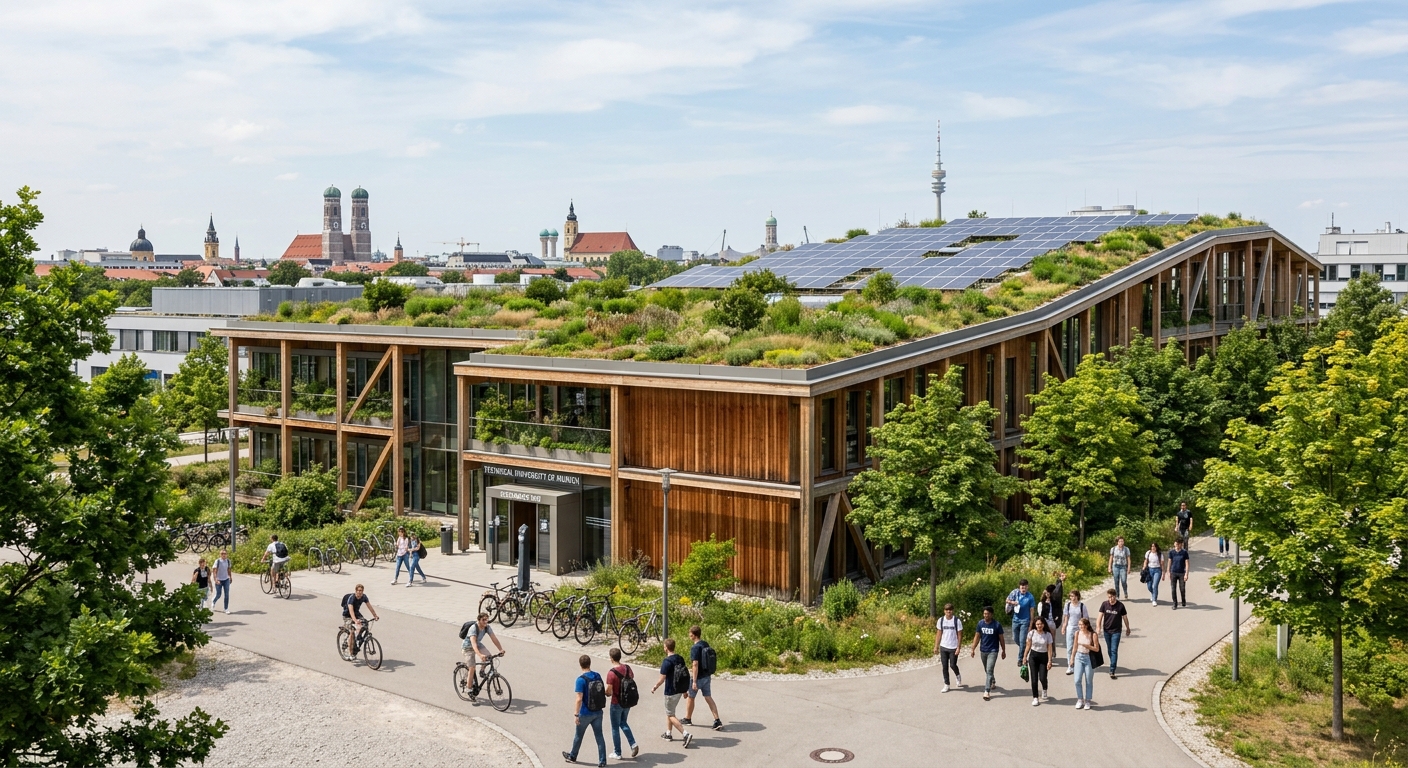
Master of Science in Resource Efficient and Sustainable Building (M.Sc.)
Technical University of Munich (TUM)
Sustainable Construction and Building Engineering
Program Overview: Resource Efficient and Sustainable Building at TUM
The Master of Science in Resource Efficient and Sustainable Building at TUM prepares you to analyze and optimize construction projects with regard to their resource use and societal impact, designing them in line with social, ecological, and economic requirements. This highly interdisciplinary program integrates building physics, building services engineering, building construction, and life cycle assessment to give you a holistic perspective on the built environment.
You will develop expertise in sustainably redesigning cities, neighborhoods, and buildings to reduce CO2 emissions, minimize the use of soil, materials, and water, and adapt the built environment to rapidly changing economic and social conditions. The program considers all spatial scales from region and city down to individual building components and materials, preparing you to work across the entire value chain of the construction industry.
Graduates of this program become sought-after experts who actively shape the building of the future with their interdisciplinary understanding, professional and practical background, and solution-oriented mindset. They are excellently qualified both for further academic research and for positions of responsibility in the construction industry or the public sector.
Key Program Highlights
- Interdisciplinary networking of civil engineering, environmental engineering, architecture, and building services technology within a single program
- Central Interdisciplinary Project where mixed teams of architects and engineers tackle real-world sustainable design challenges
- Five specialization tracks covering architecture, urban planning, building physics, building services, and life cycle engineering
- Located in Munich, a major European center for technology, innovation, and sustainable development research
Curriculum and Modules
The program consists of four semesters in which 120 ECTS credits are earned. In the first three semesters, students individually choose four of five specialization areas, while the fourth semester is reserved for the Master's thesis. The courses combine lectures, practical courses, excursions, work placements, seminars, and projects.
Sustainability in Architecture, City and Landscape
Varies by module selectionExplores sustainable design principles at urban and architectural scales, including sustainable urbanism, landscape integration, and climate-responsive design strategies for buildings and neighborhoods.
Building Physics and Building Services Engineering
Varies by module selectionCovers the physical principles of energy-efficient construction, thermal performance, indoor environmental quality, and advanced building services systems for heating, cooling, and ventilation.
Life Cycle Assessment and Resource Management
Varies by module selectionTeaches methods for evaluating the environmental impact of buildings across their entire life cycle, including material selection, embodied energy analysis, and certification systems such as DGNB and LEED.
Interdisciplinary Project
Varies by module selectionThe central element of the program where interdisciplinary teams of architecture and engineering students collaborate on a design-oriented project, applying analytical and optimization skills to real-world sustainable building challenges.
Ecological Building and Construction Technology
Varies by module selectionAddresses ecological handling of resources such as energy, materials, and soil, covering renewable energies, sustainable supply and disposal systems, electromobility, and sustainable material use in construction.
Master's Thesis
30 ECTSAn independent research project completed in the fourth semester, allowing you to investigate a specific topic in resource-efficient and sustainable building under the supervision of TUM faculty members.
Elective Modules and Specializations
Admission Requirements
Admission to the M.Sc. Resource Efficient and Sustainable Building at TUM is based on an aptitude assessment procedure that evaluates your individual talents and motivation for study. Applicants must hold a recognized undergraduate degree and demonstrate proficiency in both English and German. All applications and inquiries are handled through Uni4Edu.
Academic Requirements
- Undergraduate DegreeBachelor's degree (or equivalent) in Architecture, Civil Engineering, Environmental Engineering, Building Services Engineering, or a similar program related to technical building equipment
- Minimum Study DurationBachelor's degree with a minimum standard period of study of 6 semesters
- Minimum Credits at ApplicationAt least 135 ECTS for a 6-semester bachelor's, 170 ECTS for a 7-semester bachelor's, or 200 ECTS for an 8-semester bachelor's
- Aptitude AssessmentSuccessful completion of TUM's aptitude assessment procedure, which may include an interview on challenges and opportunities in sustainable building
- Degree CompletionProof of successful completion of the bachelor's degree must be provided within one year of the start of the master's program
Language Requirements
- English ProficiencyProof required via recognized certificate (e.g., TOEFL, IELTS, Cambridge), or evidence that more than 50% of a prior degree was taught in English, or 30 ECTS of bachelor courses in English
- German ProficiencyProof required via DSH, TestDaF, Goethe-Zertifikat, or equivalent recognized certificate; alternatively via a diploma from a German educational institution
- Alternative ProofEnglish proficiency may also be proven by a GMAT score higher than 600; German proficiency may be proven via Studienkolleg or International Baccalaureate with German component
Required Documents
Application Deadlines
For personalized admission guidance, document verification, and application support, please contact Uni4Edu
Scholarships and Funding
TUM and external organizations offer several funding opportunities for international students pursuing the M.Sc. Resource Efficient and Sustainable Building. These range from need-based financial aid to merit-based tuition fee waivers. Contact Uni4Edu for guidance on the best funding options for your profile.
TUM Scholarship for International Students
EUR 500 - EUR 1,800 per semesterA need- and merit-based scholarship for enrolled international students at TUM. It is renewable each semester with a maximum funding period of 36 months. Master's students are eligible from the 2nd semester onward.
Deutschlandstipendium (Germany Scholarship)
EUR 300 per monthA national scholarship program open to both German and international students at TUM, awarded based on academic merit and personal circumstances. Funding typically covers the standard period of study.
TUM Tuition Fee Waiver Scholarship
Full tuition fee waiverAvailable for newly enrolled non-EU/EEA students who demonstrate financial hardship or outstanding academic achievement. Successful applicants receive a waiver for two semesters, with the possibility to reapply.
For detailed tuition fee information, please contact Uni4Edu — we will guide you through the costs and available funding options for this program.
Career Prospects
Graduates of the M.Sc. Resource Efficient and Sustainable Building are sought-after experts who shape the future of the construction industry with their interdisciplinary expertise. TUM's strong employer reputation and Munich's thriving technology ecosystem provide excellent career opportunities in sustainability-focused roles worldwide.
Typical Career Paths
Potential Employers
Rankings and Recognition
The Technical University of Munich is consistently ranked among the top universities in the world, particularly excelling in engineering and natural sciences. TUM has been the number one university in Germany for over a decade across major international rankings and is recognized as the top university in the European Union.
| Subject | Ranking Body | Rank |
|---|---|---|
| Engineering and Technology | QS World Rankings by Subject | #16 |
| Natural Sciences | QS World Rankings by Subject | #19 |
| Engineering | THE World Rankings by Subject | Top 20 |
| Physical Sciences | THE World Rankings by Subject | #19 |
How to Apply
Applying for this program is easy with Uni4Edu. Our team will guide you through every step of the process — from document preparation to final enrolment.
Contact Uni4Edu
Reach out to our team via email or phone. We will assess your profile and confirm your eligibility for this program.
Prepare Your Documents
Our advisors will provide you with a personalised checklist of required documents and help you prepare your application package.
Submit Your Application
Uni4Edu will submit your application on your behalf and keep you updated on its progress throughout the review period.
Receive Your Offer
Once accepted, we will help you understand your offer, arrange visa support if needed, and guide you through the enrolment process.
Similar Programmes

Master's & Postgraduate
12 months
Earthquake Engineering MSc

Imperial College London, , United Kingdom
Earliest Intake
January 2027
Gross Tuition
45000 £

Bachelor's Degree
48 months
Environmental Geoscience B.S.
Syracuse University, Syracuse, United States
Earliest Intake
September 2026
Gross Tuition
66580 $

Bachelor's Degree
52 months
Environmental Engineering (Joint UNBC and UBC) (Co-Op) Bachelor
University of Northern British Columbia, Prince George, Canada
Earliest Intake
October 2026
Gross Tuition
26750 C$
Bachelor's Degree
48 months
Geography with Applied GIS (with Professional Placement) BSc
University of Exeter, Exeter, United Kingdom
Earliest Intake
January 2027
Gross Tuition
31200 £
Master's & Postgraduate
12 months
Volcanology MSc
Lancaster University, Lancaster, United Kingdom
Earliest Intake
January 2027
Gross Tuition
30000 £



Uni4Edu AI Assistant
