

Neuroscience
University of Mainz, Germany

Master of Science in Neuroscience
Johannes Gutenberg University Mainz
Neuroscience
Program Overview: M.Sc. Neuroscience at JGU Mainz
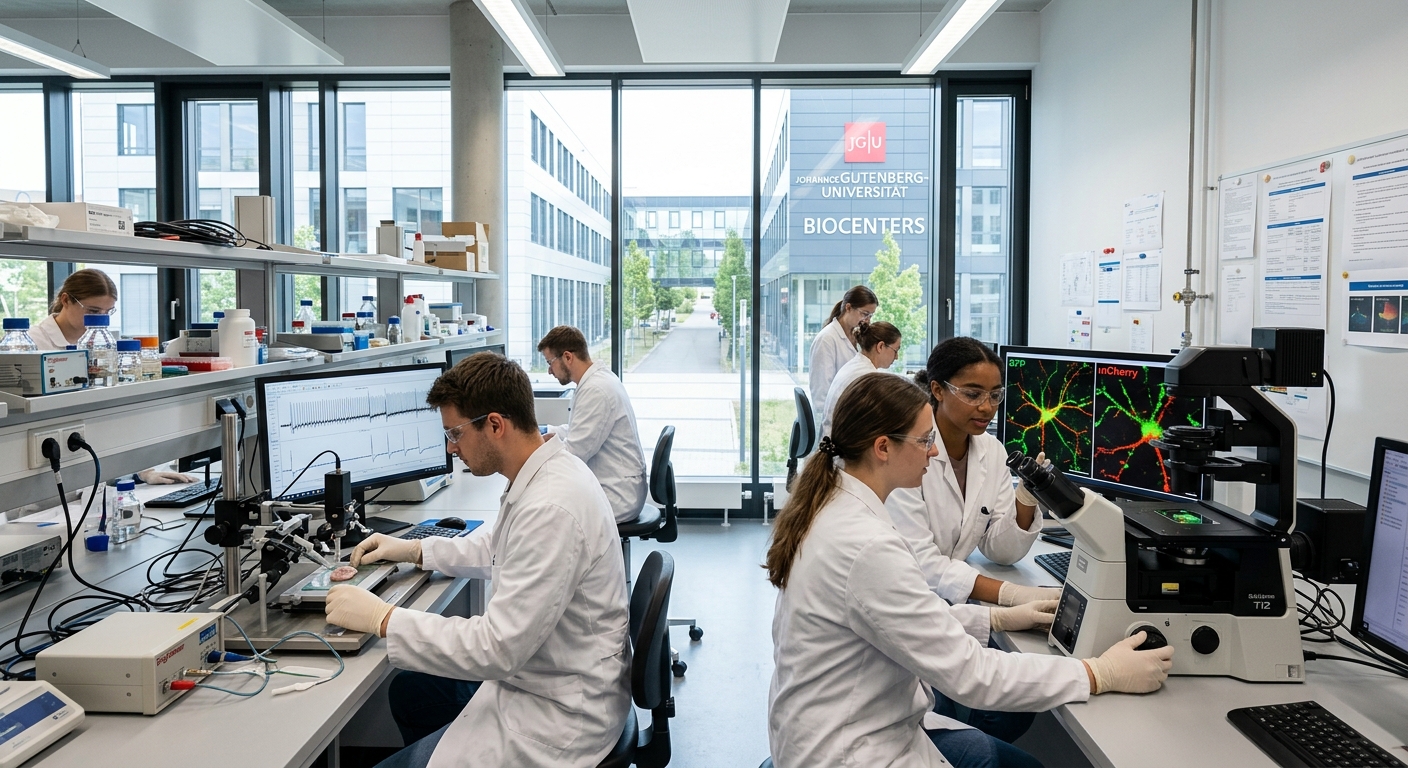
The Master of Science in Neuroscience at Johannes Gutenberg University Mainz is an English-taught program designed to train neuroscientists with solid knowledge and skills in molecular and cellular neurobiology. The program places two key aspects in the foreground: methodological education in optical, electrophysiological, neurogenetic, histological, and behavioral biological methods, alongside the analysis and interpretation of data using computer-aided methods.
Situated on a research-focused life sciences campus, students benefit from proximity to the Institute of Molecular Biology (IMB), two Max Planck Institutes, and the Helmholtz Institute Mainz. Short walking distances between these institutions support close interdisciplinary cooperation and give students access to cutting-edge research infrastructure.
The program is structured around compulsory and elective modules, allowing you to specialize in areas ranging from sensory neuroscience and neurogenetics to computational neuroscience. Graduates are well prepared for doctoral research or careers in academia, the pharmaceutical industry, and biomedical institutions.
Key Program Highlights
- Fully English-taught program with no German language requirement for admission
- Hands-on training in optogenetics, electrophysiology, super-resolution microscopy, and gene editing
- Located on a life sciences campus alongside Max Planck Institutes and the Helmholtz Institute Mainz
- Flexible intake with both winter and summer semester start options
Curriculum and Modules
The M.Sc. Neuroscience curriculum is divided into compulsory modules and compulsory elective modules (A, B, and C categories). Students select two related A/B module pairs from the elective offerings, as well as two independent C modules from different research areas. Some modules are offered exclusively in either the winter or summer semester, so careful planning is recommended.
An introduction to the nervous system with neuroanatomical emphasis, exploring principles of nervous system organization, including how the nervous system is built, how it works, and why it is organized as it is. Topics include neuropathology and the structure and function of different brain regions.
Students investigate how nervous systems process sensory signals such as odors and visual information at multiple levels, from molecular mechanisms of sensory processing to neuronal cell types and their organization in networks, to the control of behavior.
Students learn and apply optical and electrophysiological methods to investigate synaptic activity and plastic changes at the level of single molecules, synapses, and neuronal networks, working primarily with rodent primary neurons and Drosophila neuromuscular junctions.
Covers methods of neurogenetics including optogenetics, RNAi-interference, and Cre-induced temporal deletion techniques. Students gain proficiency in molecular, neurogenetic, and neurophysiological methods alongside diverse behavioral experiments.
Focuses on data analysis, signal processing, image analysis, and statistical methods. Students develop basic programming skills in tools such as MATLAB and learn to analyze and interpret experimental neurobiological data using computer-aided approaches.
Elective Specialization Areas
Admission Requirements
The M.Sc. Neuroscience program at JGU Mainz is admission-restricted. Applicants must demonstrate a strong academic background in the biological or life sciences and pass a selection interview. All applications and inquiries are handled through Uni4Edu.
Academic Requirements
- Bachelor's DegreeBachelor's degree in biology, biochemistry, biophysics, bioinformatics, molecular biology, biomedicine, molecular medicine, or a comparable degree from a German or international university
- Related DegreesAdmission is also possible with a bachelor's degree in a natural science subject related to biology
- Minimum CreditsIf your bachelor's degree is not yet completed at the application deadline, at least 135 credit points must have been earned
- Selection InterviewSuccessful completion of a selection interview covering personal motivation, identification with neuroscience, and future career prospects
- German LanguageGerman language skills are not required for the M.Sc. Neuroscience program
English Language Requirements
- Minimum LevelEnglish proficiency at B2 level (CEFR) or higher
- School CertificateGerman Abitur with at least the grade 'sufficient' in continued English as a foreign language is accepted as proof of B2
- Other CertificatesAdditional recognized certificates are specified in the enrollment regulations of JGU Mainz. Contact Uni4Edu for details.
Required Documents
Application Deadlines
For personalized admission guidance, document verification, and application support, please contact Uni4Edu
Scholarships and Funding
Johannes Gutenberg University Mainz is a public university with a tuition-free policy for first degree-seeking students, including international students. Beyond tuition savings, several scholarship and funding opportunities are available to support your living expenses and academic costs. Contact Uni4Edu for personalized guidance on funding options.
Deutschlandstipendium
EUR 300 per month for one yearInternational students are eligible for the Deutschlandstipendium, a merit-based scholarship funded equally by a private sponsor and the German Federal Ministry of Education and Research. It supports outstanding students regardless of nationality.
DAAD Scholarships
Monthly stipend plus health insurance and research allowancesThe German Academic Exchange Service (DAAD) offers comprehensive scholarships for international master's and PhD students, including monthly stipends, health insurance coverage, and research allowances. Multiple DAAD programs are available depending on your country of origin and field of study.
Research Assistantships
Varies by positionJGU Mainz offers research assistantship positions that provide partial funding in the form of salaries to students engaged in research projects within the university's neuroscience and life sciences laboratories.
For detailed tuition fee information, please contact Uni4Edu — we will guide you through the costs and available funding options for this program.
Career Prospects
Graduates of the M.Sc. Neuroscience program are qualified for research careers and professional roles across a broad range of sectors. The program's strong methodological training in molecular, cellular, and computational neuroscience, combined with a fully English-taught curriculum, prepares graduates for international research environments and industry positions.
Potential Career Roles
Typical Employer Sectors
Rankings and Recognition
Johannes Gutenberg University Mainz is one of Germany's largest and most research-intensive universities, consistently ranked among the top institutions worldwide. Founded in 1477 and re-established in 1946, JGU is particularly well-regarded for its programs in physics, chemistry, and life sciences, making it an excellent environment for neuroscience studies.
| Subject | Ranking Body | Rank |
|---|---|---|
| Natural Sciences | Various Rankings | Highest-ranked subject area at JGU |
| Life Sciences and Medicine | QS World Rankings | Top 300 globally |
| Biological Sciences | THE Subject Rankings | Contact Uni4Edu for current data |
| Neuroscience | Nature Index | Contact Uni4Edu for current data |
How to Apply
Applying for this program is easy with Uni4Edu. Our team will guide you through every step of the process — from document preparation to final enrolment.
Contact Uni4Edu
Reach out to our team via email or phone. We will assess your profile and confirm your eligibility for this program.
Prepare Your Documents
Our advisors will provide you with a personalised checklist of required documents and help you prepare your application package.
Submit Your Application
Uni4Edu will submit your application on your behalf and keep you updated on its progress throughout the review period.
Receive Your Offer
Once accepted, we will help you understand your offer, arrange visa support if needed, and guide you through the enrolment process.
Similar Programmes

Bachelor's Degree
36 months
Neuroscience Bsc

University of Roehampton, London, United Kingdom
Earliest Intake
January 2027
Gross Tuition
17628 £


Bachelor's Degree
12 months
Neuropharmacology and Behaviour (Intercalated) BMSc (Hons)
University of Dundee, Dundee City, United Kingdom
Earliest Intake
July 2027
Gross Tuition
22500 £

Bachelor's Degree
48 months
Neuroscience
Loyola University New Orleans, New Orleans, United States
Earliest Intake
March 2027
Gross Tuition
47390 $

Bachelor's Degree
48 months
BS in Neuroscience with a Biology concentration
Loyola University New Orleans, New Orleans, United States
Earliest Intake
October 2026
Gross Tuition
47390 $

Bachelor's Degree
48 months
BS in Neuroscience with a Psychology concentration
Loyola University New Orleans, New Orleans, United States
Earliest Intake
October 2026
Gross Tuition
47390 $



Uni4Edu AI Assistant
