
University of Mainz
Mainz, Germany
Johannes Gutenberg University Mainz
Mainz, Germany
Founded
1477
Institution Type
Public Research University
Total Students
32,000+
Faculties
10 Faculties
Discover Johannes Gutenberg University Mainz
Discover Johannes Gutenberg University Mainz
Johannes Gutenberg University Mainz (JGU) is a leading public research university located in Mainz, the capital of Rhineland-Palatinate in southwestern Germany. Named after Johannes Gutenberg, the inventor of the movable-type printing press, the university has carried forward his legacy of knowledge dissemination since its re-opening in 1946. JGU is a member of the prestigious German U15, a coalition of fifteen major research-intensive and medical universities in Germany.
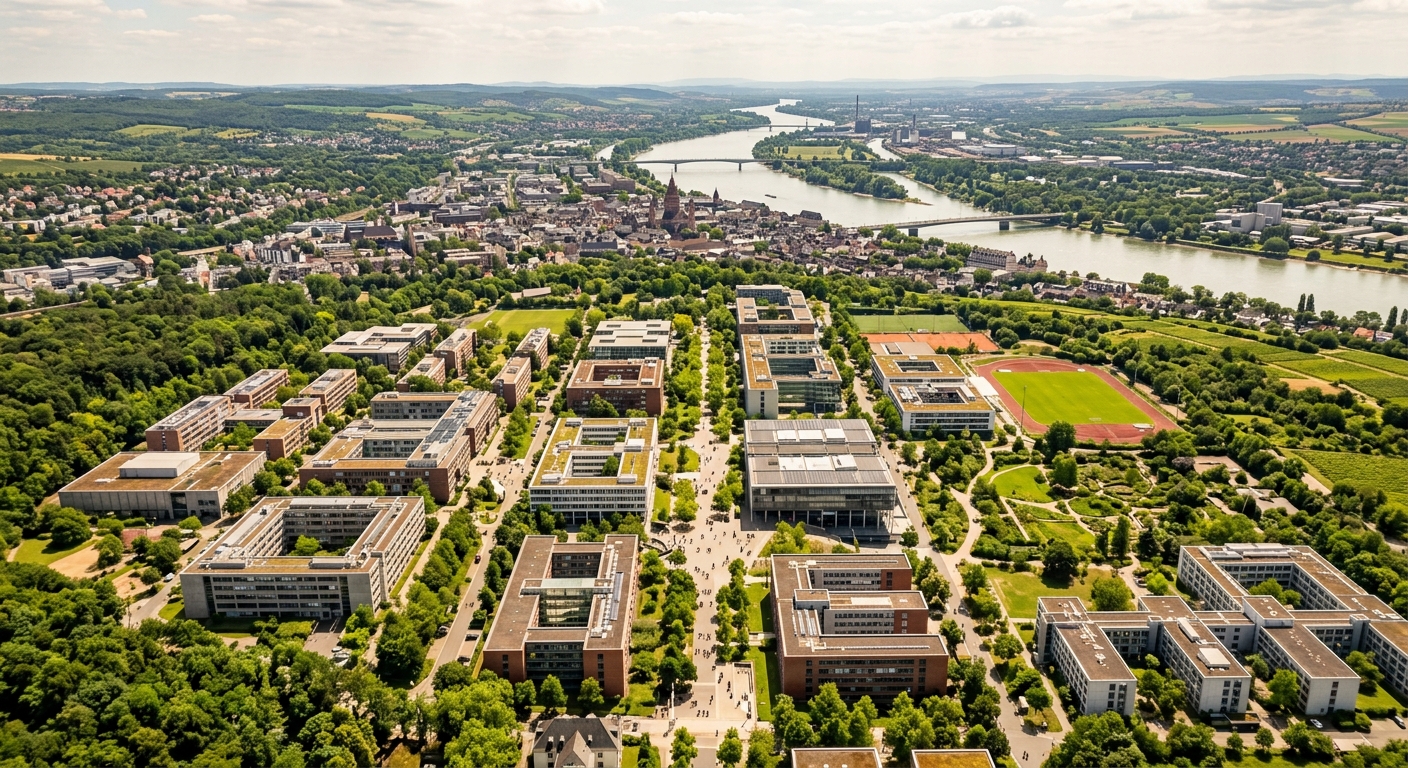
As one of the few campus universities in Germany, nearly all of JGU's institutions and facilities are located on a single campus near the city center. The campus is home to over 150 institutes and clinics, and is neighbored by the Max Planck Institute for Chemistry, the Max Planck Institute for Polymer Research, the Helmholtz Institute Mainz, and the Institute of Molecular Biology. Students can choose from approximately 75 fields of study and over 260 degree programs across the natural sciences, humanities, social sciences, medicine, law, economics, and the arts.
JGU has demonstrated exceptional research strength, particularly through the PRISMA+ Cluster of Excellence in Precision Physics, Fundamental Interactions, and Structure of Matter. In 2015, the university co-founded the Rhine-Main Universities (RMU) alliance with Goethe University Frankfurt and Technische Universitat Darmstadt, creating an internationally visible academic hub with a combined total of over 95,000 students and 1,500 professors.
Key Milestones
- 1477: Original University of Mainz founded by Archbishop Diether von Isenburg, becoming one of the oldest universities in Europe.
- 1946: University re-opened by the French occupying authorities and named after Johannes Gutenberg, the inventor of the printing press.
- 2005: University reorganized into its current faculty structure, streamlining academic administration and interdisciplinary collaboration.
- 2015: Co-founded the Rhine-Main Universities (RMU) alliance with Goethe University Frankfurt and TU Darmstadt.
Academic Structure and Faculties
Academic Structure and Faculties
JGU is organized into ten faculties plus two independent academies for music and art. With over 260 degree programs spanning 75 fields of study, the university offers one of the broadest academic portfolios in Germany, combining research-oriented teaching with interdisciplinary collaboration.
Faculty of Medicine
One of Germany's leading medical faculties, operating the University Medical Center with extensive clinical and research facilities in close proximity to the main campus.
- Medicine (State Examination)
- Dentistry (State Examination)
- Biomedical Chemistry
Faculty of Physics, Mathematics, and Computer Science
Home to the PRISMA+ Cluster of Excellence, this faculty is recognized as one of the strongest in Germany for natural sciences research, with access to the MAMI electron accelerator and TRIGA research reactor.
- Physics (B.Sc./M.Sc.)
- Mathematics (B.Sc./M.Sc.)
- Computer Science (B.Sc./M.Sc.)
Faculty of Law, Management, and Economics
Offers comprehensive programs in legal studies, business administration, and economics, with a strong international orientation including English-taught master's programs.
- Law (State Examination)
- International Economics and Public Policy (M.Sc.)
- Business Administration (B.Sc.)
Faculty of Social Sciences, Media, and Sports
A diverse faculty combining political science, sociology, media studies, and sport science, reflecting JGU's commitment to interdisciplinary social research.
- Political Science (B.A./M.A.)
- Media Studies and Communication
- Sport Science (B.Ed./M.Ed.)
Faculty of Chemistry, Pharmaceutical Sciences, Geosciences, and Biology
Covers a wide range of natural and life sciences, with particular strengths in polymer chemistry and molecular biology, supported by partnerships with neighboring Max Planck Institutes.
- Chemistry (B.Sc./M.Sc.)
- Pharmacy (State Examination)
- Biology (B.Sc./M.Sc.)
Faculty of Philosophy and Philology
One of the largest humanities faculties in Germany, offering a broad spectrum of programs in philosophy, linguistics, literary studies, and cultural studies.
- Philosophy (B.A./M.A.)
- German Studies (B.A./M.A.)
- English Language and Literature (B.A./M.A.)
Admission Requirements for International Students
Admission Requirements for International Students
Undergraduate Admission
- Academic QualificationHigh school diploma equivalent to German Abitur; credential evaluation may be required via uni-assist
- German Language ProficiencyDSH-2 or TestDaF 4x4 for German-taught programs
- English ProficiencyIELTS 6.5 or TOEFL iBT 90 for English-taught programs
- Recognition FeeEUR 60 for international certificate recognition
- Additional RequirementsTestAS aptitude test may be required for non-EU applicants
Graduate Admission
- Bachelor's DegreeCompleted bachelor's degree in a related field with minimum 135 ECTS credits
- GPA RequirementMinimum GPA of 2.5 on the German scale (equivalent to approximately 3.0 on a 4.0 scale)
- Language ProficiencyDSH-2 for German-taught programs; IELTS 6.5 / TOEFL iBT 88-90 for English-taught programs
- Supporting DocumentsTranscripts, CV, statement of purpose, and two recommendation letters (program-dependent)
- Standardized TestsGRE may be required for select programs such as International Economics and Public Policy
Application deadline for international non-EU students for the winter semester starting in October.
Application deadline for EU and German students for restricted programs in the winter semester.
Application deadline for international non-EU students for the summer semester starting in April.
Application deadline for EU and German students for restricted programs in the summer semester.
Tuition Fees and Cost of Attendance
Tuition Fees and Cost of Attendance
Johannes Gutenberg University Mainz does not charge tuition fees for regular degree programs, making it an exceptionally affordable option for both domestic and international students. Students are only required to pay a modest semester contribution that covers administrative services and a public transportation pass.
| Cost Category | German/EU Students | International Students |
|---|---|---|
| Tuition Fees (per semester) | EUR 0 | EUR 0 |
| Semester Contribution | EUR 350 (approx.) | EUR 350 (approx.) |
| Living Expenses (per semester) | EUR 4,200 - EUR 5,200 | EUR 4,200 - EUR 5,200 |
| Health Insurance (per semester) | EUR 600 - EUR 700 | EUR 600 - EUR 700 |
| Total | EUR 5,150 - EUR 6,250 per semester | EUR 5,150 - EUR 6,250 per semester |
DAAD Scholarships
The German Academic Exchange Service (DAAD) offers a wide range of scholarships for international students at all academic levels, including monthly stipends and travel allowances.
- Award Amount: EUR 861 - EUR 1,200 per month (varies by level)
- Eligibility: International students with strong academic records
- Application: Apply through the DAAD portal; deadlines vary by program
Deutschlandstipendium (Germany Scholarship)
A merit-based national scholarship program co-funded by the German federal government and private sponsors, available to both German and international students.
- Award Amount: EUR 300 per month for at least two semesters
- Eligibility: Outstanding academic performance and civic engagement
- Application: Apply directly through JGU; annual application cycle
Campus and Facilities
Campus and Facilities
JGU is one of the few campus universities in Germany, with nearly all of its institutions and facilities located on a single campus in the southwestern part of Mainz. The campus also hosts world-renowned research partners including the Max Planck Institutes, a botanical garden, the MAMI electron accelerator, and the TRIGA research reactor.
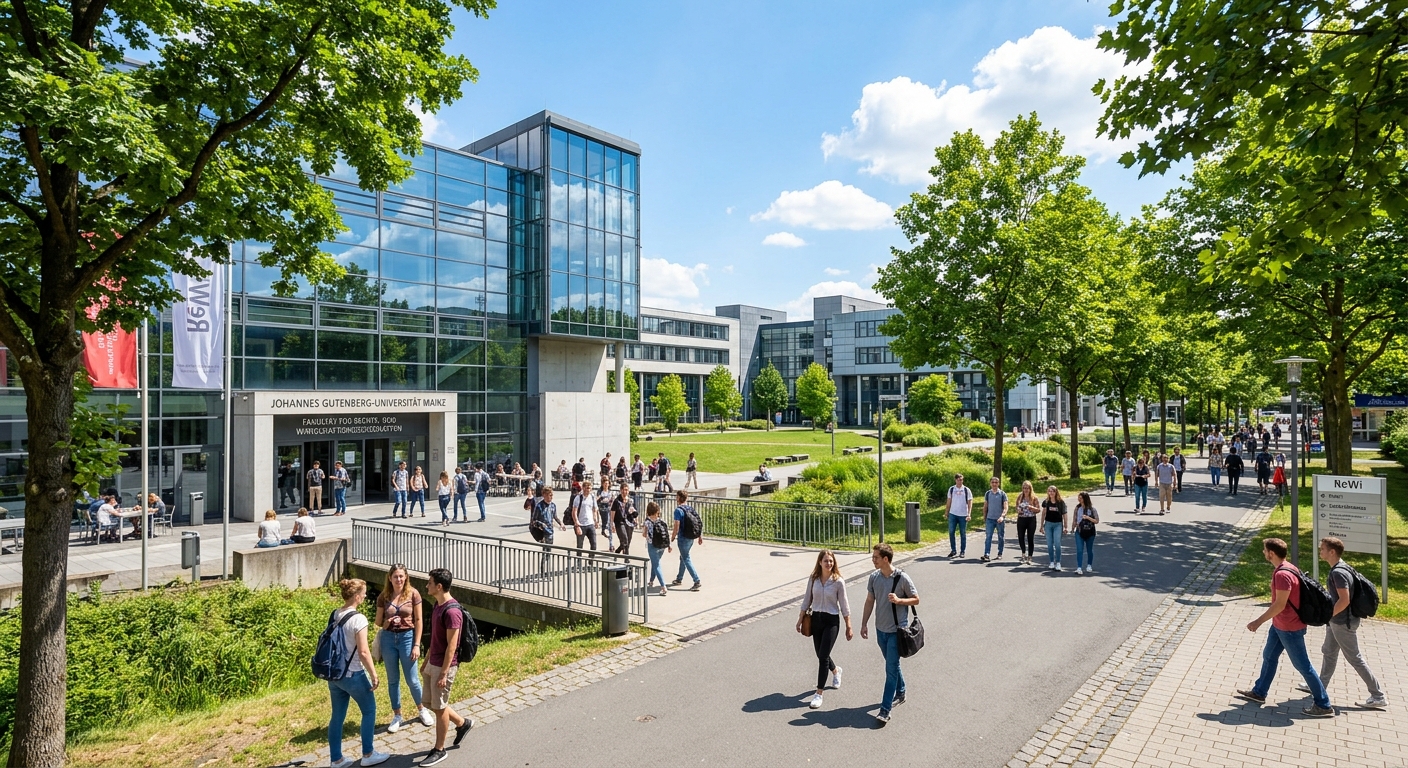
The compact campus brings together over 150 institutes, clinics, and research centers in a walkable environment near the city center.

The central university library offers extensive print and digital collections, group study rooms, and modern research facilities.
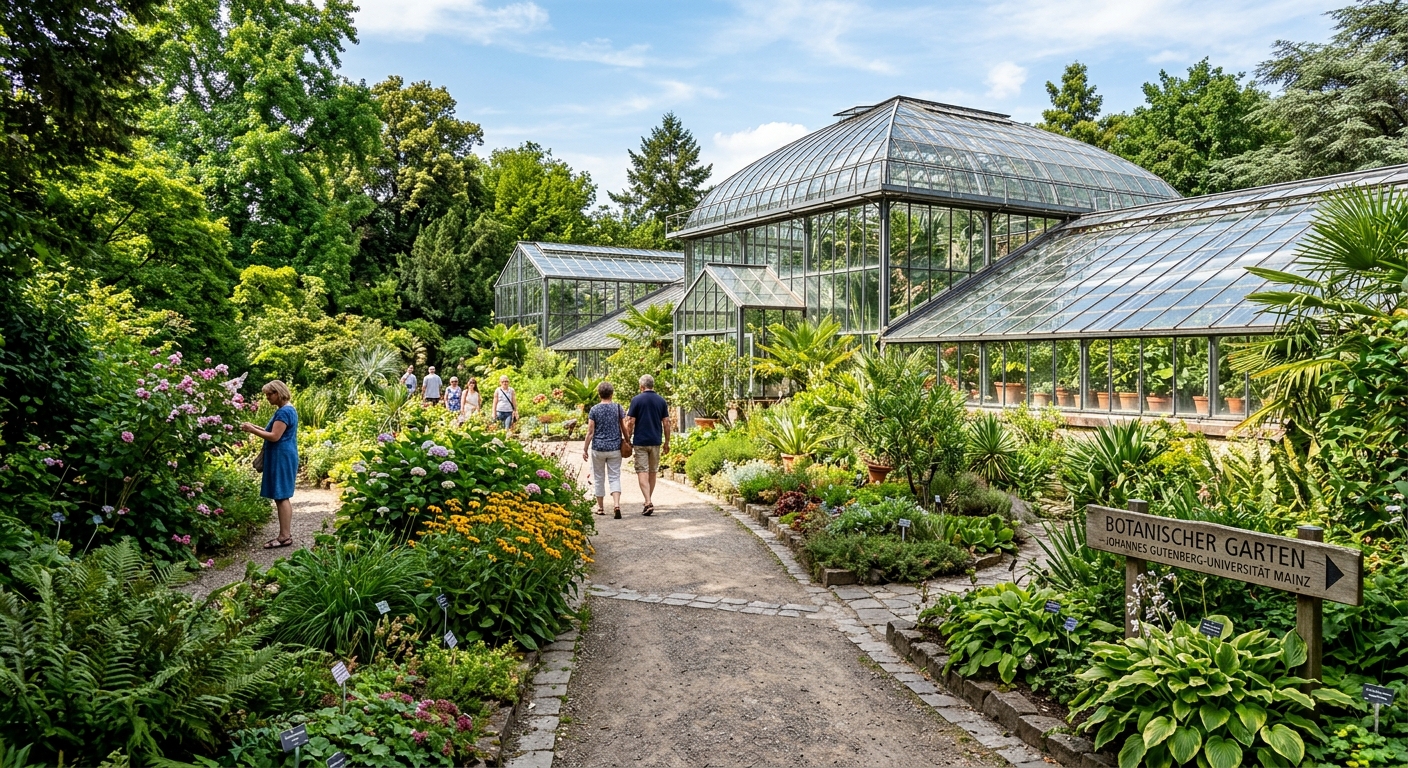
The on-campus botanical garden serves as both a research facility and a peaceful retreat for students and visitors.
Housing and Dining
Student Housing
The Studierendenwerk Mainz manages student dormitories and assists students in finding private accommodation. Rooms are allocated on a first-come, first-served basis.
- On-campus and near-campus dormitories
- Single rooms and shared apartments available
- Private housing assistance through the housing office
Dining Options
The Studierendenwerk operates several dining facilities across campus, offering affordable and diverse meal options for students.
- Main campus Mensa with daily rotating menus
- Multiple cafeterias and coffee bars
- Vegetarian, vegan, and international food options
Student Life at JGU
Student Life at JGU
With over 32,000 students from more than 120 countries, JGU offers a vibrant and diverse student life. The campus features a sports stadium, indoor swimming pool, and a wide range of extracurricular activities that make the university experience rich and engaging.
Mainz: A City of History, Wine, and Culture
Mainz: A City of History, Wine, and Culture

Life in Mainz
Mainz is the capital of Rhineland-Palatinate with approximately 220,000 residents, situated on the western bank of the Rhine River. The city blends a 2,000-year history dating back to Roman times with modern innovation, and is just 25 minutes by S-Bahn from Frankfurt Airport. Known as one of the World Wine Capitals, Mainz offers students an affordable, culturally rich, and well-connected place to live and study.
Gutenberg Museum
Mainz's flagship cultural attraction houses two original Gutenberg Bibles and demonstrates historical printing techniques in honor of the city's most famous son.
Rhine River Promenade
A scenic waterfront area perfect for walking, jogging, or relaxing, offering beautiful views of the Rhine and easy access to the city's restaurants and cultural venues.
Mainz Cathedral (Dom)
A magnificent Romanesque cathedral with over 1,000 years of history, dominating the city skyline and serving as one of Germany's most important religious buildings.
Wine Festivals and Carnival
Mainz is the heart of Germany's largest wine-growing region, Rheinhessen, and hosts vibrant festivals including the famous Mainzer Fastnacht carnival and seasonal wine markets.
Career Outcomes and Alumni Network
Career Outcomes and Alumni Network
Notable Employers and Affiliated Organizations
Practical Information for International Students
Practical Information for International Students
For International Students
JGU's International Office supports incoming students with application guidance, visa and residence permit assistance, orientation programs, and integration into university life.
The university offers intensive German language courses through the International Studien- und Sprachenkolleg (ISSK) to help international students meet language requirements and integrate into daily life.
The semester contribution includes a public transportation pass valid throughout the Rhine-Main region, covering buses, trams, S-Bahn, and regional trains at no additional cost.
Key Contacts
- +90 5435286292
- +44 7868736984
- [email protected]
- [email protected]
Worldwide University Rankings
Worldwide University Rankings
Johannes Gutenberg University Mainz consistently ranks among the top universities in Germany and worldwide, with particular recognition for its strengths in physics, natural sciences, and humanities. The university's research output and academic reputation continue to strengthen its global standing.
| Subject | Ranking Body | Rank |
|---|---|---|
| Physics | Known for the PRISMA+ Cluster of Excellence; ranked first in Germany for competitive DFG research grants in physics. | Top in Germany (DFG) |
| Natural Sciences | Received the highest number of competitive grants in natural sciences from the German Research Foundation (DFG) during the 2014-2016 review period. | Top in Germany (DFG) |
| Linguistics | JGU is recognized as one of the leading German universities for linguistics, supported by the Faculty of Translation Studies in Germersheim. | Top ranked in Mainz |
| Medicine and Health | The University Medical Center contributes to strong rankings in medical research, particularly in cardiovascular systems and immunology. | Nationally recognized |


Features
Johannes Gutenberg University Mainz has a broad, multidisciplinary offering, combining nearly all academic disciplines (including arts, medicine, fine arts) under one campus. It is known for international diversity (students & staff from 100+ countries), strong research, and historical legacy since 1477 (re-founded 1946).

Accommodation
Off-Campus Accommodations Students wishing to live off-campus need to research availability on their own, and should arrive well before the start of term to do so.

Work While Studying
See guidelines on working while studying here.

Co-op/Internship Participation
Even if you do NOT meet our minimum English requirement (IELTS or TOEFL), you still can get conditionally accepted in the program of your choice with the condition of completing our English program prior to starting your chosen program.
Featured Programmes





Location
Saarstraße 21\n55122 Mainz\nGermany

Map not found.

Uni4Edu AI Assistant