Economics
Main Campus, Germany

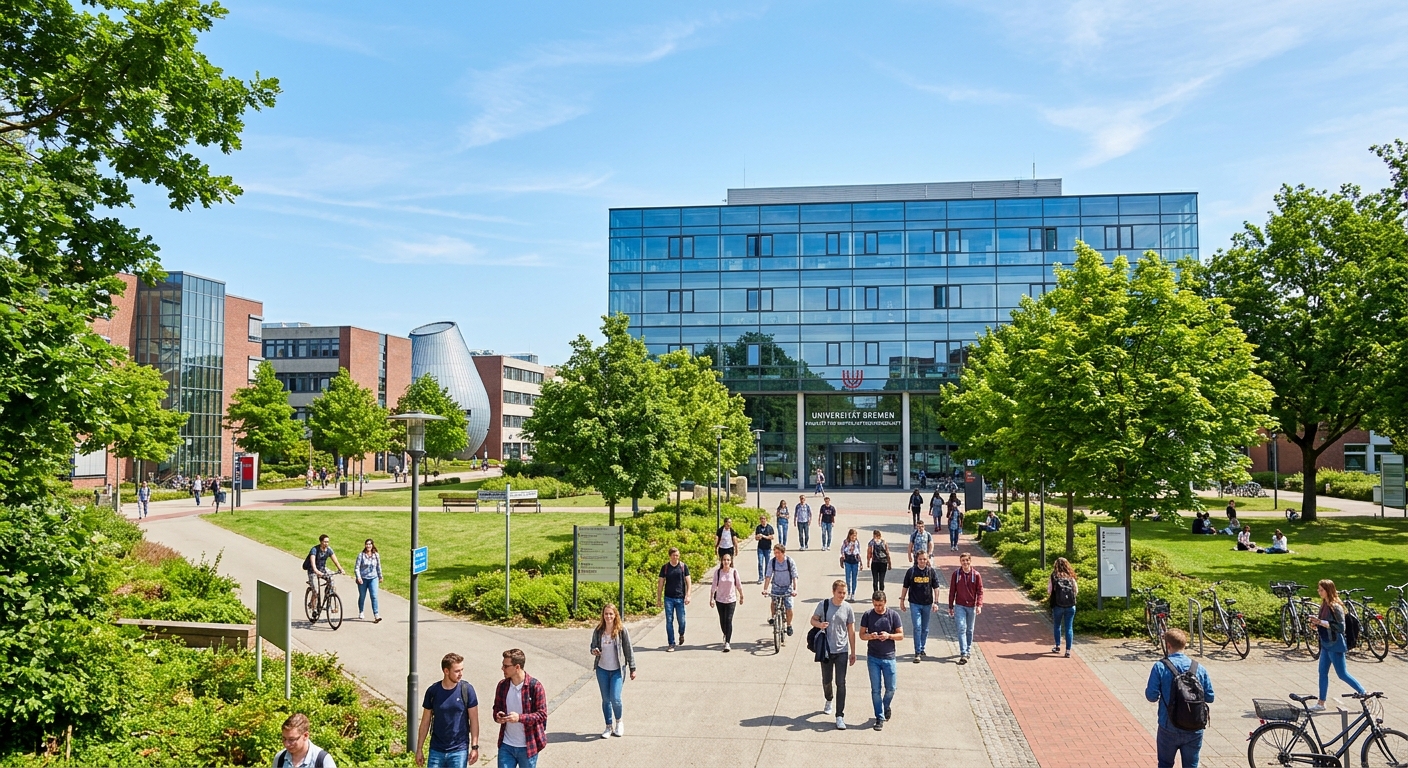
Bachelor of Science in Economics
University of Bremen
Economics
Program Overview: Bachelor of Science in Economics
The Bachelor of Science in Economics at the University of Bremen is a six-semester full-time program that provides a comprehensive foundation in both economics and business studies. The first half of the program focuses on core fundamentals including microeconomics, macroeconomics, mathematics, statistics, and business administration, while the second half allows students to specialize through the major Economic Evolution, Human Behavior and Policy.
A distinctive feature of this program is its interdisciplinary approach, expanding the traditional economics curriculum with insights from psychology, behavioral science, and social sciences to provide more realistic analyses of economic phenomena. Students gain hands-on experience with modern econometric methods, experimental techniques, and modeling tools that they apply to pressing economic questions such as digitalization, sustainability, and innovation.
From the fourth semester onward, students choose between two specialization tracks: Sustainability Economics or Digital Economics. The program concludes with a Bachelor's thesis and prepares graduates for careers in economic consulting, public administration, private industry, and research, as well as for advanced Master's programs such as the University of Bremen's own The Economics of Global Challenges (M.Sc.).
Key Program Highlights
- Interdisciplinary curriculum integrating behavioral science, psychology, and heterodox economic perspectives alongside traditional economics training
- Two specialization tracks from the fourth semester: Sustainability Economics and Digital Economics within the major Economic Evolution, Human Behavior and Policy
- Innovative WiWi Onboarding Challenge module in the first week to facilitate a smooth start to university studies through collaborative, practice-oriented group work
- Strong methodological training in econometrics, programming, and analytical skills, preparing students for data-driven careers and research
Curriculum and Modules
The Economics curriculum at the University of Bremen is structured to build a strong foundation in business and economics during the first three semesters, followed by specialization and independent research in the final three semesters. The program integrates intensive methodological training with subject-specific content, culminating in a Bachelor's thesis.
Microeconomics
9 ECTSCovers fundamental microeconomic theory including consumer behavior, firm theory, market structures, and welfare economics, providing the analytical foundation for advanced economic analysis.
Macroeconomics
9 ECTSIntroduces key macroeconomic models and concepts such as national income accounting, monetary and fiscal policy, economic growth, and international trade dynamics.
Mathematics and Statistics
12 ECTSProvides essential quantitative skills including calculus, linear algebra, probability theory, and statistical inference, forming the methodological backbone for empirical economic research.
Business Studies Fundamentals
12 ECTSCovers core business topics such as accounting, marketing, human resource management, finance and investment, and corporate organization, shared with the Business Studies degree program.
Advanced Econometrics
6 ECTSDevelops advanced skills in econometric methods, data analysis, and programming, enabling students to conduct independent empirical research and interpret complex economic data.
Bachelor Thesis
12 ECTSAn independent research project in which students apply the theoretical knowledge and methodological skills acquired throughout the program to investigate an economic topic of their choice.
Specialization Tracks and Electives
Admission Requirements
Admission to the Bachelor of Science in Economics at the University of Bremen requires a recognized university entrance qualification. The program begins in the winter semester, and study places are allocated through the Dialogue-Oriented Service Procedure (DoSV). Contact Uni4Edu for guidance on eligibility and the application process.
Academic Requirements
- University Entrance QualificationGeneral qualification for university entrance (e.g., Abitur or equivalent) or specific higher education entrance qualification (Einstufungsprüfung)
- International CredentialsForeign school-leaving certificates equivalent to the German Abitur, verified through the Anabin database or uni-assist evaluation
- Preparatory CollegeApplicants whose qualifications are not directly recognized may need to complete a Studienkolleg preparatory program and pass the Feststellungsprüfung assessment test
- Admission RestrictionThe program may have a numerus clausus (NC); selection is based on the grade point average of the entrance qualification. Contact Uni4Edu for current NC thresholds.
- Program StartWinter semester only (lectures typically begin mid-October)
Language Requirements
- German ProficiencyC1 level required for enrollment; accepted certificates include TestDaF (minimum 16 points), DSH-2, or Feststellungsprüfung
- English ProficiencyB2 level recommended from the fourth semester onward, as some advanced materials and electives may be offered in English
- ExemptionsGerman C1 requirement is waived for holders of a German-language Abitur or equivalent certificate from a German educational institution
Required Documents
Application Deadlines
For personalized admission guidance, document verification, and application support, please contact Uni4Edu
Scholarships and Funding
As a public university in Germany, the University of Bremen does not charge tuition fees for most degree programs. However, students are responsible for a semester fee and living expenses. Several scholarship opportunities are available to help international students finance their studies in Bremen.
Deutschlandstipendium (Germany Scholarship)
EUR 300 per monthA merit-based scholarship funded jointly by the German federal government and private sponsors, awarded to high-achieving students regardless of nationality. It supports students for at least two semesters based on academic performance and social engagement.
DAAD Scholarships for International Students
Varies by programThe German Academic Exchange Service (DAAD) offers a range of scholarships for international students at all academic levels. Awards may cover living expenses, travel costs, and health insurance. Contact Uni4Edu for details on eligibility and application procedures.
Bremen State Scholarships and Faculty Funding
VariesThe University of Bremen and the Faculty of Business Studies and Economics occasionally offer financial support through emergency funds, research assistant positions, and partnerships with regional companies. Contact Uni4Edu for current availability.
For detailed tuition fee information, please contact Uni4Edu — we will guide you through the costs and available funding options for this program.
Career Prospects
Graduates of the Bachelor of Science in Economics from the University of Bremen are well-prepared for a wide range of careers in the private and public sectors. The program's emphasis on quantitative methods, behavioral economics, and sustainability or digital economics provides a versatile skill set valued by employers across industries. Many graduates also pursue advanced Master's programs to further specialize their expertise.
Potential Career Roles
Typical Employers and Sectors
Rankings and Recognition
The University of Bremen is a recognized University of Excellence in Germany and consistently ranks among the top German universities across multiple international ranking systems. Its Faculty of Business Studies and Economics has achieved notable results in both national and international assessments.
| Subject | Ranking Body | Rank |
|---|---|---|
| Business and Economics | THE World University Rankings by Subject | #251 |
| Business and Management Studies | QS World University Rankings by Subject | #601 |
| Sociology | QS World University Rankings by Subject | #101 |
| Social Sciences | THE World University Rankings by Subject | Top 300 |
How to Apply
Applying for this program is easy with Uni4Edu. Our team will guide you through every step of the process — from document preparation to final enrolment.
Contact Uni4Edu
Reach out to our team via email or phone. We will assess your profile and confirm your eligibility for this program.
Prepare Your Documents
Our advisors will provide you with a personalised checklist of required documents and help you prepare your application package.
Submit Your Application
Uni4Edu will submit your application on your behalf and keep you updated on its progress throughout the review period.
Receive Your Offer
Once accepted, we will help you understand your offer, arrange visa support if needed, and guide you through the enrolment process.
Similar Programmes


Bachelor's Degree
36 months
Economics and Politics\t

University of Kent, Canterbury, United Kingdom
Earliest Intake
June 2026
Gross Tuition
19300 £

Bachelor's Degree
48 months
Economics with a Year Abroad\t
University of Kent, Canterbury, United Kingdom
Earliest Intake
October 2026
Gross Tuition
19300 £


Bachelor's Degree
42 months
Business Economics with Marketing BSc (Hons)
University of Dundee, Dundee City, United Kingdom
Earliest Intake
July 2027
Gross Tuition
21900 £

Bachelor's Degree
48 months
Economics
Manhattan University, Bronx, United States
Earliest Intake
August 2026
Gross Tuition
46100 $
Bachelor's Degree
48 months
Economics
University of Toledo, Toledo, United States
Earliest Intake
October 2026
Gross Tuition
36570 $



Uni4Edu AI Assistant