Energy Engineering
University of Stuttgart PO Box 10 60 37 70049 Stuttgart, Germany

Master of Science in Energy Engineering
University of Stuttgart
Energy Engineering
Program Overview: M.Sc. Energy Engineering at the University of Stuttgart
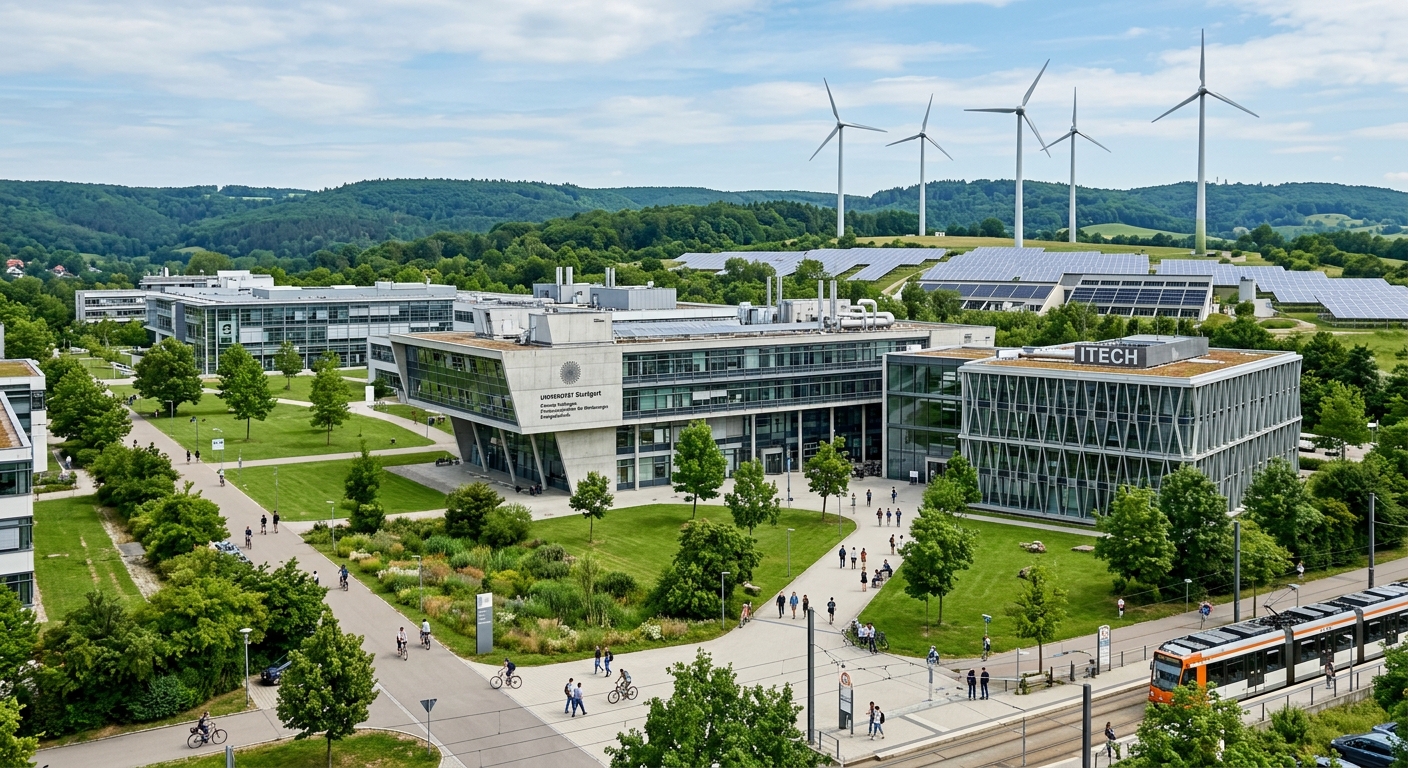
The Master of Science in Energy Engineering (Energietechnik) at the University of Stuttgart provides an in-depth exploration of the scientific and engineering principles behind energy conversion, storage, and distribution. You will study the potential and economic viability of various energy sources — including fossil fuels, nuclear energy, solar, wind, hydropower, and biomass — and their integration into modern energy systems.
The program is designed for four semesters and requires the completion of 120 ECTS credits. Students choose two specialization subjects that form the focal points of their degree, with the first drawn from subject-specific areas and the second from either subject-specific or cross-disciplinary options. This flexible structure allows you to tailor your studies to your professional interests.
As a member of the TU9 alliance of leading German technical universities, the University of Stuttgart is situated in one of Europe's most industrially vibrant regions. Graduates emerge with broad competencies in energy technology and are well-prepared for careers in global corporations, engineering firms, consultancies, and the public sector.
Key Program Highlights
- Seven subject-specific specializations including Energy Storage, Thermofluid Dynamics, and Energy Systems and Energy Management
- Strong industry connections in Baden-Württemberg, one of Europe's leading high-tech and automotive regions
- Flexible intake with both winter and summer semester start options
- Integrated industrial internship or compulsory elective modules worth 15 ECTS for hands-on professional experience
Curriculum and Modules
The M.Sc. Energy Engineering program at the University of Stuttgart comprises compulsory modules, optional modules, a student research project, laboratory practicals, an industrial internship, and a final Master's thesis. Students select two specialization subjects and three additional specialization modules from a catalog, creating a highly individualized study plan across four semesters.
Thermofluid Dynamics
18 ECTS (specialization)Covers advanced topics in thermodynamics and fluid mechanics as applied to energy systems, including heat transfer, combustion processes, and computational fluid dynamics for energy applications.
Energy Systems and Energy Management
18 ECTS (specialization)Focuses on the design, analysis, and optimization of integrated energy systems, including grid management, energy economics, and the planning of sustainable energy supply structures.
Energy Storage
18 ECTS (specialization)Examines technologies for storing electrical and thermal energy, including battery systems, hydrogen storage, pumped hydro, and emerging storage solutions critical to the energy transition.
Electrical Machines and Drives
18 ECTS (specialization)Provides advanced knowledge in the design, control, and operation of electrical machines and drive systems used in power generation, electromobility, and industrial applications.
Modelling and Simulation Methods
18 ECTS (specialization)Trains students in computational modelling and simulation techniques applied to energy engineering problems, including numerical methods, system modelling, and optimization algorithms.
Master's Thesis
30 ECTSAn independent scientific research project completed in the fourth semester, allowing students to apply their accumulated knowledge to a current topic in energy engineering, often in collaboration with industry or research institutes.
Elective Modules and Cross-Disciplinary Options
Admission Requirements
Admission to the M.Sc. Energy Engineering program at the University of Stuttgart is competitive and based on academic qualifications, subject-specific suitability, and language proficiency. To learn more about your eligibility or to begin the application process, contact Uni4Edu for personalized guidance.
Academic Requirements
- Bachelor's DegreeCompletion of a Bachelor's degree (minimum six semesters) in Energy Engineering, Mechanical Engineering, or a closely related engineering field
- Academic PerformanceEligible examination results demonstrating strong academic performance; knowledge and skills must be equivalent to the University of Stuttgart's related B.Sc. programs
- Subject-Specific SuitabilityDemonstrated competence in scientific, mathematical, and engineering methods relevant to energy technology
- ECTS RequirementsSufficient credit hours in core engineering subjects including thermodynamics, fluid mechanics, and mathematics
- International QualificationsAn equivalent degree with eligible results from a recognized foreign higher education institution
Language Requirements
- German ProficiencyDSH-2 or equivalent (e.g., TestDaF 4x4) — this is a German-taught program and proof of German language skills is mandatory for non-native speakers
- Alternative German CertificatesGoethe-Zertifikat C1 or C2, telc Deutsch C1 Hochschule, or successful completion of a German Studienkolleg
- English ProficiencyNot formally required for admission, though some individual modules may be offered in English; contact Uni4Edu for details
Required Documents
Application Deadlines
For personalized admission guidance, document verification, and application support, please contact Uni4Edu
Scholarships and Funding
While the University of Stuttgart does not typically offer full scholarships for degree programs directly, several prestigious external and institutional funding opportunities are available to international students. Uni4Edu can help you identify and apply for scholarships that match your profile and academic goals.
Deutschlandstipendium (Germany Scholarship)
EUR 300 per monthAwarded based on academic excellence and social engagement, this scholarship is open to students of all nationalities enrolled at the University of Stuttgart. Half is funded by private sponsors and half by the German Federal Ministry of Education and Research.
DAAD Scholarships for International Students
Monthly stipend plus additional benefits (varies by program)The German Academic Exchange Service (DAAD) offers a range of scholarships for international Master's students in Germany, including study and research grants. The University of Stuttgart also administers DAAD STIBET scholarships for advanced international students.
For detailed tuition fee information, please contact Uni4Edu — we will guide you through the costs and available funding options for this program.
Career Prospects
Graduates of the M.Sc. Energy Engineering program at the University of Stuttgart possess broad knowledge in energy technology and related fields, making them highly sought after in Germany's thriving industrial landscape. The university's location in the Stuttgart metropolitan area — home to major energy, automotive, and engineering companies — provides exceptional networking and employment opportunities.
Typical Career Roles for Graduates
Top Employers in the Region and Industry
Rankings and Recognition
The University of Stuttgart is a member of the prestigious TU9 alliance of Germany's leading technical universities and consistently ranks among the top institutions globally for engineering and technology. Its strong industry ties, research output, and graduate employability are reflected in multiple international ranking systems.
| Subject | Ranking Body | Rank |
|---|---|---|
| Engineering and Technology | QS World Rankings by Subject | #182 |
| Mechanical, Aeronautical and Manufacturing Engineering | QS World Rankings by Subject | #82 |
| Engineering | THE World Rankings by Subject | Top 125 |
| Engineering Sciences | ARWU (GRAS) | Top 200 |
How to Apply
Applying for this program is easy with Uni4Edu. Our team will guide you through every step of the process — from document preparation to final enrolment.
Contact Uni4Edu
Reach out to our team via email or phone. We will assess your profile and confirm your eligibility for this program.
Prepare Your Documents
Our advisors will provide you with a personalised checklist of required documents and help you prepare your application package.
Submit Your Application
Uni4Edu will submit your application on your behalf and keep you updated on its progress throughout the review period.
Receive Your Offer
Once accepted, we will help you understand your offer, arrange visa support if needed, and guide you through the enrolment process.
Similar Programmes
Master's & Postgraduate
16 months
Satellite Systems Engineering MSc

University of Bradford, Bradford, United Kingdom
Earliest Intake
August 2026
Gross Tuition
19500 £
Master's & Postgraduate
12 months
Electronic Engineering
Prifysgol Bangor University, Bangor, United Kingdom
Earliest Intake
May 2026
Gross Tuition
21000 £

Master's & Postgraduate
12 months
Marine Renewable Energy
Prifysgol Bangor University, Bangor, United Kingdom
Earliest Intake
May 2026
Gross Tuition
19500 £
Master's & Postgraduate
12 months
MSc Engineering Management
BPP University, City of London, United Kingdom
Earliest Intake
July 2026
Gross Tuition
17100 £


Bachelor's Degree
48 months
Engineering (BS)
University Of Arizona, Tucson, United States
Earliest Intake
January 2027
Gross Tuition
39958 $



Uni4Edu AI Assistant