
Marine Renewable Energy
Bangor , United Kingdom

Master of Science in Marine Renewable Energy
Prifysgol Bangor University
Marine Renewable Energy
Program Overview: MSc Marine Renewable Energy
The MSc Marine Renewable Energy at Bangor University equips students with the skills necessary to identify and quantify the potential of specific locations for marine renewable energy generation installations, with an emphasis on wave and tidal resources, time series analysis, and site characterisation. Delivered by the School of Ocean Sciences, the program builds on over 50 years of teaching experience in physical oceanography and is one of only three MSc programmes in marine energy in the UK.
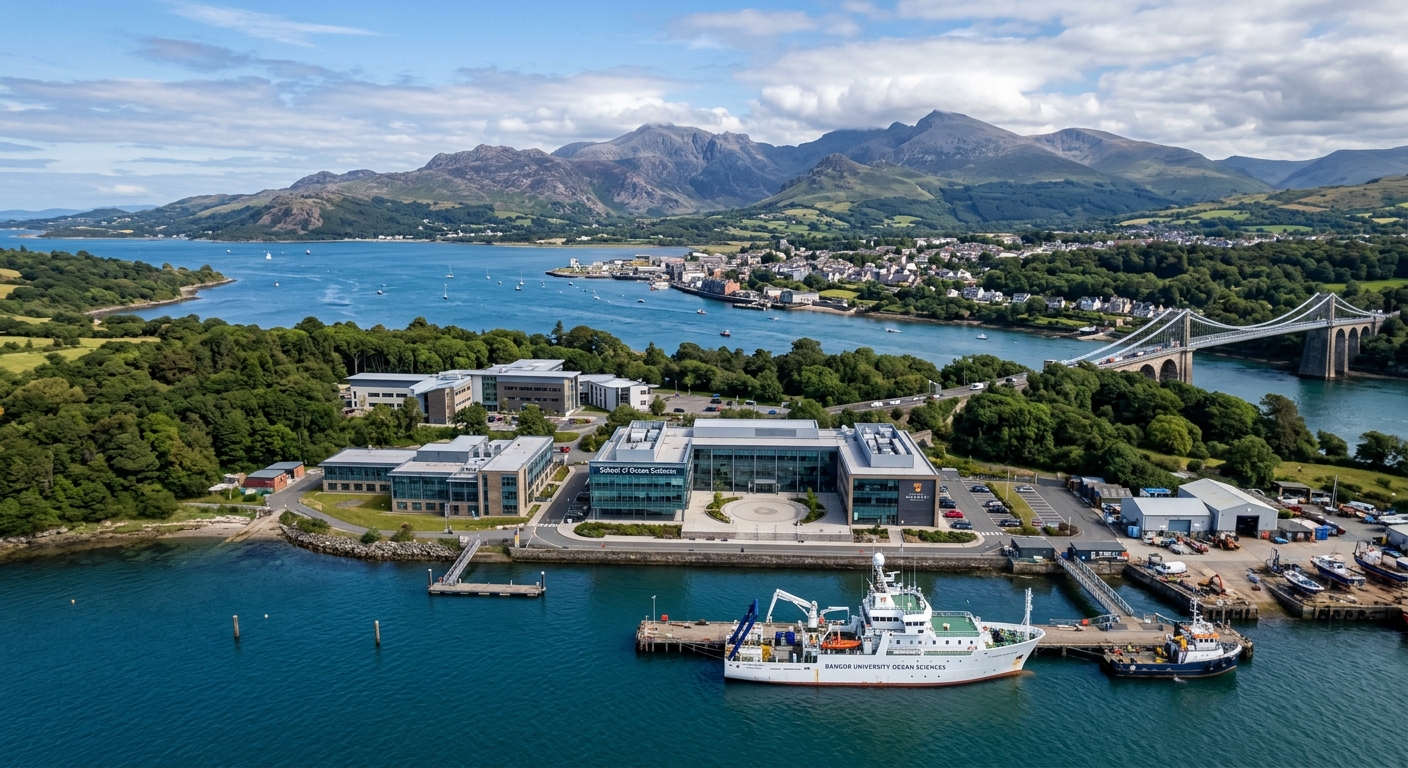
The course places particular emphasis on assessing the wave and tidal energy resource and the geophysical nature of sites, providing students with the necessary skills for marine renewable energy resource and site characterisation from theoretical, technical, and practical perspectives. Students benefit from hands-on experience aboard the university's 35-metre research vessel, RV Prince Madog, as well as training in state-of-the-art oceanographic instrumentation and numerical modelling.
Situated between the mountains of Snowdonia and the Menai Strait in North Wales, the School of Ocean Sciences offers a unique learning environment with direct access to diverse marine environments. The program also prepares graduates for careers in offshore wind and provides a strong foundation for progression to a PhD in marine renewable energy or a related discipline.
Key Program Highlights
- One of only three MSc programmes in marine energy in the UK, delivered by the internationally recognised Ocean Physics group
- Hands-on fieldwork aboard the 35-metre RV Prince Madog research vessel and access to industry-standard geophysical equipment
- Extensive industry links with summer research projects often conducted in collaboration with marine renewable energy companies
- Located on the Menai Strait with direct access to tidal energy sites and diverse coastal marine environments
Curriculum and Modules
The MSc Marine Renewable Energy is structured across two taught semesters followed by a substantial summer research project. The first two semesters introduce the physics of the ocean and the ways in which we can harness the ocean to generate electricity while minimising environmental impacts. Modules cover both oceanographic theory and its application, as well as practical oceanography, culminating in an independent research dissertation.
Key Concepts and Techniques
20 CreditsThis foundational module introduces essential mathematical, physical, and analytical concepts underpinning ocean science and marine renewable energy. Students develop core competencies in data analysis, signal processing, and scientific computing required for subsequent modules.
Marine Renewable Energy
20 CreditsThis dedicated module explores marine renewable energy technologies, resources, and impacts, combining industry insight with key energy concepts, wave-tide dynamics, environmental feedbacks, and the critical appraisal of feedback mechanisms between energy extraction and the resource.
Practical Oceanography
20 CreditsDevelops skills in oceanographic fieldwork, data collection and analysis, signal processing, ArcGIS, and numerical modelling through hands-on research cruises aboard the RV Prince Madog and practical laboratory sessions.
Geophysical Surveying
20 CreditsTeaches the techniques used to survey sites suitable for deploying wave and tidal energy arrays, including sub-surface mapping, industry-standard software and hardware, and critical analysis of acquired geophysical datasets for engineering and environmental applications.
Literature Review
20 CreditsStudents conduct an extensive critical review of current scientific literature in their chosen area of marine renewable energy, developing skills in academic writing, source evaluation, and synthesis of complex research topics.
Research Project / Dissertation
60 CreditsThe major component of the course, where students independently investigate a specific scientific topic chosen in close consultation with academic staff. Many projects are conducted in collaboration with industry partners in the marine renewable energy sector.
Elective and Optional Modules
Admission Requirements
The MSc Marine Renewable Energy welcomes applicants with a strong foundation in the physical, mathematical, or other numerate sciences. Candidates from related disciplines with relevant professional experience are also encouraged to apply through Uni4Edu, provided they can demonstrate strong motivation and a suitable grounding in mathematics.
Academic Requirements
- Minimum Degree Classification2:2 (Second Class Honours, Lower Division) undergraduate degree or equivalent
- Preferred Subject BackgroundPhysical sciences, mathematical sciences, or other numerate disciplines
- Alternative Backgrounds ConsideredGeography, Geology, Biology, and other sciences with demonstrated mathematical grounding
- Professional ExperienceApplicants with relevant employment experience in lieu of formal qualifications may be considered
- Supporting DocumentsA strong personal statement and CV demonstrating high levels of motivation and relevant experience
English Language Requirements
- IELTS AcademicOverall 6.0 with no element below 5.5
- TOEFL iBTContact Uni4Edu for current accepted scores and equivalencies
- PTE AcademicContact Uni4Edu for current accepted scores and equivalencies
Required Documents
Application Deadlines
For personalized admission guidance, document verification, and application support, please contact Uni4Edu
Scholarships and Funding
Bangor University offers a range of scholarships and bursaries to support international postgraduate students. Funding opportunities are available through the university's International Education Centre, external bodies, and collaborative schemes. Contact Uni4Edu for personalised guidance on the funding options best suited to your profile.
Bangor University International Scholarship
Up to GBP 3,000Available to all international postgraduate taught students paying international tuition fees. No separate scholarship application is required — all applicants are automatically considered based on academic performance, personal statement, and other criteria.
Commonwealth Shared Scholarship Scheme
Full funding (tuition, living costs, travel)Jointly funded by Bangor University and the Commonwealth Scholarship Commission, this scheme supports students from eligible Commonwealth countries pursuing taught master's programmes. Covers tuition fees, living allowance, and travel costs.
GREAT Scholarships (British Council)
GBP 10,000Funded by the British Council, this scholarship is available to students from selected countries for any taught master's programme at Bangor University. Eligibility criteria and available countries vary by academic year — contact Uni4Edu for the latest details.
For detailed tuition fee information, please contact Uni4Edu — we will guide you through the costs and available funding options for this program.
Career Prospects
Graduates of the MSc Marine Renewable Energy are well-positioned for high-demand roles across the rapidly growing marine energy sector. The program equips you with specialist skills in resource assessment, numerical modelling, and geophysical surveying that are directly applicable to industry. The School of Ocean Sciences has extensive links with the marine renewable energy industry, and many graduates secure employment through connections made during their research projects.
Potential Career Roles
Typical Employers and Organisations
Rankings and Recognition
Bangor University is a well-established institution founded in 1884, recognised for its research excellence and strong student experience. The university's Ocean Physics group, which delivers this MSc program, has been acknowledged for world-leading research impact in the Research Excellence Framework (REF). Bangor is also a partner in the PRIMaRE ocean renewable energy network and staff hold advisory roles in the Supergen ORE Hub.
| Subject | Ranking Body | Rank |
|---|---|---|
| Environmental Sciences | QS World University Rankings by Subject | Top 350 |
| Agriculture and Forestry | QS World University Rankings by Subject | Top 150 |
| Environmental Science | EduRank | #495 World / #43 UK |
| Physics | EduRank | #765 World / #50 UK |
How to Apply
Applying for this program is easy with Uni4Edu. Our team will guide you through every step of the process — from document preparation to final enrolment.
Contact Uni4Edu
Reach out to our team via email or phone. We will assess your profile and confirm your eligibility for this program.
Prepare Your Documents
Our advisors will provide you with a personalised checklist of required documents and help you prepare your application package.
Submit Your Application
Uni4Edu will submit your application on your behalf and keep you updated on its progress throughout the review period.
Receive Your Offer
Once accepted, we will help you understand your offer, arrange visa support if needed, and guide you through the enrolment process.
Similar Programmes

Master's & Postgraduate
16 months
Satellite Systems Engineering MSc

University of Bradford, Bradford, United Kingdom
Earliest Intake
August 2026
Gross Tuition
19500 £


Master's & Postgraduate
12 months
Electronic Engineering
Prifysgol Bangor University, Bangor, United Kingdom
Earliest Intake
May 2027
Gross Tuition
21000 £


Master's & Postgraduate
12 months
MSc Engineering Management
BPP University, City of London, United Kingdom
Earliest Intake
July 2027
Gross Tuition
17100 £


Bachelor's Degree
48 months
Engineering (BS)
University Of Arizona, Tucson, United States
Earliest Intake
January 2027
Gross Tuition
39958 $


Master's & Postgraduate
24 months
Stem Cell And Tissue Engineering MSc (Thesis) TR
Istinye University, Zeytinburnu, Turkey
Earliest Intake
March 2026
Gross Tuition
8500 $



Uni4Edu AI Assistant