
Nanotechnology and Microfabrication
Bangor , United Kingdom

Master of Science in Nanotechnology and Microfabrication
Bangor University (Prifysgol Bangor)
Nanotechnology and Microfabrication
Program Overview: MSc Nanotechnology and Microfabrication
The MSc in Nanotechnology and Microfabrication at Bangor University teaches numerate graduates the knowledge and skills needed to work in the rapidly evolving field of nanotechnology and microfabrication. The program takes an immersive approach to learning both the principles and practices of the discipline, with much of the material based around real-world examples and practical exercises.
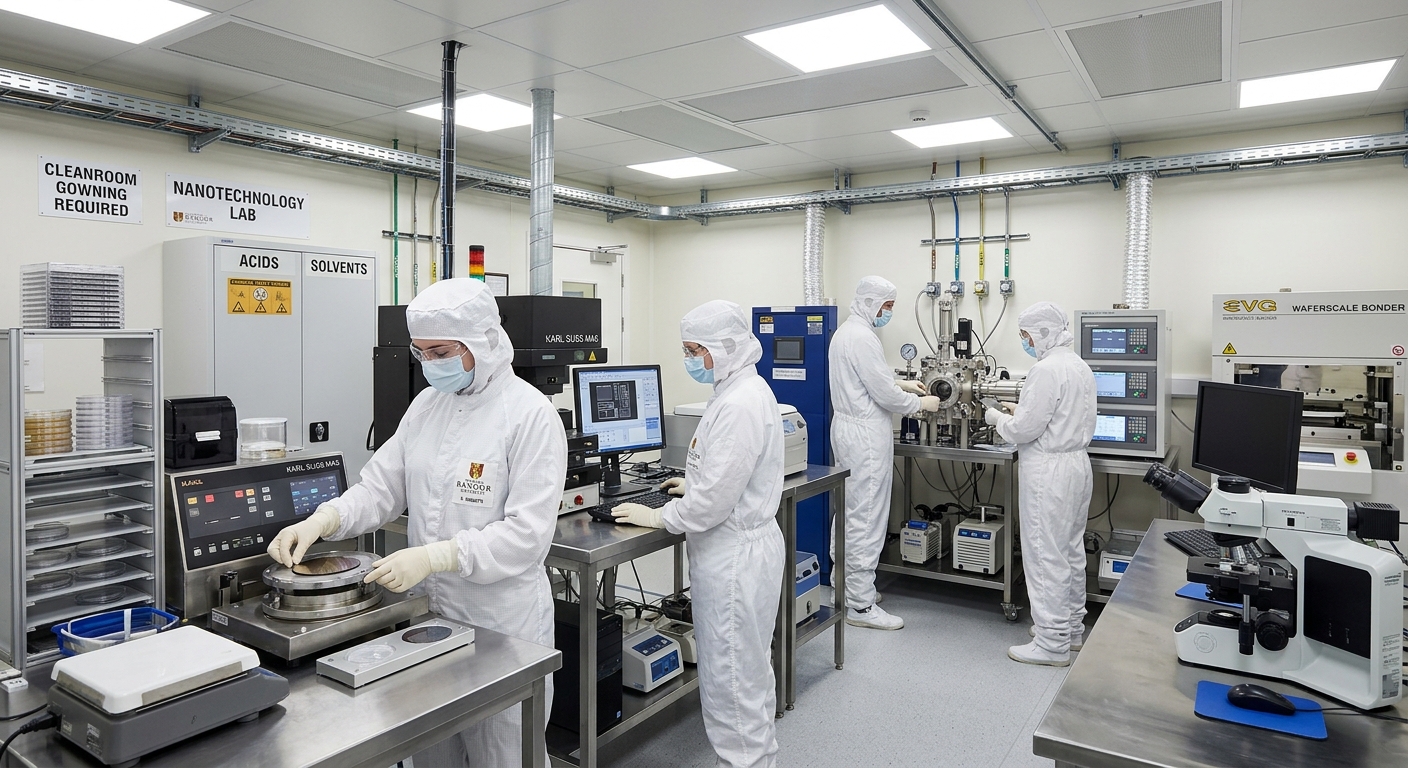
Bangor University is one of the very few universities in the UK to offer hands-on time fabricating devices in a clean room environment and operator time on laser micro-machining equipment. External examiners have commended the strong practical element of this course, noting that students undertake significant projects in the clean room facility.
Nanotechnology and microfabrication involves working at extremely small scales, ranging from individual atoms to structures measuring several micrometers. The degree program covers all aspects of nanotechnology, including device design, fabrication, and measurements, preparing you for a career at the forefront of technological innovation.
Key Program Highlights
- Hands-on clean room access for device fabrication, a rare offering among UK universities
- Immersive practical approach with laser micro-machining equipment and real-world exercises
- Strong numerical modelling skills development, including expertise in multiphysics modelling
- Delivered by the School of Computer Science and Electronic Engineering with research-active staff
Curriculum and Modules
The MSc Nanotechnology and Microfabrication curriculum combines taught modules with a substantial individual research project. The program is designed to give you a firm grasp of current practices and emerging directions in nanotechnology, equipping you with the skills to design and build microscale devices. Module listings are for guidance purposes and may be subject to change.
MSc Individual Project
60 CreditsAn in-depth study of a topic at near or actual state-of-the-art research level. You will design, implement, and evaluate a solution while exploring the wider professional, ethical, social, and environmental impact of your work.
Introduction to Nanotechnology and Microsystems Technology
20 CreditsProvides an introductory background to nanotechnology and microsystems technology, covering the development of the subjects, microfabrication techniques, scanning probe methods, and current and future business prospects and markets.
Microengineering
20 CreditsAn introduction to the rapidly expanding subject of microengineering, investigating clean room-based lithographic and other methods of microfabrication for silicon, polymers, and metals, along with routes to larger scale manufacture.
Advanced Microfabrication
20 CreditsBuilds on microengineering knowledge to provide practical microfabrication experience. Examines a broad range of advanced manufacturing processes including techniques suitable for larger scale production, particularly of polymer devices.
Photonic and RF MEMS
20 CreditsIntroduces the use and benefits of miniaturised microelectromechanical systems (MEMS) in semiconductor-based photonic and RF technologies. Covers mechanical, electrostatic, and optical/RF concepts underlying MEMS technology along with manufacturing processes and applications.
Multiphysics Modelling and Simulation
20 CreditsDevelops strong numerical modelling skills with a focus on the emerging field of multiphysics modelling. You will learn to simulate complex nanotechnology and microfabrication processes using industry-standard software tools.
Elective Modules and Specialisations
Admission Requirements
Admission to the MSc Nanotechnology and Microfabrication program is competitive and based on academic merit. To be considered, you should meet the following requirements. For personalised guidance on your eligibility and application, contact Uni4Edu.
Academic Requirements
- Undergraduate DegreeHonours degree in Electronic Engineering, Physics, or a related scientific discipline at 2:1 (Upper Second Class) or higher, or the international equivalent
- Alternative QualificationsApplicants with degrees in other disciplines will be considered on an individual basis, assessed on potential to succeed on and benefit from the course
- Numeracy SkillsStrong quantitative and analytical skills are expected, given the technical nature of the program
- Academic ReferencesAt least two academic references supporting your application
- Personal StatementA clear statement outlining your motivation, relevant experience, and career goals in nanotechnology
English Language Requirements
- IELTSOverall score of 6.5 with no element below 6.0
- TOEFL iBTEquivalent score accepted; contact Uni4Edu for current requirements
- Pre-sessional EnglishAn appropriate ELCOS (Bangor University English Language School) pre-sessional course may be taken if language requirements are not initially met
Required Documents
Application Deadlines
For personalized admission guidance, document verification, and application support, please contact Uni4Edu
Scholarships and Funding
Bangor University offers a range of scholarships and bursaries to help international students fund their postgraduate studies. All international applicants are automatically considered for the university's main scholarship when they submit their application through Uni4Edu. Additional funding opportunities may also be available.
Bangor University International Scholarship
Up to GBP 3,000 for postgraduate studentsAvailable for all international postgraduate taught courses. No separate application is required; candidates are assessed based on course choice, academic performance, personal statement, references, skills, and experience. You must be self-funding or partially funded to be eligible.
Commonwealth Master's Scholarships
Full funding (covers tuition, living costs, and travel)Funded jointly by the UK Foreign and Commonwealth Office and partner universities. Open to nationals of eligible Commonwealth countries pursuing a Master's degree at a UK university. Contact Uni4Edu for current eligibility and application details.
Inclusive Bangor Scholarships
Up to GBP 9,500 towards tuition feesDesigned to support graduating students continuing their studies at Bangor, particularly in areas where student numbers show underrepresentation. One scholarship per College is awarded for a one-year taught or research postgraduate Master's degree.
For detailed tuition fee information, please contact Uni4Edu — we will guide you through the costs and available funding options for this program.
Career Prospects
Graduates of the MSc Nanotechnology and Microfabrication program are well-positioned for careers across a range of high-technology industries. With strong practical fabrication skills and expertise in multiphysics modelling, you will be equipped to design and build microscale devices in a growing number of industries that apply nanotechnology to new products and processes.
Potential Career Roles
Typical Employers
Rankings and Recognition
Bangor University has a strong reputation for research and teaching quality, with 85% of its research rated as world-leading or internationally excellent in the Research Excellence Framework (REF) 2021. The university continues to be recognised across multiple global and national ranking systems.
| Subject | Ranking Body | Rank |
|---|---|---|
| Engineering | EduRank | #52 in UK |
| Agriculture and Forestry | QS Subject Rankings | Top 150 globally |
| Environmental Sciences | QS Subject Rankings | Top 350 globally |
| Physics | EduRank | #50 in UK |
How to Apply
Applying for this program is easy with Uni4Edu. Our team will guide you through every step of the process — from document preparation to final enrolment.
Contact Uni4Edu
Reach out to our team via email or phone. We will assess your profile and confirm your eligibility for this program.
Prepare Your Documents
Our advisors will provide you with a personalised checklist of required documents and help you prepare your application package.
Submit Your Application
Uni4Edu will submit your application on your behalf and keep you updated on its progress throughout the review period.
Receive Your Offer
Once accepted, we will help you understand your offer, arrange visa support if needed, and guide you through the enrolment process.
Similar Programmes


Master's & Postgraduate
12 months
Advanced Electronic and Electrical Engineering MSc

Queen Mary, University of London, London, United Kingdom
Earliest Intake
January 2027
Gross Tuition
31450 £


Bachelor's Degree
48 months
Civil Engineering
Texas State University, San Marcos, United States
Earliest Intake
May 2027
Gross Tuition
24520 $

Bachelor's Degree
48 months
Electrical and Electronics Engineering
Beykent University, Sarıyer, Turkey
Earliest Intake
January 2027
Gross Tuition
3500 $

Bachelor's Degree
36 months
Electrical and Electronic Engineering BEng
University of Sheffield, Sheffield, United Kingdom
Earliest Intake
January 2027
Gross Tuition
32100 £


Bachelor's Degree
48 months
Electronic Engineering and Internet of Things (including foundation year) - BEng (Hons)
London Metropolitan University, London, United Kingdom
Earliest Intake
April 2026
Gross Tuition
15500 £



Uni4Edu AI Assistant