
Astronomy
Toledo, Ohio, United States, United States

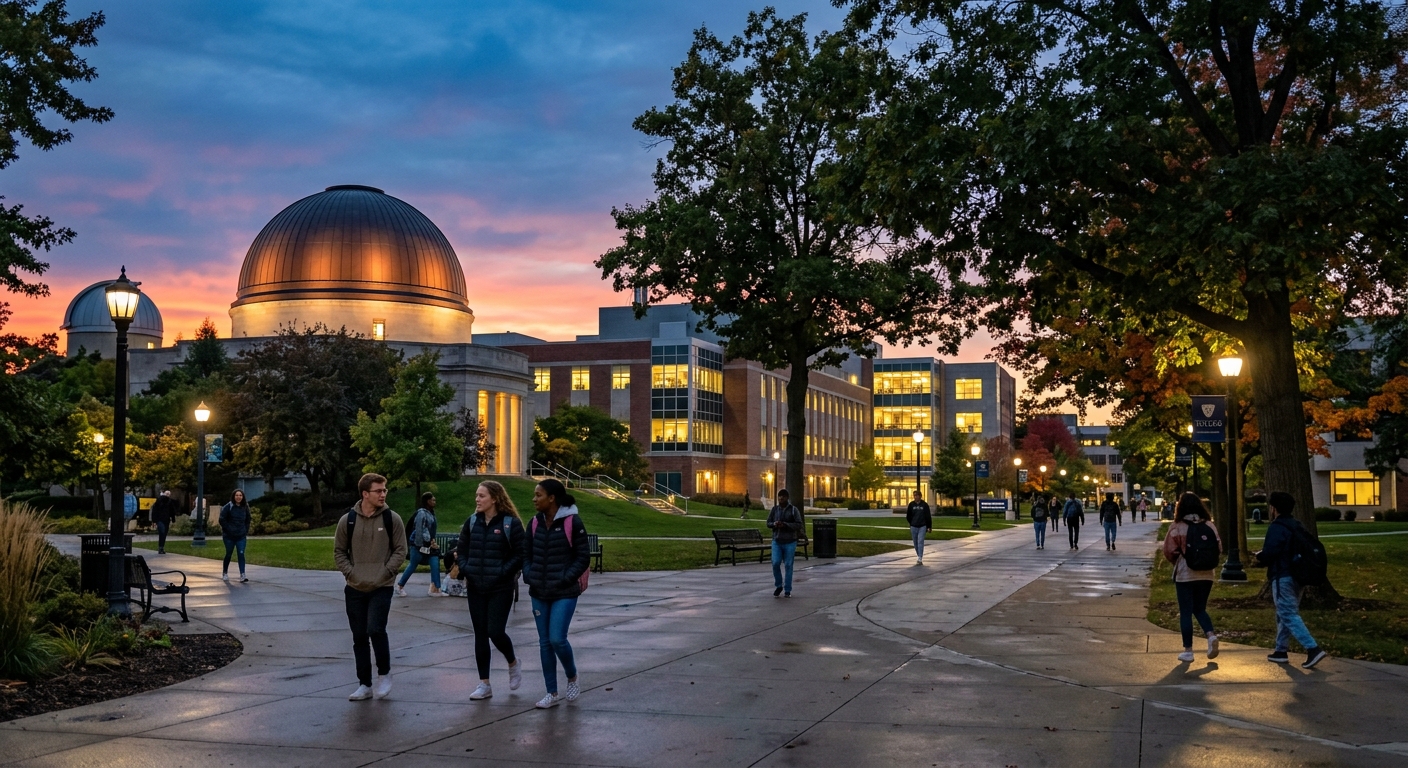
Bachelor of Arts in Astronomy
University of Toledo
Astronomy
Program Overview: Bachelor of Arts in Astronomy
The Bachelor of Arts in Astronomy at the University of Toledo provides a strong foundation in physics, astronomy, mathematics, and chemistry, preparing you for a wide range of careers in science and technology. Housed within the Department of Physics and Astronomy, the program is closely tied to leading-edge research with NASA and colleagues around the world, and undergraduates can collaborate on research starting in their freshman year.
The curriculum covers topics ranging from the origins of the Earth and other planets to the structure of galaxies and the fate of the universe. You will build skills in critical thinking, problem solving, modeling, and data analysis that are highly valued across many professional fields. The program also offers flexibility for students who wish to pursue interdisciplinary studies or prepare for careers in teaching and other professions.
The University of Toledo is a member of the Association of Universities for Research in Astronomy (AURA), and its astronomers and astrophysicists are involved in major NASA missions. The department boasts over USD 42 million in external research funding over a five-year period, giving students access to exceptional research infrastructure including the Ritter 1-meter telescope, Ritter Planetarium, and Brooks Observatory.
Key Program Highlights
- Undergraduate research opportunities beginning in freshman year, with access to the Ritter 1-meter telescope and Brooks Observatory
- Faculty actively engaged in NASA missions and federally funded astrophysics research
- Member of the Association of Universities for Research in Astronomy (AURA)
- Flexible curriculum combining astronomy, physics, and mathematics with interdisciplinary electives
Curriculum and Modules
The B.A. in Astronomy requires 120 credit hours, including 40 hours of astronomy and physics courses, 15 hours of mathematics, and at least 9 additional hours in natural sciences and mathematics chosen with your advisor's approval. Early coursework builds a foundation in mechanics, thermodynamics, and electromagnetism before advancing to observational and theoretical astronomy.
Basic Astronomy Sequence (ASTR 2010, 2020)
6 Credit HoursAn introductory sequence covering the solar system, stars, galaxies, and cosmology, providing the essential observational and conceptual framework for advanced astronomy study.
General Physics (PHYS 2130-2140 or PHYS 2070-2100)
10-12 Credit HoursA comprehensive physics sequence covering mechanics, thermodynamics, electromagnetism, waves, and optics, establishing the physical principles underlying astronomical phenomena.
Advanced Astronomy Courses (ASTR 3880, 4810, 4820, 4880)
13 Credit HoursAdvanced coursework in stellar astrophysics, galactic astronomy, cosmology, and observational techniques, preparing students for professional-level understanding of the universe.
Modern Physics and Quantum Mechanics (PHYS 3310)
3 Credit HoursAn introduction to modern physics topics including atomic physics, quantum mechanics, and their applications to technologies such as lasers, semiconductors, and solar cells.
Mathematics Sequence (Calculus and Differential Equations)
15 Credit HoursRequired mathematics courses including Calculus I and II, Multivariable Calculus, and Differential Equations, providing the mathematical tools essential for physics and astronomy.
Senior Research and Capstone (PHYS 4920, PHYS 4950)
VariableA culminating research experience where students work alongside faculty on original research projects, gaining hands-on experience with professional-grade instrumentation and data analysis.
Elective Opportunities
Admission Requirements
The University of Toledo welcomes applications from domestic and international students throughout the year. Admission to the B.A. in Astronomy program is based on academic achievement and English language proficiency. Contact Uni4Edu for personalized guidance on your application.
Academic Requirements
- High School DiplomaCompletion of secondary education equivalent to a U.S. high school diploma is required
- Minimum GPAA minimum GPA equivalent of 2.5 on a 4.0 scale is generally required for undergraduate admission
- Standardized TestsTest-optional admissions policy; SAT/ACT scores are not required but may be submitted
- Math PreparationStrong background in high school mathematics including algebra, geometry, and pre-calculus is recommended
- TranscriptsOfficial transcripts from all secondary schools and any post-secondary institutions attended must be provided
English Language Requirements
- TOEFL iBTMinimum score of 71
- IELTSMinimum overall band score of 6.0
- Duolingo English TestMinimum score of 105
Required Documents
Application Deadlines
For personalized admission guidance, document verification, and application support, please contact Uni4Edu
Scholarships and Funding
The University of Toledo offers a range of merit-based scholarships for international students, with more than 85% of international students receiving scholarships or special tuition rates. Contact Uni4Edu to explore funding options tailored to your profile.
International Merit Scholarship
Up to USD 7,500 per yearAvailable to eligible freshman and transfer international students with a GPA of 3.0 to 3.49 at the time of admission. Students with a GPA of 3.5 or higher may qualify for enhanced awards.
For detailed tuition fee information, please contact Uni4Edu — we will guide you through the costs and available funding options for this program.
Career Prospects
Graduates of the B.A. in Astronomy program develop versatile skills in critical thinking, data analysis, mathematical modeling, and problem solving that are valued across many industries. Many graduates pursue advanced degrees in astronomy, physics, or related fields, while others launch careers in technology, data science, education, and more.
Potential Career Paths
Potential Employers
Rankings and Recognition
The University of Toledo is a Carnegie R1 classified institution recognized for very high research activity. It is consistently ranked among the top national universities by U.S. News and World Report and is a member of the Association of Universities for Research in Astronomy (AURA), underscoring its strength in astronomical sciences.
| Subject | Ranking Body | Rank |
|---|---|---|
| Materials Science | U.S. News Best Global Universities | Top Quarter Globally |
| Physics and Astronomy Research Funding | UToledo Department Data | Highest at UToledo (USD 42M+ over 5 years) |
| Most-Cited Research (Materials Science) | U.S. News Best Global Universities | #1 Globally (% of Top 1% Cited Papers) |
| Carnegie Classification | Carnegie Classifications | R1: Very High Research Activity |
How to Apply
Applying for this program is easy with Uni4Edu. Our team will guide you through every step of the process — from document preparation to final enrolment.
Contact Uni4Edu
Reach out to our team via email or phone. We will assess your profile and confirm your eligibility for this program.
Prepare Your Documents
Our advisors will provide you with a personalised checklist of required documents and help you prepare your application package.
Submit Your Application
Uni4Edu will submit your application on your behalf and keep you updated on its progress throughout the review period.
Receive Your Offer
Once accepted, we will help you understand your offer, arrange visa support if needed, and guide you through the enrolment process.
Similar Programmes


Bachelor's Degree
48 months
Hydrology and Atmospheric Science (BS)

University Of Arizona, Tucson, United States
Earliest Intake
May 2027
Gross Tuition
39958 $

Bachelor's Degree
48 months
Astronomy (BS)
University Of Arizona, Tucson, United States
Earliest Intake
May 2027
Gross Tuition
39958 $


Bachelor's Degree
48 months
Earth Sciences B.A.
Syracuse University, Syracuse, United States
Earliest Intake
September 2026
Gross Tuition
66580 $

Bachelor's Degree
36 months
Applied Environmental Informatics and Earth Observation Bachelor of Science (B.Sc.)
Karlsruhe Institute of Technology (KIT), Karlsruhe, Germany
Earliest Intake
August 2026
Gross Tuition
3000 €

Bachelor's Degree
36 months
Biological Sciences BSc
Northumbria University, Newcastle upon Tyne, United Kingdom
Earliest Intake
January 2027
Gross Tuition
21500 £



Uni4Edu AI Assistant