Electrical Engineering
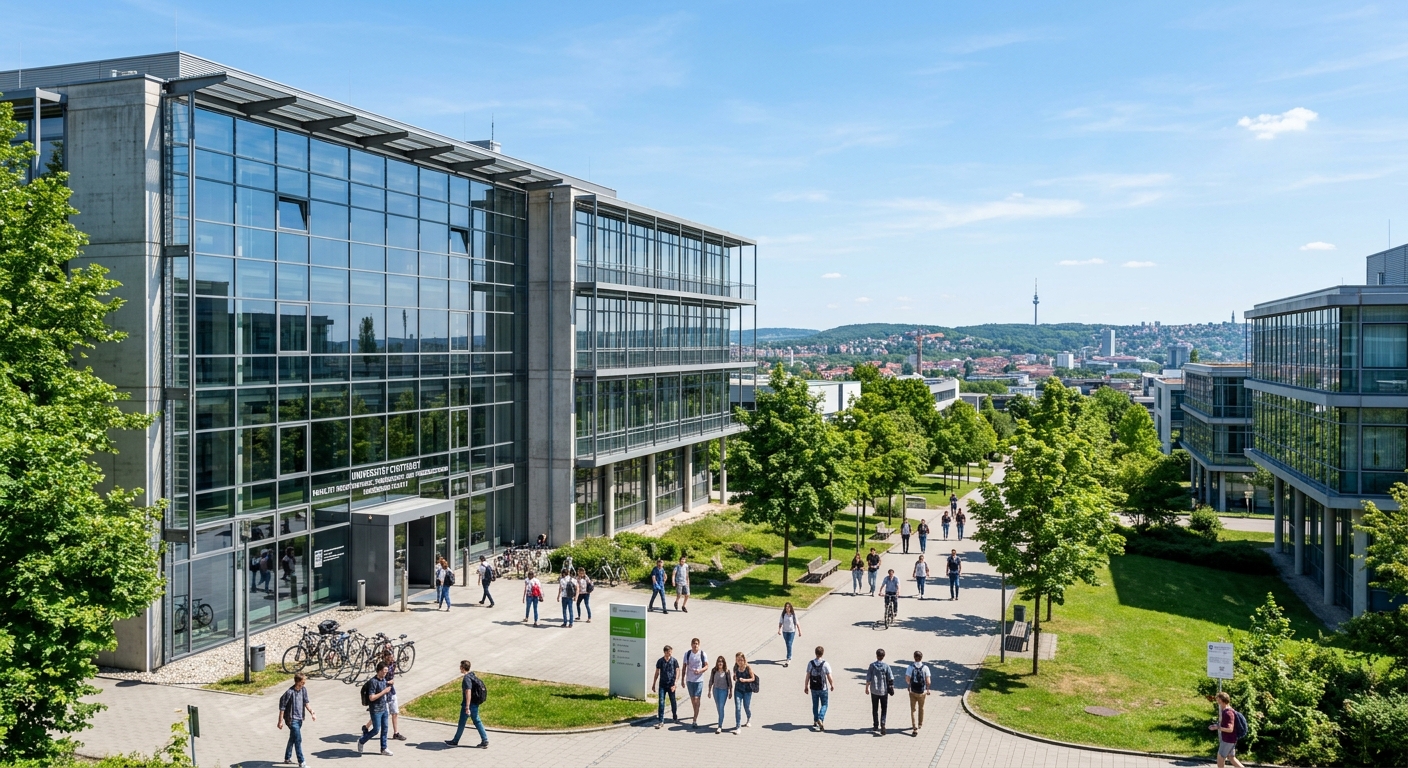
University of Stuttgart PO Box 10 60 37 70049 Stuttgart, Germany

Master of Science in Electrical Engineering
University of Stuttgart
Electrical Engineering
Program Overview: M.Sc. Electrical Engineering at University of Stuttgart
The Master of Science in Electrical Engineering at the University of Stuttgart is an English-language program offered by the Faculty of Computer Science, Electrical Engineering and Information Technology. Situated in one of Europe's most innovative industrial regions, the program provides a research-oriented education with strong ties to leading technology companies and research institutes in the Stuttgart area.
Students choose from seven areas of specialization, including Smart Information Processing, Communication Systems, Nano- and Optoelectronics, Electromagnetics and Applications, Power-electronic Systems and Technologies, Smart Systems, and Electrical Energy Systems. This flexibility allows you to tailor your studies to your career goals and research interests within the broad field of electrical engineering and information technology.
The first three semesters focus on coursework combining core specialization modules with elective courses, while the fourth semester is dedicated to the Master's thesis project. Additional practical training and research opportunities allow you to apply theoretical knowledge in real-world settings, preparing you for careers in industry or further academic pursuits.
Key Program Highlights
- Fully English-taught program with seven specializations covering cutting-edge fields from smart systems to nano-optoelectronics
- Located in Stuttgart, Germany's industrial hub and home to leading companies like Bosch, Daimler, and Porsche
- Member of TU9, the alliance of Germany's nine leading technical universities, ensuring top-tier engineering education
- Access to state-of-the-art laboratories, clean rooms, and the fully equipped StudLab with 3D printers and advanced measuring tools
Curriculum and Modules
The M.Sc. Electrical Engineering program comprises 120 ECTS credits spread across four semesters. Students complete a mix of core specialization courses and elective modules during the first three semesters, followed by a dedicated Master's thesis semester. This structure provides both depth in your chosen specialization and breadth across the electrical engineering discipline.
Advanced Signal Processing and Machine Learning
6 ECTSCovers advanced methods in digital signal processing, statistical learning theory, and their applications in intelligent information systems and pattern recognition.
Power Electronics and Drive Systems
6 ECTSExplores the design and control of power electronic converters and electric drive systems used in energy conversion, electric vehicles, and industrial automation.
Electromagnetic Field Theory and Applications
6 ECTSProvides an in-depth understanding of electromagnetic wave propagation, antenna design, and high-frequency engineering for communications and sensing applications.
Control Systems and Automation
6 ECTSFocuses on advanced control theory, robust and optimal control design, and their application to automated and autonomous systems in industrial environments.
Semiconductor Devices and Nanotechnology
6 ECTSExamines the physics and fabrication of semiconductor devices at the nanoscale, including optoelectronic components, photovoltaic cells, and integrated circuits.
Master's Thesis
30 ECTSAn independent research project conducted in the fourth semester, allowing you to investigate a specialized topic in collaboration with faculty members or industry partners.
Elective Modules
Admission Requirements
Admission to the M.Sc. Electrical Engineering program is based on a qualification assessment procedure (Eignungsfeststellungsverfahren) conducted by the admissions committee. Applicants are evaluated on competences demonstrated in their bachelor's program and their cumulative GPA. All applications and inquiries are handled through Uni4Edu.
Academic Requirements
- Bachelor's DegreeA bachelor's degree (minimum six semesters) in electrical engineering, information technology, or a closely related field from a recognized university
- Academic PerformanceStrong academic record assessed through a qualification procedure; there is no fixed minimum CGPA but higher grades improve admission chances
- Subject-Specific EligibilityDemonstrated competence in core electrical engineering subjects as evaluated by the admissions committee based on your transcript
- Conditional AdmissionStudents who have not yet completed their bachelor's degree may apply with at least 110 ECTS credits earned by the application deadline
- Selection InterviewThe admissions committee may conduct a selection interview or entrance examination as part of the assessment process
Language Requirements
- IELTSAccepted as proof of English language proficiency (contact Uni4Edu for minimum score details)
- TOEFLAccepted as proof of English language proficiency (contact Uni4Edu for minimum score details)
- Other CertificatesPTE Academic and other recognized English proficiency certificates may also be accepted
Required Documents
Application Deadlines
For personalized admission guidance, document verification, and application support, please contact Uni4Edu
Scholarships and Funding
While the University of Stuttgart does not directly offer full scholarships for degree programs, several prestigious national and institutional funding opportunities are available to international students. Strategic planning and early applications are key to securing financial support for your studies in Stuttgart.
Deutschlandstipendium
EUR 300 per month for one year (renewable)A merit-based scholarship awarded to students with above-average academic performance and additional achievements such as social engagement or relevant career experience. Half is funded by private sponsors and half by the German Federal Ministry of Education and Research.
DAAD STIBET Scholarships
Varies (up to 6 months of support)Funded by the German Academic Exchange Service (DAAD), these scholarships support qualified and highly committed international degree students at the University of Stuttgart. Priority is given to students with strong academic records and demonstrated potential for completing their studies.
DAAD Annual Scholarships for Study Abroad
Monthly stipend plus additional benefitsFully funded scholarships offered by the DAAD for international students pursuing Master's degrees in Germany. Benefits may include tuition fee subsidies, monthly living stipend, health insurance, and travel allowances depending on the specific program.
For detailed tuition fee information, please contact Uni4Edu — we will guide you through the costs and available funding options for this program.
Career Prospects
Graduates of the M.Sc. Electrical Engineering program benefit from Stuttgart's position as one of Europe's leading industrial and technology hubs. The university's strong industry connections facilitate a seamless transition from academic studies to professional careers in research, development, and technical management across diverse sectors.
Potential Career Roles
Top Employers in the Region
Rankings and Recognition
The University of Stuttgart is a member of TU9, the alliance of Germany's nine leading technical universities, and consistently ranks among the top engineering institutions worldwide. Its strong research output, industry partnerships, and graduate employability contribute to its excellent standing in international university rankings.
| Subject | Ranking Body | Rank |
|---|---|---|
| Engineering and Technology | QS World | #182 |
| Engineering (overall) | THE Subject | Top 125 |
| Electrical and Information Engineering | CHE Ranking | 11 of 16 criteria rated excellent |
| Engineering Sciences | ARWU (GRAS) | Top 200 |
How to Apply
Applying for this program is easy with Uni4Edu. Our team will guide you through every step of the process — from document preparation to final enrolment.
Contact Uni4Edu
Reach out to our team via email or phone. We will assess your profile and confirm your eligibility for this program.
Prepare Your Documents
Our advisors will provide you with a personalised checklist of required documents and help you prepare your application package.
Submit Your Application
Uni4Edu will submit your application on your behalf and keep you updated on its progress throughout the review period.
Receive Your Offer
Once accepted, we will help you understand your offer, arrange visa support if needed, and guide you through the enrolment process.
Similar Programmes


Master's & Postgraduate
12 months
Advanced Electronic and Electrical Engineering MSc

Queen Mary, University of London, London, United Kingdom
Earliest Intake
January 2026
Gross Tuition
31450 £


Bachelor's Degree
48 months
Civil Engineering
Texas State University, San Marcos, United States
Earliest Intake
May 2026
Gross Tuition
24520 $
Bachelor's Degree
48 months
Electrical and Electronics Engineering
Beykent University, Sarıyer, Turkey
Earliest Intake
January 2026
Gross Tuition
3500 $

Bachelor's Degree
36 months
Electrical and Electronic Engineering BEng
University of Sheffield, Sheffield, United Kingdom
Earliest Intake
January 2026
Gross Tuition
32100 £

Bachelor's Degree
48 months
Electronic Engineering and Internet of Things (including foundation year) - BEng (Hons)
London Metropolitan University, London, United Kingdom
Earliest Intake
April 2025
Gross Tuition
15500 £



Uni4Edu AI Assistant