University of Leipzig
Leipzig, Germany

University of Leipzig (Universität Leipzig)
Leipzig, Germany
Founded
1409
Institution Type
Public Research University
Total Students
31,000+
Faculties
14
Discover the University of Leipzig: Over 600 Years of Academic Excellence
Discover the University of Leipzig: Over 600 Years of Academic Excellence
Founded on 2 December 1409 by Frederick I, Elector of Saxony, and his brother William II, Margrave of Meissen, the University of Leipzig is one of the oldest universities in Europe and the second oldest in Germany. With more than 600 years of uninterrupted teaching and research, it has shaped generations of scholars, scientists, and world leaders.
Today, the University of Leipzig is a comprehensive public research university with 14 faculties, over 130 institutes and centres, and approximately 465 professorships. It offers 158 degree programmes spanning the humanities, social sciences, natural sciences, life sciences, and medicine, serving more than 31,000 students from around the world.
As a member of the prestigious German U15 network of leading research universities, Leipzig has particular strengths in biodiversity research, biomedicine, and mathematical sciences. The university is associated with ten Nobel laureates and boasts an alumni roster that includes Angela Merkel, Gottfried Wilhelm Leibniz, Johann Wolfgang von Goethe, Friedrich Nietzsche, and Richard Wagner.
Key Milestones
- 1409: University founded by Frederick I and William II after German scholars withdrew from the University of Prague, receiving a papal charter from Pope Alexander V.
- 1543: The University Library of Leipzig was established, becoming one of the oldest university libraries in Germany.
- 1879: Wilhelm Wundt founded the world's first formal laboratory for psychological research at the university, pioneering experimental psychology.
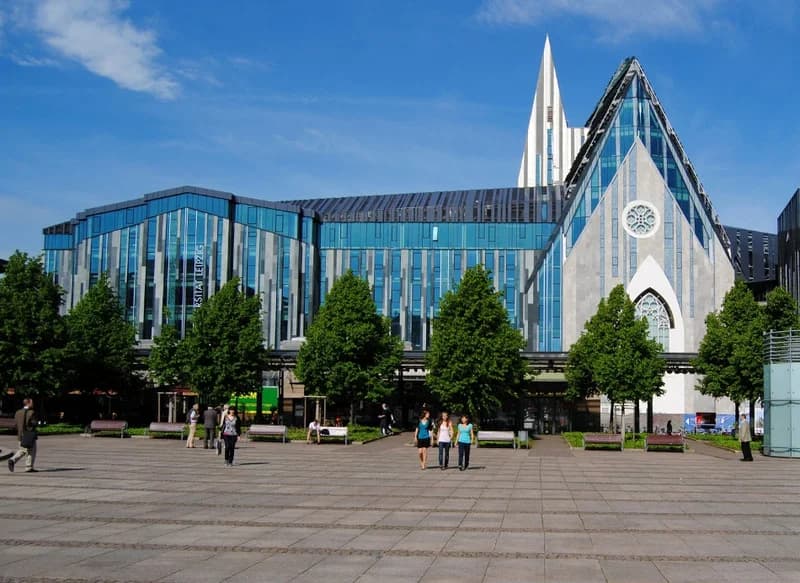
- 2017: Opening of the Paulinum — Assembly Hall and University Church of St Pauli, completing the modern redesign of the historic Augustusplatz campus.
Academic Structure and Faculties
Academic Structure and Faculties
The University of Leipzig is organized into 14 faculties covering nearly every academic discipline, from theology and law to medicine and natural sciences. With 158 degree programmes at the bachelor's, master's, and doctoral levels, the university provides a uniquely broad and interdisciplinary academic environment for students and researchers alike.
Faculty of Medicine
One of the university's most renowned faculties, the Faculty of Medicine combines clinical training at the University Hospital with cutting-edge biomedical research in areas such as metabolic diseases and regenerative medicine.
- Medicine (Staatsexamen)
- Dental Medicine
- Pharmacy
Faculty of Law
With a tradition dating back to the university's founding, the Faculty of Law offers comprehensive legal education including European and international law, and houses the Institute for International Law (InVEA).
- Law (Staatsexamen)
- European Legal Linguistics (M.A.)
- International Law (LL.M.)
Faculty of History, Art and Area Studies
This faculty brings together historians, art historians, and area studies specialists covering regions from Africa to East Asia, reflecting Leipzig's longstanding tradition of globally oriented research.
- History (B.A./M.A.)
- Art History
- African Studies
Faculty of Physics and Earth Sciences
Building on a legacy that includes Nobel laureates Werner Heisenberg and Gustav Hertz, this faculty conducts research in condensed matter physics, meteorology, and earth system science.
- Physics (B.Sc./M.Sc.)
- International Physics Studies Programme (M.Sc.)
- Meteorology
Faculty of Social Sciences and Philosophy
Home to the Global and European Studies Institute (GESI), this faculty offers interdisciplinary programmes in philosophy, political science, sociology, and the highly competitive Global Studies master's programme.
- Global Studies (M.A.)
- Political Science (B.A./M.A.)
- Communication and Media Studies
Faculty of Life Sciences
Closely linked to the German Centre for Integrative Biodiversity Research (iDiv), this faculty excels in biology, biochemistry, and biodiversity research, offering students access to one of Europe's leading ecology research networks.
- Biology (B.Sc./M.Sc.)
- Biochemistry (B.Sc./M.Sc.)
- Biodiversity, Ecology and Evolution (M.Sc.)
Admission Requirements for International Students
Admission Requirements for International Students
Undergraduate Admission
- Secondary EducationRecognized secondary school certificate equivalent to the German Abitur, or completion of a Studienkolleg preparatory year
- German LanguageDSH-2 or TestDaF 4x4 (C1 level) for German-taught programmes
- Application Portaluni-assist e.V. for international applicants
- Application FeeEUR 75 via uni-assist
- Additional TestsTestAS recommended for some restricted-admission programmes
Graduate Admission
- Bachelor's DegreeCompleted bachelor's degree in a relevant field from a recognized institution
- German LanguageDSH-2 or TestDaF 4x4 for German-taught programmes
- English LanguageTOEFL iBT 100 or IELTS equivalent for English-taught master's programmes
- Documents RequiredTranscripts, CV, letter of motivation, letters of recommendation (programme-specific)
- Application Portaluni-assist or direct university portal depending on programme
Application deadline for international students applying for the winter semester starting in October.
Application deadline for international students applying for the summer semester starting in April, where available.
Application deadline for EU and German applicants for the winter semester.
Some master's programmes and restricted-admission courses have earlier deadlines. Check the specific programme page for exact dates.
Tuition Fees and Cost of Studying at the University of Leipzig
Tuition Fees and Cost of Studying at the University of Leipzig
As a public university in the state of Saxony, the University of Leipzig does not charge general tuition fees for first-degree students, regardless of nationality. Students pay only a semester fee that covers administrative costs, the student services contribution, and a public transport ticket.
| Cost Category | EU/German Students | International Students |
|---|---|---|
| Tuition Fee (per semester) | EUR 0 | EUR 0 |
| Semester Fee (approx.) | EUR 280 | EUR 280 |
| Health Insurance (monthly) | EUR 100 - 120 | EUR 100 - 120 |
| Living Costs (monthly est.) | EUR 650 - 850 | EUR 650 - 850 |
| Total | Approx. EUR 560/year + living costs | Approx. EUR 560/year + living costs |
DAAD Scholarships
The German Academic Exchange Service (DAAD) offers a range of scholarships for international students at all academic levels, including full funding for master's and doctoral candidates at German universities.
- Coverage: Monthly stipend, travel allowance, health insurance
- Eligibility: International students with strong academic records
- Application: Via DAAD Scholarship Database (www.daad.de)
Deutschlandstipendium
A national scholarship programme co-funded by the federal government and private sponsors, awarding EUR 300 per month to high-achieving students regardless of nationality.
- Amount: EUR 300 per month (EUR 3,600 per year)
- Duration: Minimum two semesters, renewable
- Criteria: Academic excellence, social engagement, personal background
Campus and Facilities
Campus and Facilities
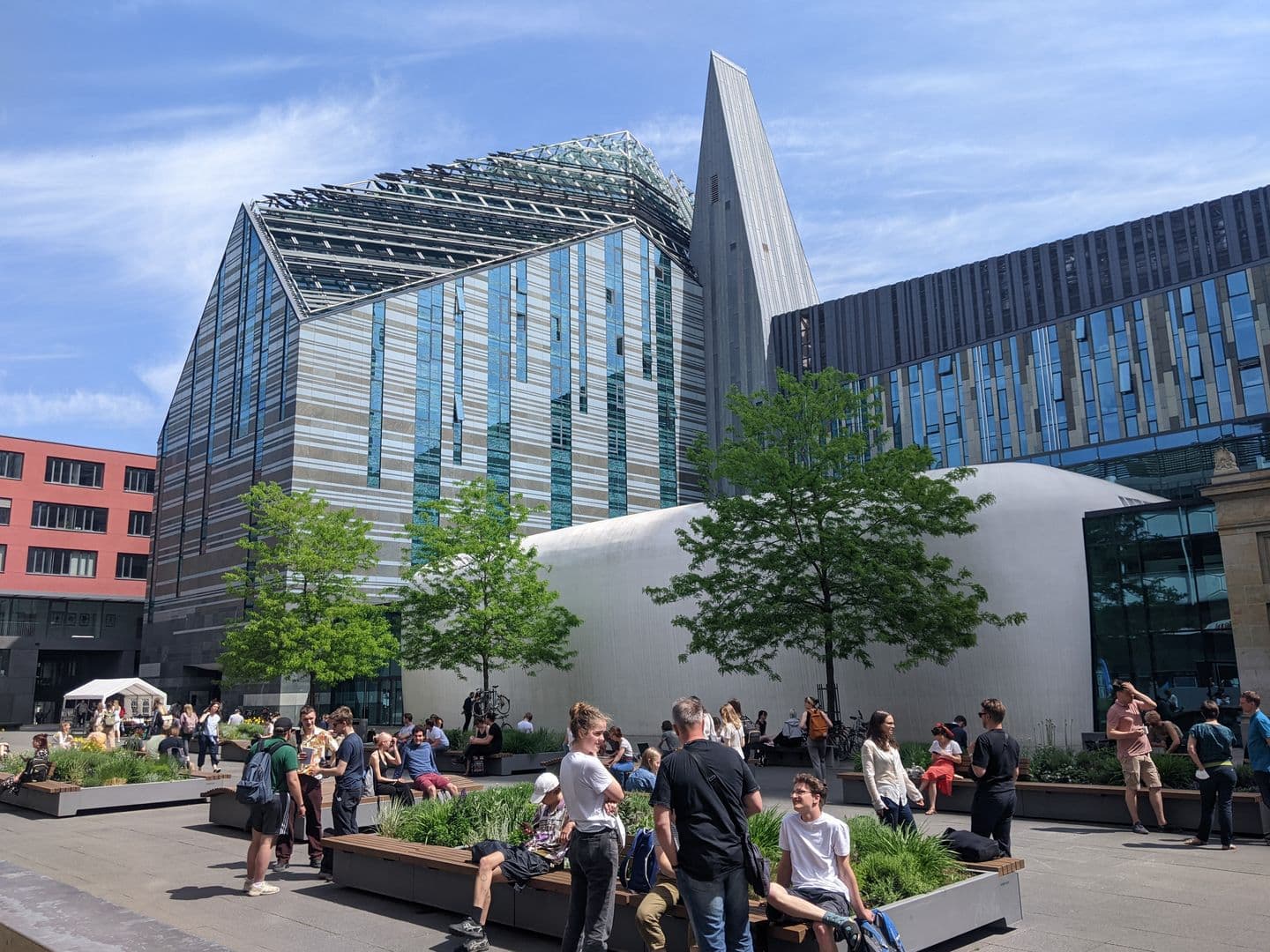
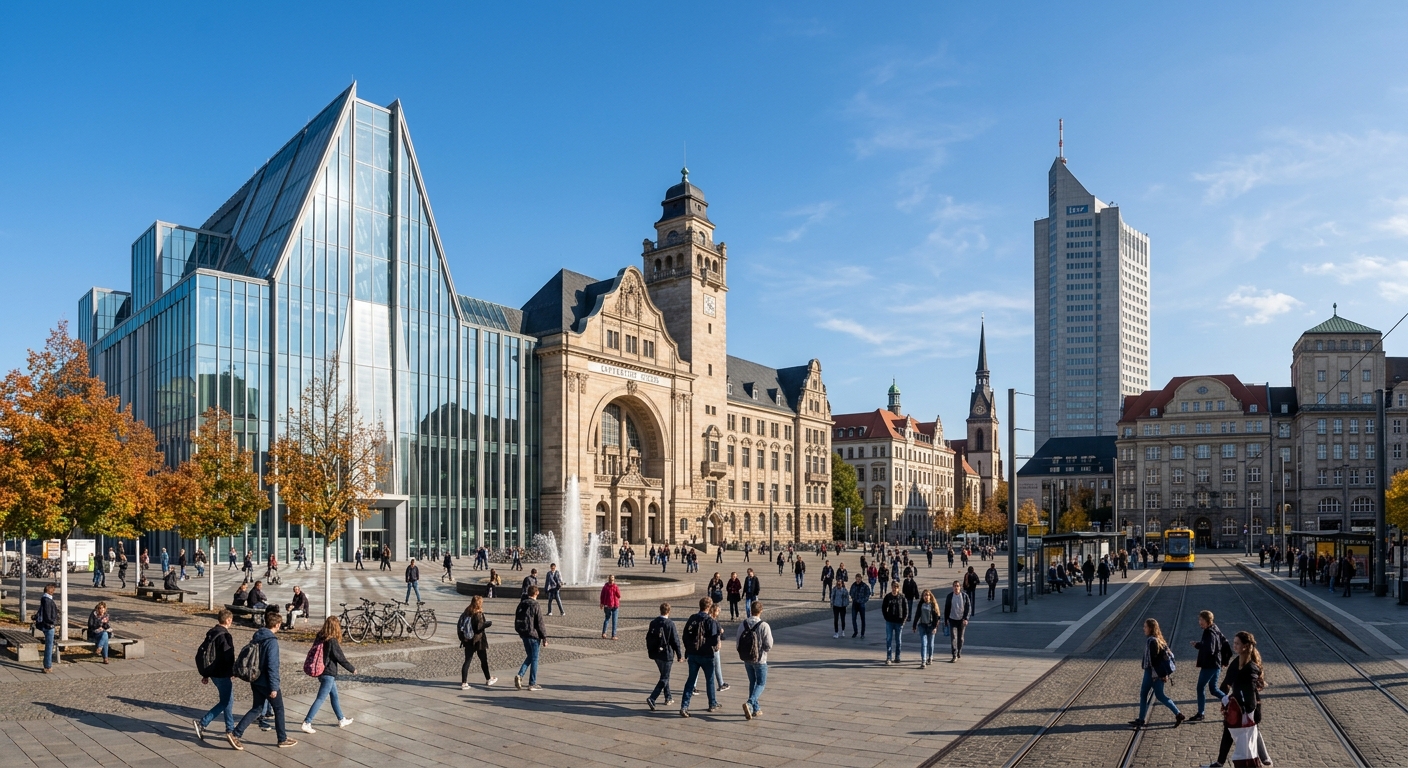
The University of Leipzig's urban campus spans 38 locations across the city, with its main buildings situated on the historic Augustusplatz in the heart of Leipzig. The modern Augusteum and the striking Paulinum — Assembly Hall and University Church of St Pauli — form the architectural centrepiece of the campus.
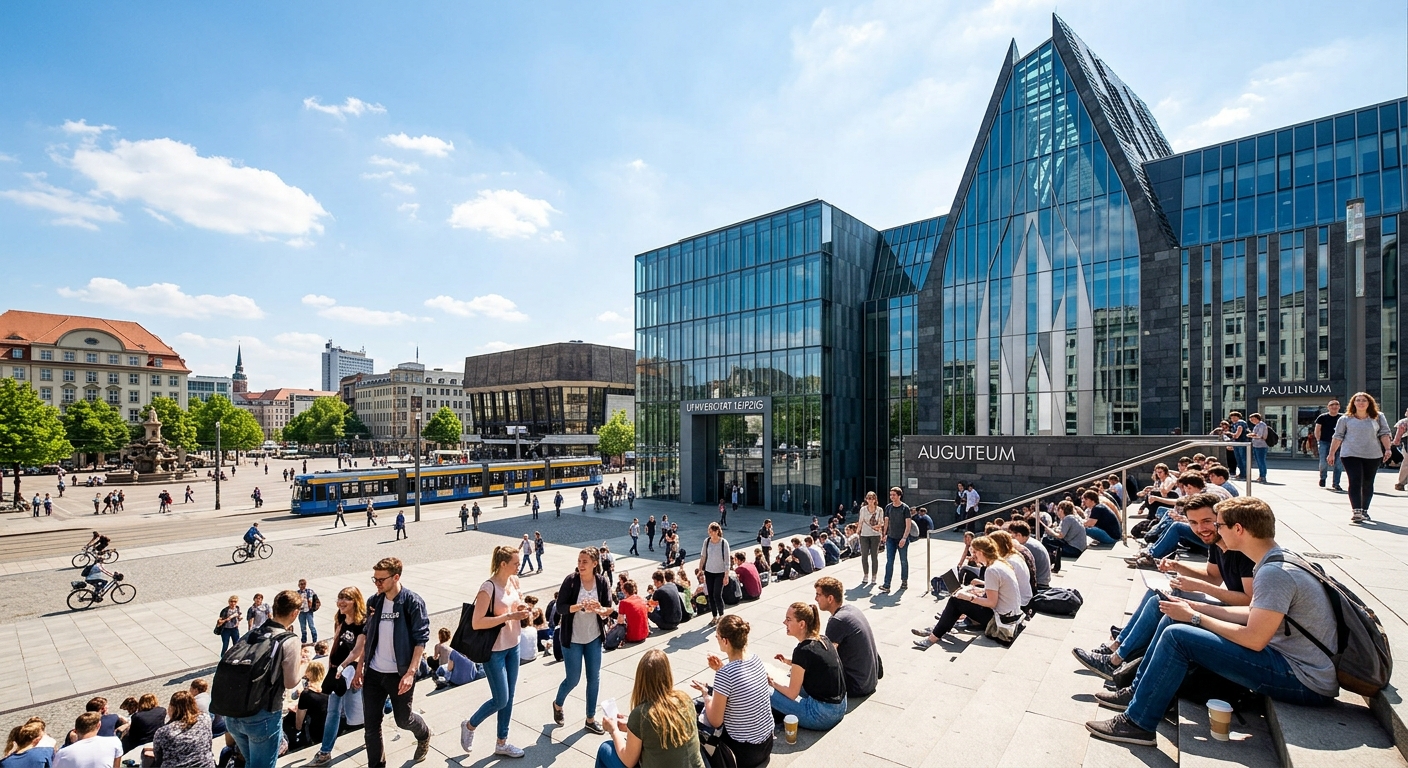
The modern main campus complex on Augustusplatz, featuring the Paulinum assembly hall with its distinctive glass facade and the Augusteum lecture hall building.
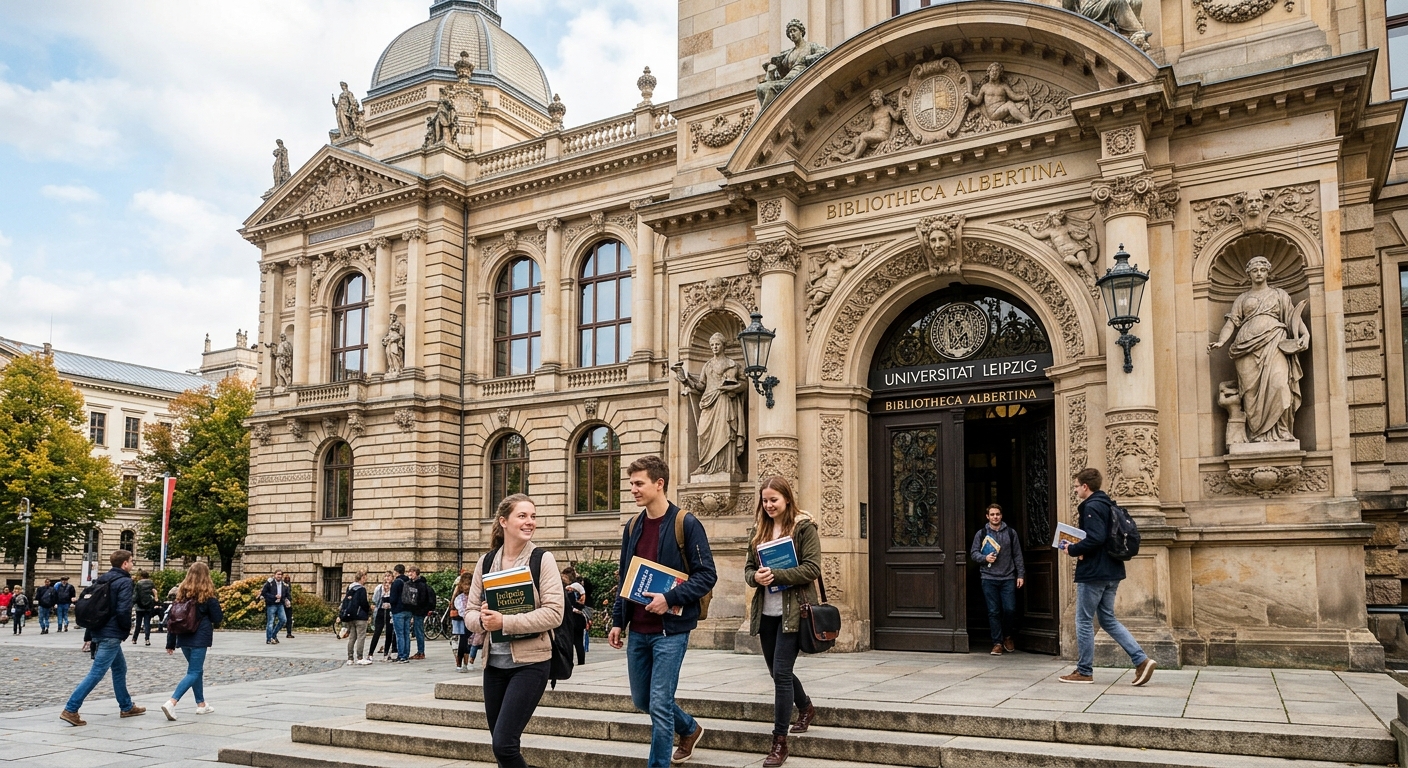
The main university library, established in 1543, houses over 5 million volumes and internationally recognized historical collections including medieval manuscripts and papyri.

Established in 1542, Leipzig's Botanical Garden is one of the oldest in Europe, serving as both a research facility and a peaceful retreat in the city centre.
Housing and Dining
Student Housing
Student housing is managed by Studentenwerk Leipzig, which operates multiple residence halls across the city offering affordable single apartments and shared flats.
- Shared flats from EUR 180 - 290 per month
- Single apartments from EUR 250 - 425 per month
- Apply via Studentenwerk Leipzig upon receiving admission
Dining Services
Studentenwerk Leipzig operates several Mensen (dining halls) and cafeterias across campus locations, offering affordable meals for students.
- Multiple Mensen across campus locations
- Subsidized meals starting from around EUR 2 - 4
- Vegetarian, vegan, and international menu options
Student Life at the University of Leipzig
Student Life at the University of Leipzig
Leipzig is known for its vibrant cultural scene, and student life at the university reflects this energy. With a diverse student body of over 31,000 and a wide array of clubs, cultural events, and recreational opportunities, there is something for everyone.
Leipzig: A Vibrant City for Students
Leipzig: A Vibrant City for Students
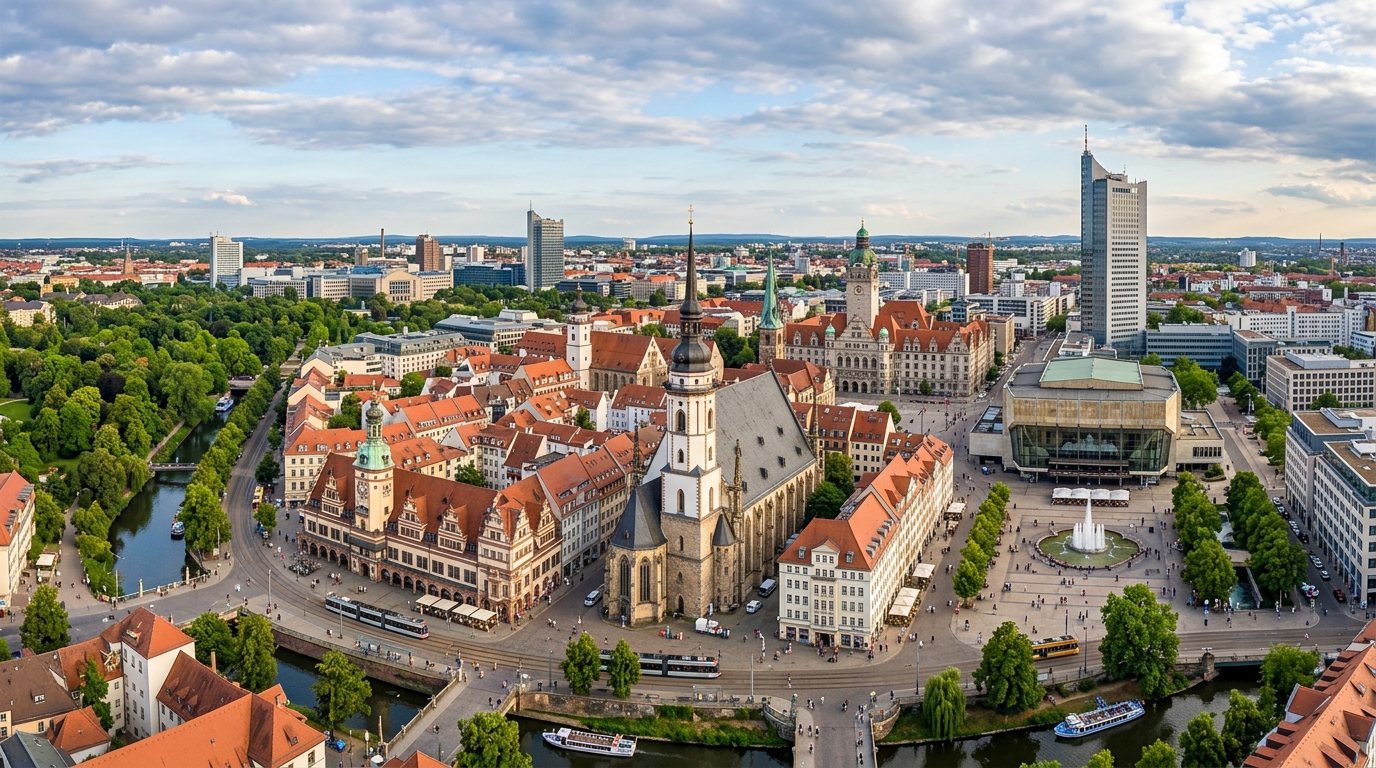
Life in Leipzig
Located in the northwest of the Free State of Saxony, Leipzig is a city of approximately 600,000 residents known for its rich cultural history, affordable cost of living, and dynamic creative scene. Often called a little Paris by Goethe, the city has become one of Germany's most popular destinations for young professionals and students.
Cultural Capital
Home to the Gewandhaus Orchestra, the St Thomas Boys Choir (Thomanerchor), and a thriving independent arts scene, Leipzig has deep roots in music, literature, and the visual arts.
Affordable Living
Leipzig offers some of the most affordable living costs among major German cities, with monthly expenses for students estimated at EUR 650 to 850 including rent, food, and transport.
Excellent Connectivity
Leipzig is a major transport hub with a modern central railway station, Leipzig/Halle Airport, and excellent road and rail connections to Berlin, Dresden, and other German cities.
Research and Innovation Hub
The city hosts prestigious research institutes including Max Planck Institutes, the Helmholtz Centre for Environmental Research, and a growing startup ecosystem.
Career Outcomes and Notable Alumni
Career Outcomes and Notable Alumni
Research Institutions and Employers in the Region
Practical Information for International Students
Practical Information for International Students
For International Students
The university's International Centre provides comprehensive support including visa guidance, orientation programmes, buddy systems, and advice on finding accommodation in Leipzig.
Intensive German language courses and semester-long programmes are available through the university's Language Centre (Sprachenzentrum) to help international students meet language requirements.
International graduates can apply for an 18-month job-seeking residence permit in Germany, allowing time to find employment related to their field of study.
Key Contacts
- +90 5435286292
- +44 7868736984
- [email protected]
- [email protected]
University of Leipzig: Worldwide Rankings
University of Leipzig: Worldwide Rankings
The University of Leipzig consistently ranks among the top universities in Germany and is featured in all major global university rankings. Its particular strengths in medicine, life sciences, and the humanities contribute to its strong international reputation.
| Subject | Ranking Body | Rank |
|---|---|---|
| Medicine | QS World University Rankings by Subject | #201 |
| Communication & Media Studies | QS World University Rankings by Subject | #101 |
| Psychology | EduRank | #22 in Germany |
| Life Sciences (Biology) | EduRank | #28 in Germany |


Features
With 158 degree programmes, our university offers a unique variety of subjects. It is the most popular institution of higher education in the Free State of Saxony. More than 31,000 students are currently enrolled, with over 7000 young people beginning their studies every year. At 60 per cent, the proportion of female students is above average. Approximately twelve per cent of our students are from abroad.\nIn terms of teaching, our university stands out as a centre in Saxony for subjects involving public services of general interest (law, medicine, teaching, pharmacy). More than a third of current students are enrolled in these subjects.\nOur university has been able to significantly improve its competitive position in research: in the German Research Foundation’s (DFG) 2018 Funding Atlas, we improved our ranking by ten positions to 28th place compared to 2012. External funding grew from 53 million euros in 2006 to 175 million euros in 2019.\n
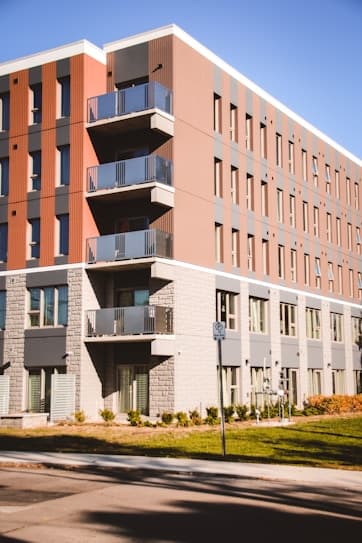
Accommodation
Accommodation service is available.\n

Work While Studying
Students can work while studying.\n

Co-op/Internship Participation
There is an internship service.\n
Featured Programmes



Location
Ritterstraße 26 04109 Leipzig Germany

Map not found.

Uni4Edu AI Assistant