Molecular Medicine (M.Sc.)
North Campus, Germany

Master of Science in Molecular Medicine
University of Göttingen
Molecular Medicine
Program Overview: M.Sc. Molecular Medicine at the University of Göttingen
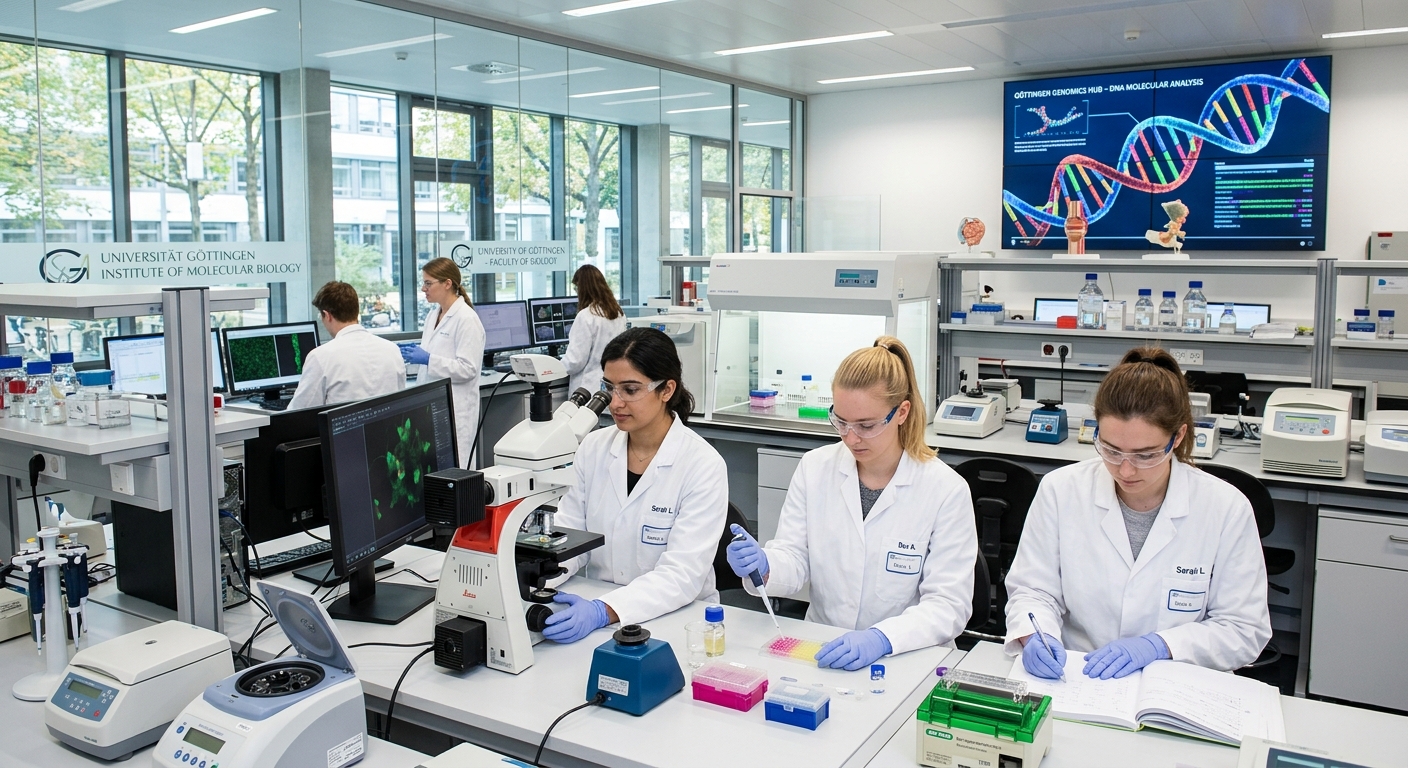
The Master of Science in Molecular Medicine at the University of Göttingen is an international, research-oriented program that deepens your understanding of molecular mechanisms underlying human disease. Taught entirely in English over three semesters, the program covers core clinical-theoretical subjects including immunology, oncology, genetics, pharmacology, and cell biology.
A defining feature of this program is its strong emphasis on hands-on laboratory training. You will complete three intensive laboratory internships, each lasting eight weeks, giving you direct experience with cutting-edge molecular medicine techniques in modern research facilities. The program culminates in a six-month Master's thesis that prepares you for independent scientific research.
Located in the historic university city of Göttingen, which is associated with over 40 Nobel Prize winners, you will benefit from close partnerships with leading research institutions including the Max Planck Institutes and the University Medical Center Göttingen. Graduates are well-prepared for careers in medical research, laboratory diagnostics, medical biotechnology, or for continuing to doctoral studies.
Key Program Highlights
- Three eight-week laboratory rotations providing intensive hands-on research training in state-of-the-art facilities
- Fully English-taught program attracting motivated students from around the world
- Access to research collaborations with Max Planck Institutes and the University Medical Center Göttingen
- Strong track record of graduates securing positions in academic research, clinical diagnostics, and the biomedical industry
Curriculum and Modules
The M.Sc. Molecular Medicine program comprises 120 ECTS credits spread across three semesters. The curriculum includes 76 ECTS in mandatory modules and 14 ECTS in elective modules, with the remaining credits allocated to the Master's thesis. The structure balances advanced theoretical knowledge with extensive practical laboratory experience.
M.MM.101 Biomolecules and Pathogens
24 ECTSThis foundational module covers the molecular biology of biomolecules and infectious pathogens. Students gain both theoretical knowledge and practical laboratory skills through an eight-week lab rotation focused on molecular immunology and bacteriology.
M.MM.102 From Cells to Disease Mechanisms
24 ECTSStudents explore molecular processes within cells and their connections to pathological changes. Topics include genetic and metabolic diseases, inflammatory processes, and cancer biology, complemented by an eight-week laboratory internship in cell biology, pathology, and oncology.
M.MM.104 Current Topics in Molecular Medicine
4 ECTSA seminar-based module in which students present and critically discuss primary scientific literature and review articles. Participants develop skills in scientific communication, critical evaluation of research methods, and constructive academic discourse.
M.MM.105 The Disease-Affected Heart and Kidney
7 ECTSThis module addresses molecular aspects of cardiovascular and renal diseases, including molecular cardiology, heart failure mechanisms, arrhythmia, and pharmacotherapeutic strategies. Students also explore potential future therapies such as gene therapy and stem-cell-based approaches.
M.MM.106 The Disease-Affected Brain
5 ECTSFocusing on neuropathology, this module covers neurodegenerative disorders such as Alzheimer's, Parkinson's, and Huntington's diseases. Students also study neuromuscular diseases, cerebrovascular conditions, neurological autoimmune diseases, and current therapeutic strategies.
M.MM.107 Lab Rotation Brain and Heart
12 ECTSAn advanced practical module where students conduct supervised research in laboratories specializing in molecular neurology or cardiology. This eight-week rotation provides one-to-one mentorship and deepens experimental research competencies.
Elective Modules
Admission Requirements
The M.Sc. Molecular Medicine program at the University of Göttingen is designed for highly motivated graduates with a strong scientific background. Admission is competitive, and applicants are evaluated based on their academic qualifications, subject relevance, and motivation for research. Contact Uni4Edu for guidance on preparing a strong application.
Academic Requirements
- Undergraduate DegreeBachelor's degree (or equivalent) in Molecular Medicine, Biology, Biochemistry, or a closely related field (not Medicine) with at least 180 ECTS credits
- Subject RelevanceAt least 90 ECTS in life sciences or at least 120 ECTS in natural sciences within the undergraduate degree
- Provisional AdmissionApplicants who have not yet completed their Bachelor's may apply with at least 150 ECTS earned in a relevant program
- Motivation LetterWritten statement (max. 1,000 words) describing your motivation for the program and your research interests
- Academic PerformanceStrong academic record in relevant subjects; selection is based on a competitive evaluation process
Language Requirements
- TOEFL iBTMinimum score of 100 (or 95 with a minimum speaking score of 25)
- Cambridge CertificateCambridge Advanced English (CAE) or Cambridge Proficiency (CPE) accepted
- Alternative ProofEnglish-medium Bachelor's degree or at least two years of study/work in an English-speaking country within the last three years
Required Documents
Application Deadlines
For personalized admission guidance, document verification, and application support, please contact Uni4Edu
Scholarships and Funding
While German public universities generally do not charge tuition fees, international students still need funding for living expenses and semester contributions. Several scholarship opportunities are available to support your studies in the M.Sc. Molecular Medicine program at Göttingen. Contact Uni4Edu for personalized guidance on funding options.
DAAD Study Scholarships for Master's Students
EUR 992/month plus travel allowance and insuranceThe German Academic Exchange Service (DAAD) offers merit-based scholarships for international Master's students across all disciplines. The scholarship covers a monthly stipend, health and liability insurance, and a travel allowance. Contact Uni4Edu for application support and current deadlines.
Deutschlandstipendium (Germany Scholarship)
EUR 300/monthA national scholarship program that supports talented students regardless of nationality, funded jointly by the German government and private sponsors. Selection is based on academic excellence, social engagement, and personal achievements.
Heinrich Böll Foundation Scholarship
Varies based on financial needThis foundation offers scholarships to international students pursuing graduate degrees in Germany who demonstrate strong academic performance and social or political engagement. The scholarship includes a monthly stipend and may cover additional study-related costs.
For detailed tuition fee information, please contact Uni4Edu — we will guide you through the costs and available funding options for this program.
Career Prospects
Graduates of the M.Sc. Molecular Medicine program at the University of Göttingen are well-positioned for diverse career paths in biomedical research, clinical diagnostics, and the pharmaceutical industry. The program's intensive laboratory training and research-oriented curriculum ensure that you are equipped with both theoretical knowledge and practical skills valued by employers worldwide.
Potential Career Roles
Typical Employers and Sectors
Rankings and Recognition
The University of Göttingen, founded in 1737, is one of Germany's most prestigious and research-intensive universities. It consistently ranks among the top universities globally and is particularly strong in life sciences and natural sciences, making it an excellent choice for Molecular Medicine studies.
| Subject | Ranking Body | Rank |
|---|---|---|
| Life Sciences | THE Subject Rankings | #60 |
| Life Sciences and Medicine | QS Subject Rankings | Top 200 |
| Molecular Biology and Genetics | US News Subject Rankings | Top 200 |
| Physical Sciences | THE Subject Rankings | #77 |
How to Apply
Applying for this program is easy with Uni4Edu. Our team will guide you through every step of the process — from document preparation to final enrolment.
Contact Uni4Edu
Reach out to our team via email or phone. We will assess your profile and confirm your eligibility for this program.
Prepare Your Documents
Our advisors will provide you with a personalised checklist of required documents and help you prepare your application package.
Submit Your Application
Uni4Edu will submit your application on your behalf and keep you updated on its progress throughout the review period.
Receive Your Offer
Once accepted, we will help you understand your offer, arrange visa support if needed, and guide you through the enrolment process.
Similar Programmes

Bachelor's Degree
36 months
Molecular Genetics BSc (Hons)

University of Dundee, Dundee City, United Kingdom
Earliest Intake
July 2026
Gross Tuition
27400 £

Bachelor's Degree
36 months
Cellular and Molecular Medicine BSc
University of Bristol, Bristol, United Kingdom
Earliest Intake
January 2026
Gross Tuition
33400 £
Master's & Postgraduate
24 months
Molecular Medicine
University of Toledo, Toledo, United States
Earliest Intake
June 2026
Gross Tuition
25327 $

Bachelor's Degree
36 months
Molecular Medicine (BSc)
University of Göttingen, Göttingen, Germany
Earliest Intake
June 2026
Gross Tuition
808 €
Bachelor's Degree
48 months
Molecular Genetics (with a year in industry) BSc (Hons) School of Life Sciences
University of Dundee, Dundee City, United Kingdom
Earliest Intake
July 2026
Gross Tuition
27400 £



Uni4Edu AI Assistant