
Physics (MS)
San Marcos, Texas, USA, United States

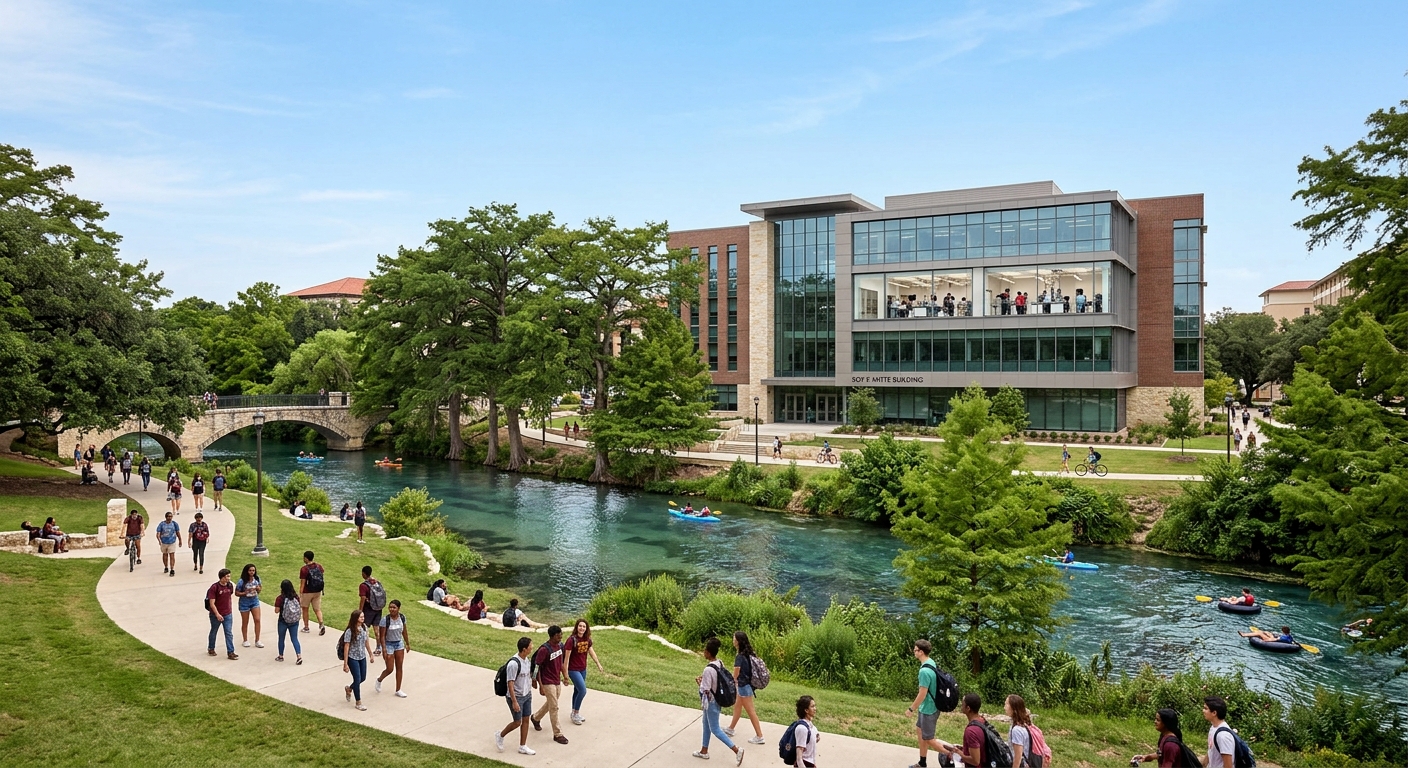
Master of Science in Physics
Texas State University
Physics
Program Overview: Master of Science in Physics
The Master of Science in Physics at Texas State University offers a rigorous graduate education with a strong emphasis on research in experimental condensed matter physics, physics education, and astronomy. Students can choose between a 30-credit-hour thesis track or a 36-credit-hour non-thesis track, both of which include core courses and electives in advanced physics with cutting-edge, hands-on training.
The thesis option includes a Materials Physics concentration, providing an exceptional opportunity for research in nanotechnology and applied physics using state-of-the-art nanofabrication and characterization facilities. The department provides a meaningful educational experience facilitated by dedicated faculty who work closely with students, and most graduate students are supported as instructional or research assistants.
Graduates are in high demand across the local and national high-tech and semiconductor industries, in K-14 physics education, and in advanced degree programs. Master's degree graduates also have the option to continue into the innovative, multidisciplinary Ph.D. program in Materials Science, Engineering, and Commercialization (MSEC) at Texas State University.
Key Program Highlights
- Thesis and non-thesis options with a specialized Materials Physics concentration available for thesis students
- State-of-the-art research facilities for thin film growth, nanofabrication, and materials characterization
- Active faculty research in condensed matter physics, nanotechnology, semiconductor devices, solar cells, and physics education
- Direct pathway to the Ph.D. in Materials Science, Engineering, and Commercialization (MSEC) at Texas State
Curriculum & Modules
The Physics M.S. curriculum combines core physics subjects with hands-on experimental training and elective specialization. The thesis option requires 30 credit hours including a thesis, while the non-thesis option requires 36 credit hours with a comprehensive written examination.
Mathematical Methods of Physics
3 Credit HoursA graduate-level survey of mathematical methods focusing on complex analysis of analytic functions, Laurent expansions, evaluation of residues, and methods of solving ordinary and partial differential equations with applications to mechanics and electromagnetic theory.
Statistical Physics
3 Credit HoursAn introduction to the laws of statistical physics and their application to realistic problems at the graduate level, covering equilibrium thermodynamics, Boltzmann and Gibbs distribution, Fermi-Dirac and Bose-Einstein statistics, and heat capacity of solids.
Experimental Research Methods
3 Credit HoursA laboratory-based course introducing experimental methods used in physics research with emphasis on quantum effects through materials synthesis and characterization methods. Students are exposed to different research topics through laboratory rotations.
Semiconductor Device Micro and Nano Fabrication
3 Credit HoursAn in-depth overview of the physics and technology of semiconductor device micro and nano fabrication, covering thin film deposition, wet and dry etching, lithography processing, and topics relevant to semiconductor research and devices.
Thin Film Synthesis and Characterization Laboratory
3 Credit HoursAn advanced experimental course designed as a research group project experience with emphasis on nanoscale device fabrication, conducted in university facilities with state-of-the-art thin film growth, processing, and characterization equipment.
Seminar in Physics
1 Credit HourA course designed to acquaint graduate students with current research areas in physics. May be repeated twice for a total of three semester hours of credit.
Elective Courses
Admission Requirements
Admission to the Physics M.S. program at Texas State University requires a strong undergraduate foundation in physics. Applicants who do not meet all requirements may be considered for conditional admission with competitive GRE scores. Contact Uni4Edu for personalized guidance on your application.
Academic Requirements
- Degree RequirementBaccalaureate degree from a regionally accredited university (non-U.S. degrees must be equivalent to a four-year U.S. bachelor's degree)
- Overall GPAMinimum 2.75 overall GPA or 2.75 GPA in the last 60 hours of undergraduate coursework
- Physics GPAMinimum 3.0 GPA in junior and senior-level physics courses including modern physics, mathematical physics, classical mechanics, electromagnetic field theory, and quantum mechanics
- GRE ScoresNot required unless physics GPA is below 3.0; competitive scores in verbal and quantitative reasoning needed for conditional admission
- Leveling CoursesMay be required if the student lacks sufficient background coursework; must be completed with grades of B or better prior to admission
English Language Requirements
- TOEFL iBTMinimum overall score of 78
- IELTS (Academic)Minimum overall score of 6.5 with no individual module below 6.0
- ExemptionApplicants with a bachelor's degree or higher from a regionally accredited U.S. institution or from an exempt country are not required to submit English proficiency scores
Required Documents
For personalized admission guidance, document verification, and application support, please contact Uni4Edu
Scholarships & Funding
Texas State University offers a range of funding opportunities for graduate physics students, including assistantships, scholarships, and fellowships. Most graduate students in the Physics Department are supported as instructional or research assistants. Contact Uni4Edu for help identifying and applying for funding opportunities.
Graduate College Scholarship
USD 1,000 per semester (up to 3 semesters)A competitive scholarship for continuing graduate students with a minimum 3.5 GPA in completed graduate coursework. The scholarship encourages students with intellectual, creative, and leadership promise to complete their degree at Texas State.
Texas State Merit Fellowship
Partial tuition coverage for the first academic yearMerit-based fellowships intended to recruit high-quality master's or doctoral students. Admitted students in eligible programs are automatically considered with no separate application required. Can be combined with assistantships.
For detailed tuition fee information, please contact Uni4Edu — we will guide you through the costs and available funding options for this program.
Career Prospects
Graduates of the Physics M.S. program at Texas State University are well-prepared for careers in the high-tech and semiconductor industries, physics education, and further academic study. The program's strong emphasis on hands-on materials physics and nanotechnology training gives graduates a competitive edge in the rapidly growing Texas tech corridor.
Potential Career Paths
Industries and Employers Hiring Graduates
Rankings & Recognition
Texas State University has been steadily climbing in national rankings and is recognized for its commitment to student success, social mobility, and expanding research enterprise. The university is pursuing Research-1 Carnegie classification and has been named among America's Top Colleges by Forbes for 2026.
| Subject | Ranking Body | Rank |
|---|---|---|
| Social Mobility | U.S. News & World Report | #144 |
| Engineering Programs (Undergraduate) | U.S. News & World Report | 194-211 Range |
| Engineering | THE World University Rankings | Top 801 |
| Physics (Program Strength) | Departmental | Contact Uni4Edu for current data |
How to Apply
Applying for this program is easy with Uni4Edu. Our team will guide you through every step of the process — from document preparation to final enrolment.
Contact Uni4Edu
Reach out to our team via email or phone. We will assess your profile and confirm your eligibility for this program.
Prepare Your Documents
Our advisors will provide you with a personalised checklist of required documents and help you prepare your application package.
Submit Your Application
Uni4Edu will submit your application on your behalf and keep you updated on its progress throughout the review period.
Receive Your Offer
Once accepted, we will help you understand your offer, arrange visa support if needed, and guide you through the enrolment process.
Similar Programmes

Bachelor's Degree
48 months
Physics (BA,BS)

University of Toledo, Toledo, United States
Earliest Intake
June 2027
Gross Tuition
37119 $


Master's & Postgraduate
12 months
PGCE Secondary Science with Physics - PGCE
London Metropolitan University, London, United Kingdom
Earliest Intake
April 2026
Gross Tuition
15500 £

Bachelor's Degree
48 months
Physics with Astrophysics BSc (Hons)
University of York, York, United Kingdom
Earliest Intake
January 2027
Gross Tuition
32350 £

Bachelor's Degree
36 months
Astrophysics BSc
UCL University College London, , United Kingdom
Earliest Intake
January 2027
Gross Tuition
42700 £


Bachelor's Degree
36 months
Physics - BSc (Hons)
University of Kent, Canterbury, United Kingdom
Earliest Intake
January 2026
Gross Tuition
23500 £



Uni4Edu AI Assistant