
Physics with Astrophysics BSc (Hons)
Campus West, United Kingdom

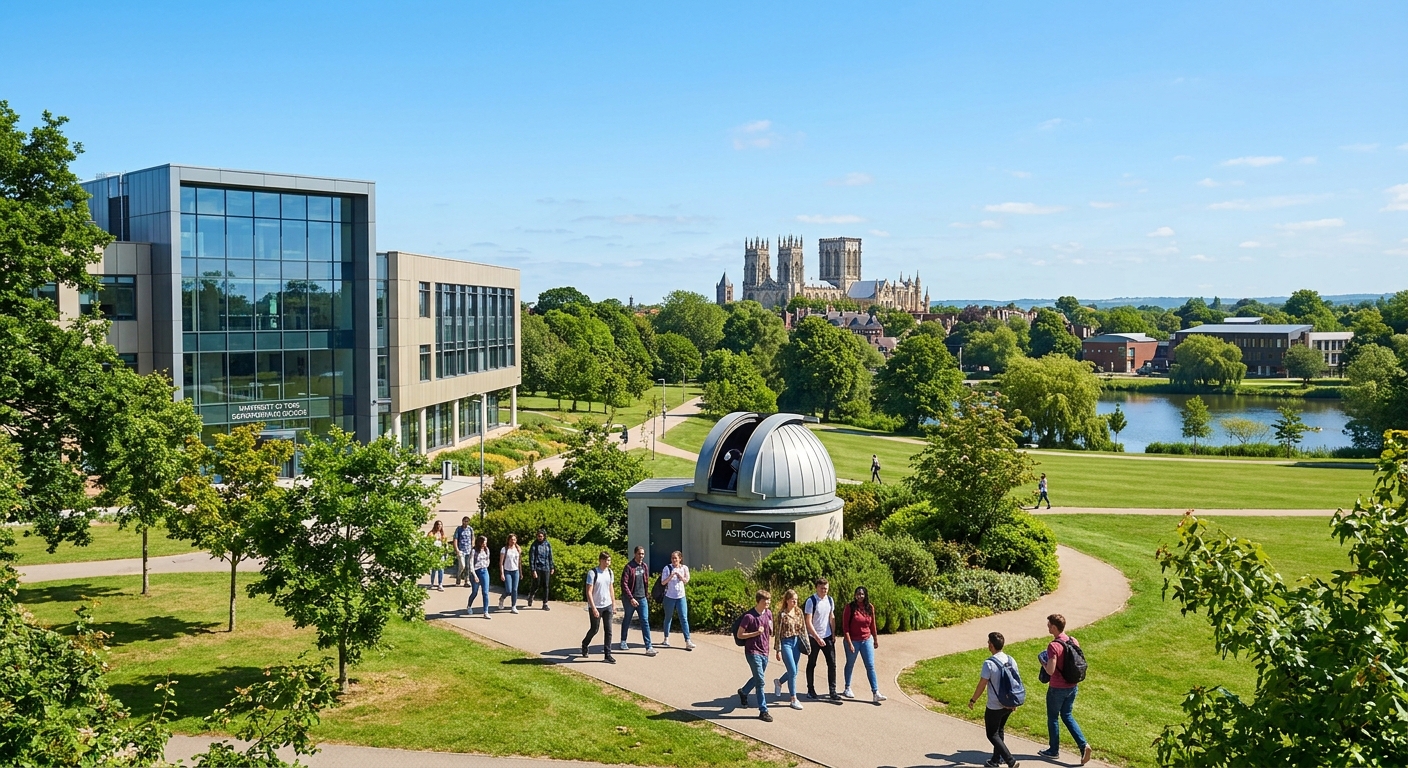
Physics with Astrophysics BSc (Hons)
University of York
Physics & Astrophysics
Program Overview: Physics with Astrophysics BSc (Hons)
The Physics with Astrophysics BSc (Hons) at the University of York provides a thorough grounding in fundamental physics and mathematics, alongside specialist modules exploring the cosmos. You will study the great challenges of cosmology, from the nuclear reactions powering stars to the mysteries of dark matter and dark energy, all linked to the department's active research.
The programme combines core physics disciplines such as optics, electromagnetism, quantum physics, and classical mechanics with dedicated astrophysics content covering stars, galaxies, and the large-scale structure of the universe. You will develop practical skills through laboratory work, data analysis, and computational techniques using modern equipment and specialist software.
In your final year, you will form a team to design and carry out an original research project under the guidance of an academic supervisor, investigating areas such as radio astronomy, infrared spectroscopy, or variable stars. On graduation, you will be equipped to communicate complex scientific concepts and solve astronomical problems, with a pathway towards becoming a Chartered Physicist.
Key Program Highlights
- Accredited by the Institute of Physics (IOP), putting graduates on track to become Chartered Physicists
- Access to the University's Astrocampus for optical, solar, and radio observations, plus dedicated atomic and nuclear laboratories
- Final-year original research project supervised by active researchers in astrophysics and related fields
- Taught within a Russell Group university rated Gold for teaching excellence (TEF) and top 10 in the UK for research quality (REF 2021)
Curriculum & Modules
The curriculum is structured across three years, beginning with core foundational material and progressing to advanced topics and independent research. Year 1 consolidates your existing knowledge, Year 2 deepens understanding of core and astrophysics-specific topics, and Year 3 offers advanced option modules alongside a substantial group research project.
Covers Newtonian mechanics, Lagrangian and Hamiltonian formulations, and introduces the principles and mathematical framework of quantum mechanics including wave functions and operators.
Explores Maxwell's equations, electromagnetic wave propagation, optical phenomena, and their applications in both terrestrial and astronomical contexts.
Develops essential mathematical tools including calculus, linear algebra, differential equations, and statistical methods required for advanced physics and astrophysics study.
Introduces stellar structure and evolution, galactic dynamics, and cosmological models including the Big Bang theory, dark matter, and dark energy concepts.
Provides hands-on experience with experimental techniques, data acquisition and analysis, error estimation, and scientific report writing to industry standards.
Elective and Option Modules
Admission Requirements
The Physics with Astrophysics BSc (Hons) programme seeks students with strong foundations in physics and mathematics. All applications are processed through Uni4Edu, which provides personalised guidance throughout the admissions process.
Academic Requirements
- A-Levels (Typical Offer)AAB including grade A in both Physics and Mathematics, with a pass in all practical components where offered
- International BaccalaureateContact Uni4Edu for current IB requirements
- Access to HE DiplomaPass with 36 credits at Distinction including Physics and Mathematics units, and 9 credits at Merit or higher
- Foundation Year OptionApplicants without suitable qualifications in Maths or Physics may apply for the Physics with a Foundation Year pathway
- Other QualificationsScottish Highers, Irish Leaving Certificates, and equivalent international qualifications are considered individually. Contact Uni4Edu for guidance.
English Language Requirements
- IELTSContact Uni4Edu for current IELTS score requirements
- TOEFLContact Uni4Edu for current TOEFL score requirements
- Other TestsPTE Academic and other approved tests accepted. Contact Uni4Edu for details.
Required Documents
Application Deadlines
For personalized admission guidance, document verification, and application support, please contact Uni4Edu
Scholarships & Funding
The University of York offers a range of scholarships and financial support to help international undergraduate students fund their studies. These awards recognise academic excellence and are designed to make studying at York accessible to talented students worldwide.
International Undergraduate Achievement Scholarship
Up to GBP 10,000 (first year of study)Aimed at celebrating the achievements of the best and brightest international undergraduate applicants, this scholarship provides a tuition fee reduction for the first year. Open to international and EU students paying overseas fees.
Dean's Global Excellence Scholarship
Up to full tuition fee discountThis prestigious scholarship offers a full tuition fee discount for the first year of study and a GBP 10,000 tuition fee discount for the second and third years, rewarding outstanding academic performance among international undergraduates.
International Regional Scholarship
Tuition fee discount (amount varies)Recognises exceptional academic achievement by providing a tuition fee discount for international students from specific regions. Contact Uni4Edu for current eligibility details and award amounts.
For detailed tuition fee information, please contact Uni4Edu — we will guide you through the costs and available funding options for this program.
Career Prospects
Physics graduates are highly sought after across many industries due to their strong analytical, problem-solving, and quantitative skills. The versatility of a physics degree means graduates pursue careers in science, technology, finance, education, and beyond, with many also continuing to postgraduate study.
Potential Career Roles
Typical Employers of Physics Graduates
Rankings & Recognition
The University of York is a prestigious Russell Group university consistently ranked among the top institutions in the UK and worldwide. It holds a Gold rating in the Teaching Excellence Framework (TEF) and is ranked in the top 10 in the UK for research quality according to the Research Excellence Framework 2021.
| Subject | Ranking Body | Rank |
|---|---|---|
| Natural Sciences | QS World Rankings | #257 |
| Physics & Astronomy | QS World Rankings | Contact Uni4Edu for current data |
| Research Quality (Overall) | REF / Times Higher Education | Top 10 in UK |
| Teaching Excellence | TEF (UK Government) | Gold |
How to Apply
Applying for this program is easy with Uni4Edu. Our team will guide you through every step of the process — from document preparation to final enrolment.
Contact Uni4Edu
Reach out to our team via email or phone. We will assess your profile and confirm your eligibility for this program.
Prepare Your Documents
Our advisors will provide you with a personalised checklist of required documents and help you prepare your application package.
Submit Your Application
Uni4Edu will submit your application on your behalf and keep you updated on its progress throughout the review period.
Receive Your Offer
Once accepted, we will help you understand your offer, arrange visa support if needed, and guide you through the enrolment process.
Similar Programmes


Bachelor's Degree
48 months
Physics (BA,BS)

University of Toledo, Toledo, United States
Earliest Intake
October 2026
Gross Tuition
37119 $


Master's & Postgraduate
12 months
PGCE Secondary Science with Physics - PGCE
London Metropolitan University, London, United Kingdom
Earliest Intake
April 2026
Gross Tuition
15500 £

Bachelor's Degree
36 months
Astrophysics BSc
UCL University College London, , United Kingdom
Earliest Intake
January 2027
Gross Tuition
42700 £


Bachelor's Degree
36 months
Physics - BSc (Hons)
University of Kent, Canterbury, United Kingdom
Earliest Intake
January 2026
Gross Tuition
23500 £

Bachelor's Degree
36 months
Physics with Astrophysics BSc
Newcastle University, , United Kingdom
Earliest Intake
January 2027
Gross Tuition
31500 £



Uni4Edu AI Assistant