
Physics
San Marcos, Texas, USA, United States

Bachelor of Science in Physics
Texas State University
Physics
Bachelor of Science in Physics at Texas State University
The Bachelor of Science in Physics at Texas State University provides a rigorous foundation in the fundamental principles of physics, combining theoretical coursework with extensive hands-on laboratory training. Housed within the College of Science and Engineering, the program prepares students for careers in the high-tech and semiconductor industry, science education, or advanced graduate studies.
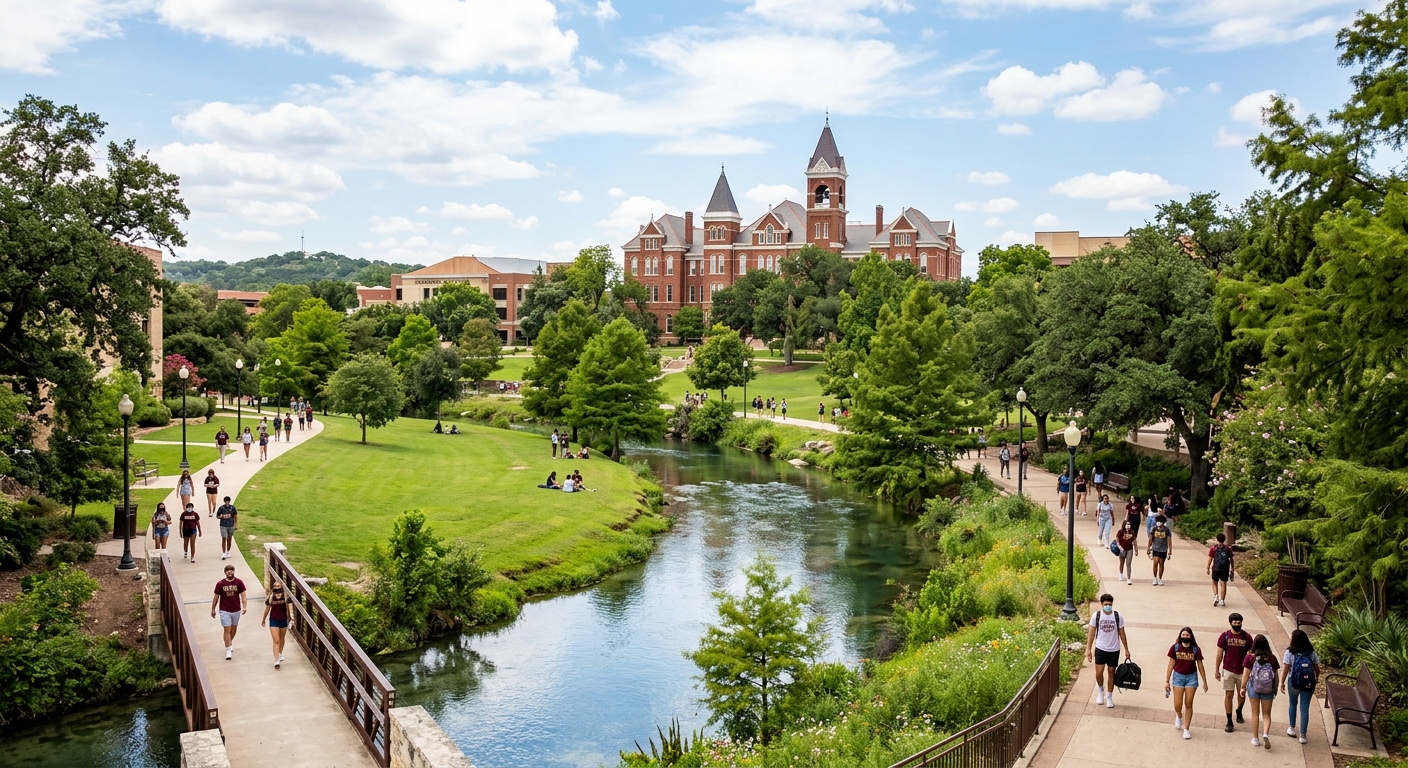
The Department of Physics emphasizes peer instruction in the classroom and cutting-edge research opportunities, with faculty actively engaged in condensed matter physics, materials physics, physics education research, and astrophysics. Students benefit from a dynamic and inclusive learning community situated on the scenic San Marcos campus, located in the Innovation Corridor between Austin and San Antonio.
With a minimum of 120 credit hours required for graduation, the program includes a general education core curriculum, advanced physics coursework, supporting mathematics and science courses, and a required minor. Graduates are well-positioned to pursue master's and doctoral programs or enter the workforce in engineering, technology, and education sectors.
Program Highlights
- Hands-on laboratory training with cutting-edge research equipment in condensed matter and materials physics
- Faculty-led research opportunities in nanotechnology, semiconductor devices, solar energy, and astrophysics
- Pathway to the innovative Materials Science, Engineering, and Commercialization Ph.D. program at Texas State
- Located in the Innovation Corridor between Austin and San Antonio with abundant internship and career opportunities
Curriculum and Course Modules
The B.S. in Physics curriculum at Texas State University balances foundational physics and mathematics coursework with advanced upper-division courses and laboratory experiences. Students must complete a minimum of 36 advanced hours at the 3000 or 4000 level, along with a required minor and general education core requirements.
General Physics I and II with Laboratories
8 Credit HoursA two-semester sequence covering the fundamental laws and principles of physics, including mechanics, heat, waves, light, electricity, and magnetism, accompanied by hands-on laboratory sessions.
Modern Physics
3 Credit HoursAn introduction to the key developments of 20th-century physics, including special relativity, quantum mechanics, atomic structure, and nuclear physics.
Classical Mechanics
3 Credit HoursAn advanced treatment of Newtonian mechanics using analytical methods, covering Lagrangian and Hamiltonian formulations, oscillations, and central force problems.
Electromagnetic Field Theory
3 Credit HoursA rigorous study of electric and magnetic fields, Maxwell's equations, electromagnetic waves, and their applications in modern technology.
Quantum Mechanics
3 Credit HoursCovers the mathematical framework and physical principles of quantum mechanics, including the Schrodinger equation, wave functions, operators, and applications to atomic systems.
Mathematical Physics
3 Credit HoursDevelops the mathematical tools essential for advanced physics, including differential equations, linear algebra, complex analysis, and Fourier methods.
Elective Courses
Admission Requirements
Admission to the Bachelor of Science in Physics at Texas State University is available to international students who meet the academic and English proficiency requirements. All applications and inquiries are handled through Uni4Edu, your dedicated point of contact throughout the admissions process.
Academic Requirements
- Secondary EducationCompletion of a foreign secondary school diploma with an academic profile equivalent to a U.S. high school curriculum
- Math PreparationStrong background in algebra, geometry, pre-calculus, and calculus is recommended
- Science PreparationCoursework in biology, chemistry, and physics at the secondary level
- GPA RequirementMinimum cumulative GPA of 2.0 on a 4.0 scale for freshman applicants
- Application FeeNon-refundable application fee required for international applicants
English Language Requirements
- TOEFL iBTMinimum score of 78 overall
- IELTS (Academic)Minimum score of 6.5 overall with 6.0 in each module
- Duolingo English TestMinimum score of 110 overall
Required Documents
For personalized admission guidance, document verification, and application support, please contact Uni4Edu
Scholarships and Funding
Texas State University offers merit-based scholarship opportunities for qualified international students, including incoming freshmen. Uni4Edu can help you identify and apply for available funding to support your studies in the B.S. in Physics program.
International Freshman Merit Scholarship
Merit-based awards available to first-time incoming international freshmen who meet minimum scholarship qualifications based on academic achievement.
College of Science and Engineering Scholarship
Departmental scholarships offered to outstanding students within the College of Science and Engineering based on academic performance and potential.
External and Private Scholarships
VariesA range of external scholarships are available for international students studying in the United States. Uni4Edu can guide you through eligible options and application processes.
For detailed tuition fee information, please contact Uni4Edu — we will guide you through the costs and available funding options for this program.
Career Prospects for Physics Graduates
A Bachelor of Science in Physics from Texas State University opens doors to diverse career paths in technology, engineering, education, and research. The San Marcos location within the Innovation Corridor between Austin and San Antonio provides access to a thriving high-tech and semiconductor industry with abundant internship and employment opportunities.
Potential Career Roles
Top Employers in the Region
Rankings and Recognition
Texas State University has steadily climbed in national and international rankings, reflecting its growing reputation for academic quality, research output, and commitment to student success. The university is recognized by major ranking bodies and is profiled in the Princeton Review's Best Colleges guide.
| Subject | Ranking Body | Rank |
|---|---|---|
| Physics (Bachelor's Program) | College Factual | #104 |
| Physics in Texas | College Factual | #6 |
| Social Mobility | U.S. News & World Report | #144 |
| Undergraduate Engineering | U.S. News & World Report | 194-211 Range |
How to Apply
Applying for this program is easy with Uni4Edu. Our team will guide you through every step of the process — from document preparation to final enrolment.
Contact Uni4Edu
Reach out to our team via email or phone. We will assess your profile and confirm your eligibility for this program.
Prepare Your Documents
Our advisors will provide you with a personalised checklist of required documents and help you prepare your application package.
Submit Your Application
Uni4Edu will submit your application on your behalf and keep you updated on its progress throughout the review period.
Receive Your Offer
Once accepted, we will help you understand your offer, arrange visa support if needed, and guide you through the enrolment process.
Similar Programmes

Bachelor's Degree
48 months
Physics (BA,BS)

University of Toledo, Toledo, United States
Earliest Intake
October 2026
Gross Tuition
37119 $


Master's & Postgraduate
12 months
PGCE Secondary Science with Physics - PGCE
London Metropolitan University, London, United Kingdom
Earliest Intake
April 2026
Gross Tuition
15500 £

Bachelor's Degree
48 months
Physics with Astrophysics BSc (Hons)
University of York, York, United Kingdom
Earliest Intake
January 2027
Gross Tuition
32350 £

Bachelor's Degree
36 months
Astrophysics BSc
UCL University College London, , United Kingdom
Earliest Intake
January 2027
Gross Tuition
42700 £


Bachelor's Degree
36 months
Physics - BSc (Hons)
University of Kent, Canterbury, United Kingdom
Earliest Intake
January 2026
Gross Tuition
23500 £



Uni4Edu AI Assistant