
Materials Science, Engineering, and Commercialization (PhD)
San Marcos, Texas, USA, United States
Doctor of Philosophy (Ph.D.) in Materials Science, Engineering, and Commercialization
Texas State University
Materials Science and Engineering
Program Overview: PhD in Materials Science, Engineering, and Commercialization
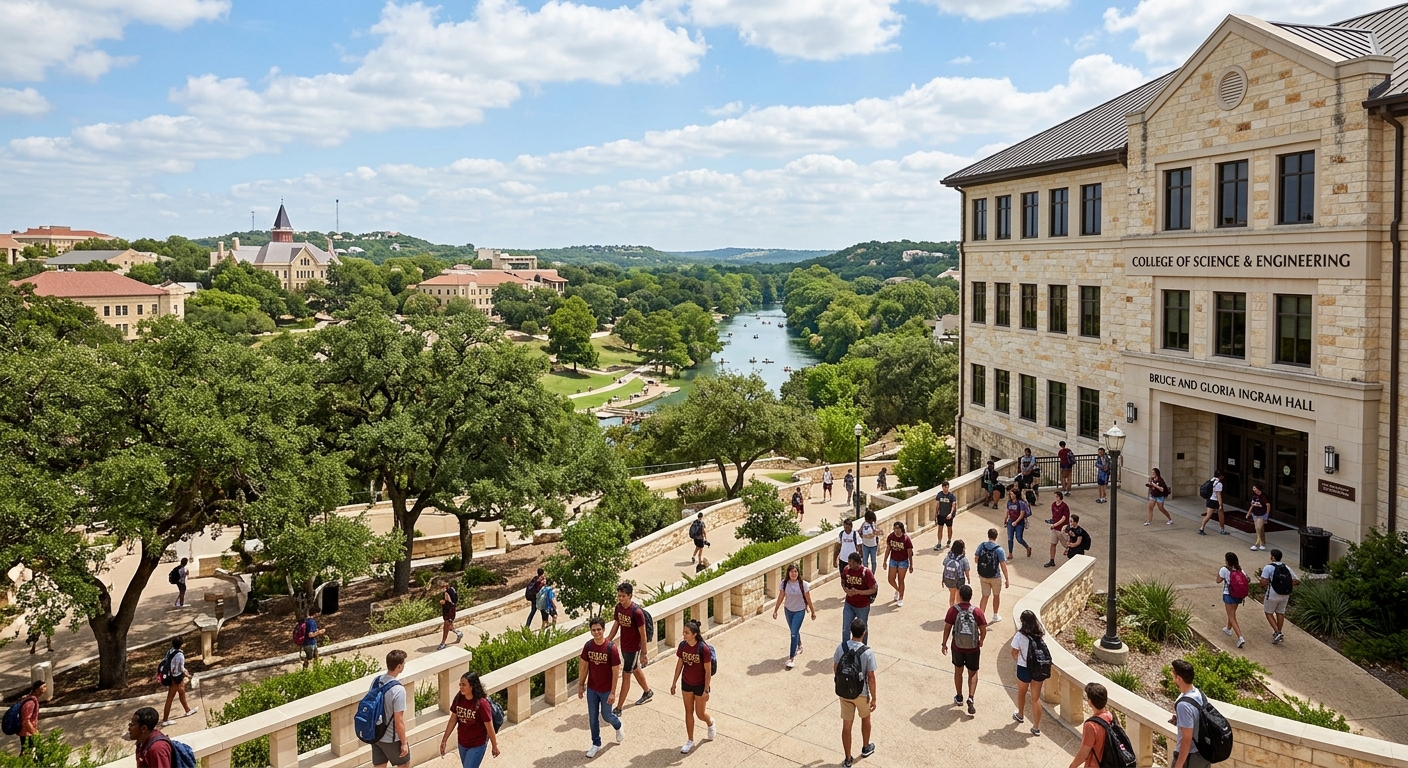
The Ph.D. in Materials Science, Engineering, and Commercialization (MSEC) at Texas State University is an interdisciplinary doctoral program housed in the College of Science and Engineering. Students work with faculty across Biology, Chemistry and Biochemistry, Engineering, Engineering Technology, and Physics on the research, development, and validation of advanced materials for electronics, medicines, plastics, sensors, infrastructure, and renewable energy.
What sets this program apart is its unique integration of commercialization with science and engineering. The curriculum infuses an understanding of intellectual property law, business planning skills, competency in transforming innovations from the lab to commercial production, and the ability to organize and lead interdisciplinary research teams.
Located in San Marcos, Texas, between Austin and San Antonio, the program positions you within a thriving technology corridor. Students augment their science and engineering studies with commercialization activities such as technology internships, interdisciplinary boot camps, entrepreneurial coursework, and forums, preparing them for leadership roles in both academia and industry.
Key Program Highlights
- Unique interdisciplinary PhD combining materials science, engineering, and commercialization training
- Faculty with industrial experience from technology companies and defense laboratories
- Required entrepreneurship boot camps and business plan development coursework
- Optional combined MBA/PhD dual degree pathway through the McCoy College of Business
Curriculum and Modules
The MSEC PhD program requires a minimum of 51 credit hours, encompassing core materials science and engineering courses, commercialization and entrepreneurship courses, prescribed electives, research credits, and dissertation work. The curriculum is designed to build both deep technical expertise and practical business acumen for technology commercialization.
MSEC 7401 - Fundamental Materials Science and Engineering
4 Credit HoursCovers fundamentals of chemical kinetics, physical properties, and continuum mechanics. Topics include electronic and atomic structure, crystalline materials, thermodynamic and kinetic principles, phase diagrams, diffusion, phase transformations, conservation laws, and kinematics.
MSEC 7402 - Advanced Materials Science and Engineering Concepts
4 Credit HoursExplores fundamentals of quantum mechanics, solid state physics, and physical electronics and photonics for advanced materials. Topics include quantum basis for properties of solids, lattice vibration, semiconductors, nanostructures, superconductivity, and recent advances in new materials.
MSEC 7301 - Practical Skills in Commercialization and Entrepreneurship
3 Credit HoursFirst of a two-course series imparting business and commercialization skills through producing a business plan. Key areas include intellectual property law, technology transfer and licensing strategies, business finance, management structures, and project management methods.
MSEC 7302 - Leadership Skills in Commercialization and Entrepreneurship
3 Credit HoursSecond course in the commercialization series, focusing on leadership competencies for technology ventures. Taught by faculty from the McCoy College of Business, this course builds on practical skills to develop effective entrepreneurial leadership.
MSEC 7101 - Commercialization Forum
1 Credit HourA recurring forum where doctoral students engage with topics in technology commercialization, entrepreneurship, and innovation. Students participate in discussions, presentations, and networking with industry professionals and fellow researchers.
MSEC 7102 - Materials Science, Engineering, and Commercialization Seminar
1 Credit HourA recurring seminar course where students present and discuss current research topics in materials science, engineering, and commercialization. Develops scientific communication skills and provides exposure to diverse research areas within the program.
Prescribed Electives
Admission Requirements
Admission to the MSEC PhD program is competitive and requires a strong academic background in a relevant science or engineering discipline. Applicants may enter with either a bachelor's or master's degree, with specific requirements varying by entry pathway. All applications are processed through Uni4Edu.
Academic Requirements
- Degree Requirement (Master's Entry)Master's degree in biology, chemistry, engineering, materials science, physics, technology, or a closely related field from a regionally accredited university
- Degree Requirement (Bachelor's Entry)Baccalaureate degree in biology, chemistry, engineering, materials science, physics, technology, or a closely related field from a regionally accredited university
- Minimum GPA (Bachelor's Entry)3.3 on a 4.0 scale in all completed undergraduate coursework
- GRE ScoresRequired only if GPA is below 3.5; applicants with GPA of 3.5 or higher are not required to submit GRE scores
- Additional RequirementsThree letters of recommendation and interviews with core doctoral faculty
English Language Requirements
- TOEFL iBTMinimum 78 overall
- IELTS (Academic)Minimum 6.5 overall with no individual module below 6.0
- Duolingo English TestMinimum 110 overall
Required Documents
Application Deadlines
For personalized admission guidance, document verification, and application support, please contact Uni4Edu
Scholarships and Funding
Texas State University offers various funding opportunities for MSEC PhD students, including scholarships, fellowships, and assistantships. Applying by the priority deadline ensures eligibility for certain funding opportunities. Contact Uni4Edu for guidance on available financial support.
Graduate Research Assistantship
Research assistantships allow doctoral students to work alongside faculty on funded research projects in materials science and engineering. These positions typically include a stipend and may include tuition support.
For detailed tuition fee information, please contact Uni4Edu — we will guide you through the costs and available funding options for this program.
Career Prospects
Graduates of the MSEC PhD program are well-prepared for diverse career paths spanning industry, academia, and entrepreneurship. While some graduates pursue post-doctoral fellowships and faculty positions, most obtain private sector science and technology positions. Several alumni have started their own businesses based on technology developed during their doctoral studies at Texas State.
Potential Career Roles
Types of Employers
Rankings and Recognition
Texas State University is a rapidly growing public research institution with an expanding research enterprise. The university has been designated as an emerging research university and continues to climb in national and global rankings, reflecting its commitment to academic excellence and innovation.
| Subject | Ranking Body | Rank |
|---|---|---|
| Engineering Programs (Undergraduate) | U.S. News & World Report | #194-211 |
| Engineering and Technology | Times Higher Education | #801 |
| MBA Program | CEO Magazine | Tier 1 |
| Economics | U.S. News & World Report | #240 |
How to Apply
Applying for this program is easy with Uni4Edu. Our team will guide you through every step of the process — from document preparation to final enrolment.
Contact Uni4Edu
Reach out to our team via email or phone. We will assess your profile and confirm your eligibility for this program.
Prepare Your Documents
Our advisors will provide you with a personalised checklist of required documents and help you prepare your application package.
Submit Your Application
Uni4Edu will submit your application on your behalf and keep you updated on its progress throughout the review period.
Receive Your Offer
Once accepted, we will help you understand your offer, arrange visa support if needed, and guide you through the enrolment process.
Similar Programmes

Bachelor's Degree
48 months
Information Technology BS

McMurry University, Abilene, United States
Earliest Intake
December 2025
Gross Tuition
33124 $


Master's & Postgraduate
24 months
Materials Science and Engineering (MS)
University Of Arizona, Tucson, United States
Earliest Intake
May 2026
Gross Tuition
32065 $


Master's & Postgraduate
12 months
Advanced Functional Materials MSc
University of Glasgow, Glasgow, United Kingdom
Earliest Intake
January 2026
Gross Tuition
33210 £
Bachelor's Degree
48 months
Materials Science and Nano Engineering Program
Sabancı University, Tuzla, Turkey
Earliest Intake
January 2026
Gross Tuition
36500 $


Bachelor's Degree
36 months
Sustainable Engineering for Materials and Processes (B.Sc.)
Technical University of Munich (TUM), Munich, Germany
Earliest Intake
May 2026
Gross Tuition
2000 €



Uni4Edu AI Assistant