
Electrical Engineering and Information Technology B.Sc.
Technical University of Munich (TUM), Germany

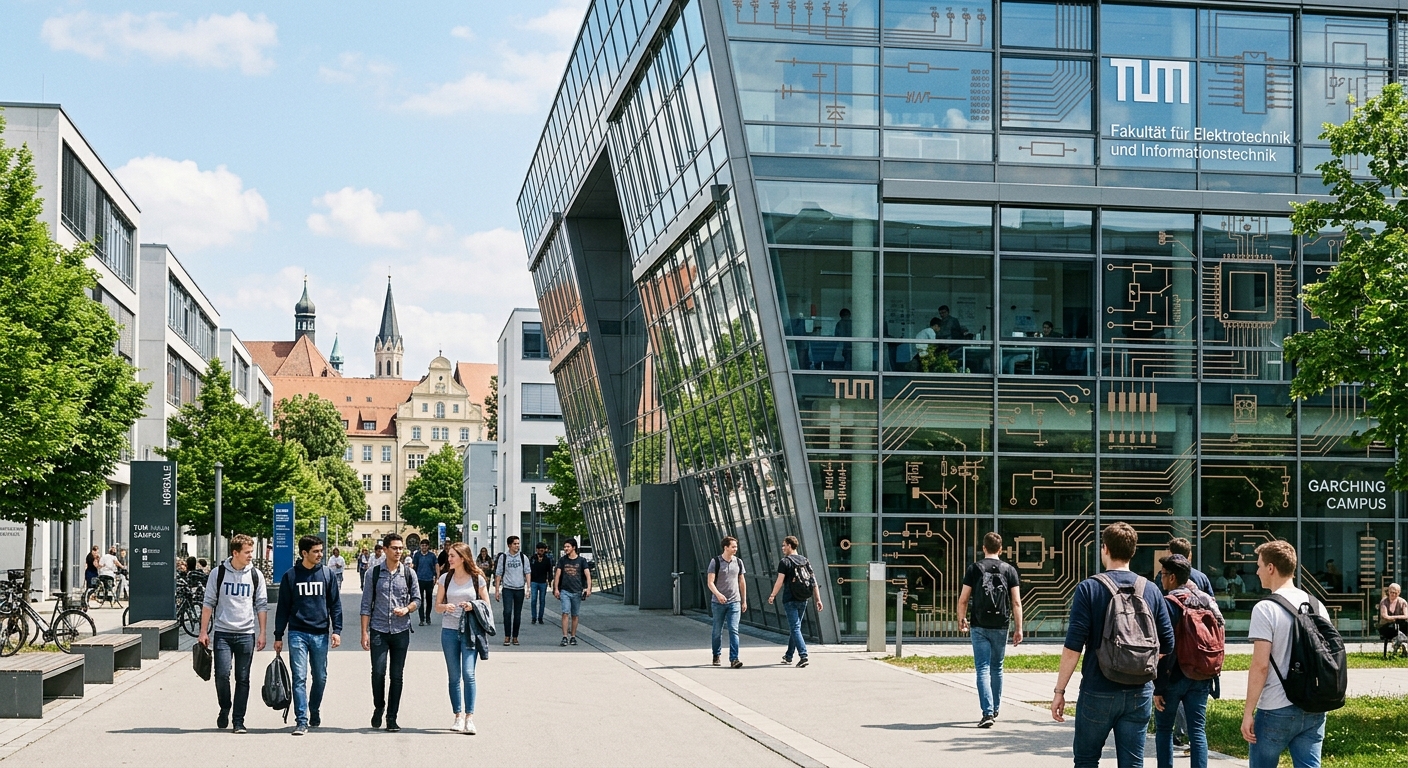
Bachelor of Science in Electrical Engineering and Information Technology
Technical University of Munich (TUM)
Electrical Engineering and Information Technology
Program Overview: Electrical Engineering and Information Technology B.Sc. at TUM
The Bachelor of Science in Electrical Engineering and Information Technology at the Technical University of Munich (TUM) provides a solid foundation in electrical engineering, mathematics, physics, signals and systems, and information technology. As part of the TUM School of Computation, Information and Technology (CIT), the program addresses the growing demand for highly qualified engineers in Germany and across the globe.
The program is divided into two study phases. During the first four semesters, you focus on core fundamentals, while in the fifth and sixth semesters you choose elective modules that allow you to specialize according to your individual interests and career goals. A nine-week engineering internship ensures you gain hands-on industrial or research experience before graduation.
Graduates possess strong foundational and methodological knowledge and are well prepared for careers in engineering or for further qualification in a Master's program. With approximately 40% of enrolled bachelor students coming from international backgrounds, TUM fosters a diverse and collaborative learning environment.
Key Program Highlights
- Broad specialization options including automation technology, cyber-physical systems, machine learning and AI, mechatronics, and micro- and nanoelectronics
- Mandatory nine-week engineering internship providing real-world industry or research experience
- Part of the TUM School of Computation, Information and Technology (CIT), uniting mathematics, informatics, and electrical engineering
- TUM is ranked 19th worldwide for Electrical and Electronic Engineering in the QS World University Rankings by Subject
Curriculum and Modules
The B.Sc. in Electrical Engineering and Information Technology comprises 180 ECTS credits. The first four semesters cover 120 credits of compulsory foundational modules, while the fifth and sixth semesters offer 30 credits of technical electives, 6 credits of soft skills, a 12-credit engineering internship, and a 12-credit Bachelor's thesis.
Mathematics for Engineers
32 ECTSCovers linear algebra, calculus, differential equations, and advanced mathematical methods essential for engineering analysis and modeling.
Physics
24 ECTSProvides foundational knowledge in mechanics, electromagnetism, thermodynamics, and quantum physics as they relate to electrical engineering applications.
Electrical Engineering Fundamentals
21 ECTSIntroduces circuit analysis, electromagnetic fields, electronic components, and fundamental principles of electrical systems design.
Information Technology
18 ECTSCovers digital systems, computer architecture, programming, and the fundamentals of data processing and communication technologies.
Signals and Systems
15 ECTSTeaches signal processing theory, system analysis, Fourier and Laplace transforms, and their applications in communications and control engineering.
Bachelor's Thesis
12 ECTSAn independent academic project completed over nine weeks under faculty supervision, demonstrating your ability to apply engineering methods to solve a defined technical problem.
Elective Specialization Areas
Admission Requirements
Admission to the B.Sc. in Electrical Engineering and Information Technology at TUM is based on a recognized higher education entrance qualification and demonstrated proficiency in German. A strong background in mathematics, natural sciences, and technical systems is expected. Contact Uni4Edu for personalized guidance on your eligibility and application.
Academic Requirements
- Higher Education Entrance QualificationA recognized university entrance qualification (e.g., Abitur or international equivalent) is required for admission.
- Mathematics BackgroundStrong performance in mathematics at the secondary school level is expected and highly recommended.
- Natural Sciences BackgroundSolid knowledge of physics and an interest in technical systems are essential prerequisites.
- Fundamentals and Orientation Exam (GOP)Students must pass the fundamentals and orientation exam within the first two semesters to continue in the program.
- Credential EvaluationInternational applicants may need to have their qualifications assessed for equivalency. Contact Uni4Edu for assistance.
Language Requirements
- German ProficiencySufficient German language skills are required. Recognized certificates include DSH, TestDaF, Goethe-Zertifikat, or DSD II.
- TestDaFA minimum score of TDN 4 in all four sections is typically required.
- DSHDSH-2 or higher is accepted as proof of German language proficiency.
Required Documents
Application Deadlines
For personalized admission guidance, document verification, and application support, please contact Uni4Edu
Scholarships and Funding
TUM and the German government offer several scholarships and financial aid options for international students. These range from merit-based stipends to need-based financial support. Contact Uni4Edu for help identifying and applying for the scholarships most suited to your profile.
Deutschlandstipendium (Germany Scholarship)
EUR 300 per monthA national merit-based scholarship open to both domestic and international students at TUM. Around 800 scholarships are awarded annually at TUM, recognizing academic achievement, personal commitment, and social engagement. Half is funded by private sponsors and half by the federal government.
TUM Scholarship for International Students
EUR 500 to EUR 1,800 per semesterA need-based one-time financial aid funded by the Bavarian government. Available to international students from the 3rd bachelor's semester onward, with the option to reapply each semester for a maximum funding period of 36 months.
DAAD Scholarships
Varies by programThe German Academic Exchange Service (DAAD) offers various scholarships for international students studying in Germany, covering living expenses, travel costs, and health insurance. Multiple program-specific and country-specific options are available.
For detailed tuition fee information, please contact Uni4Edu — we will guide you through the costs and available funding options for this program.
Career Prospects
Graduates of TUM's B.Sc. in Electrical Engineering and Information Technology are highly sought after in the German and international job markets. The demand for skilled engineers is particularly strong in sectors such as automotive, telecommunications, renewable energy, and semiconductor technology. TUM's graduates benefit from the university's strong industry partnerships and its ranking of 13th worldwide in the Global University Employability Ranking.
Potential Career Roles
Top Employers of TUM Graduates
Rankings and Recognition
The Technical University of Munich is consistently ranked among the top universities in Europe and worldwide, particularly in engineering and technology. TUM holds the distinction of being a German University of Excellence and is recognized as the top-ranked university in the European Union by the QS World University Rankings.
| Subject | Ranking Body | Rank |
|---|---|---|
| Electrical & Electronic Engineering | QS World Rankings by Subject | #19 (1st in Germany) |
| Engineering & Technology | THE World University Rankings by Subject | #22 |
| Computer Science | THE World University Rankings by Subject | #14 |
| Electrical Engineering | ARWU (Shanghai Ranking) | 1st in Germany |
How to Apply
Applying for this program is easy with Uni4Edu. Our team will guide you through every step of the process — from document preparation to final enrolment.
Contact Uni4Edu
Reach out to our team via email or phone. We will assess your profile and confirm your eligibility for this program.
Prepare Your Documents
Our advisors will provide you with a personalised checklist of required documents and help you prepare your application package.
Submit Your Application
Uni4Edu will submit your application on your behalf and keep you updated on its progress throughout the review period.
Receive Your Offer
Once accepted, we will help you understand your offer, arrange visa support if needed, and guide you through the enrolment process.
Similar Programmes


Master's & Postgraduate
12 months
Advanced Electronic and Electrical Engineering MSc

Queen Mary, University of London, London, United Kingdom
Earliest Intake
January 2026
Gross Tuition
31450 £

Bachelor's Degree
48 months
Civil Engineering
Texas State University, San Marcos, United States
Earliest Intake
February 2027
Gross Tuition
24520 $

Bachelor's Degree
48 months
Electrical and Electronics Engineering
Beykent University, Sarıyer, Turkey
Earliest Intake
January 2026
Gross Tuition
3500 $

Bachelor's Degree
36 months
Electrical and Electronic Engineering BEng
University of Sheffield, Sheffield, United Kingdom
Earliest Intake
January 2026
Gross Tuition
32100 £


Bachelor's Degree
48 months
Electronic Engineering and Internet of Things (including foundation year) - BEng (Hons)
London Metropolitan University, London, United Kingdom
Earliest Intake
April 2025
Gross Tuition
15500 £



Uni4Edu AI Assistant