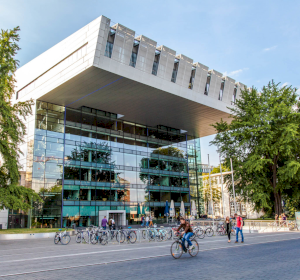
Physics
Templergraben 55, 52062 Aachen, Germany, Germany

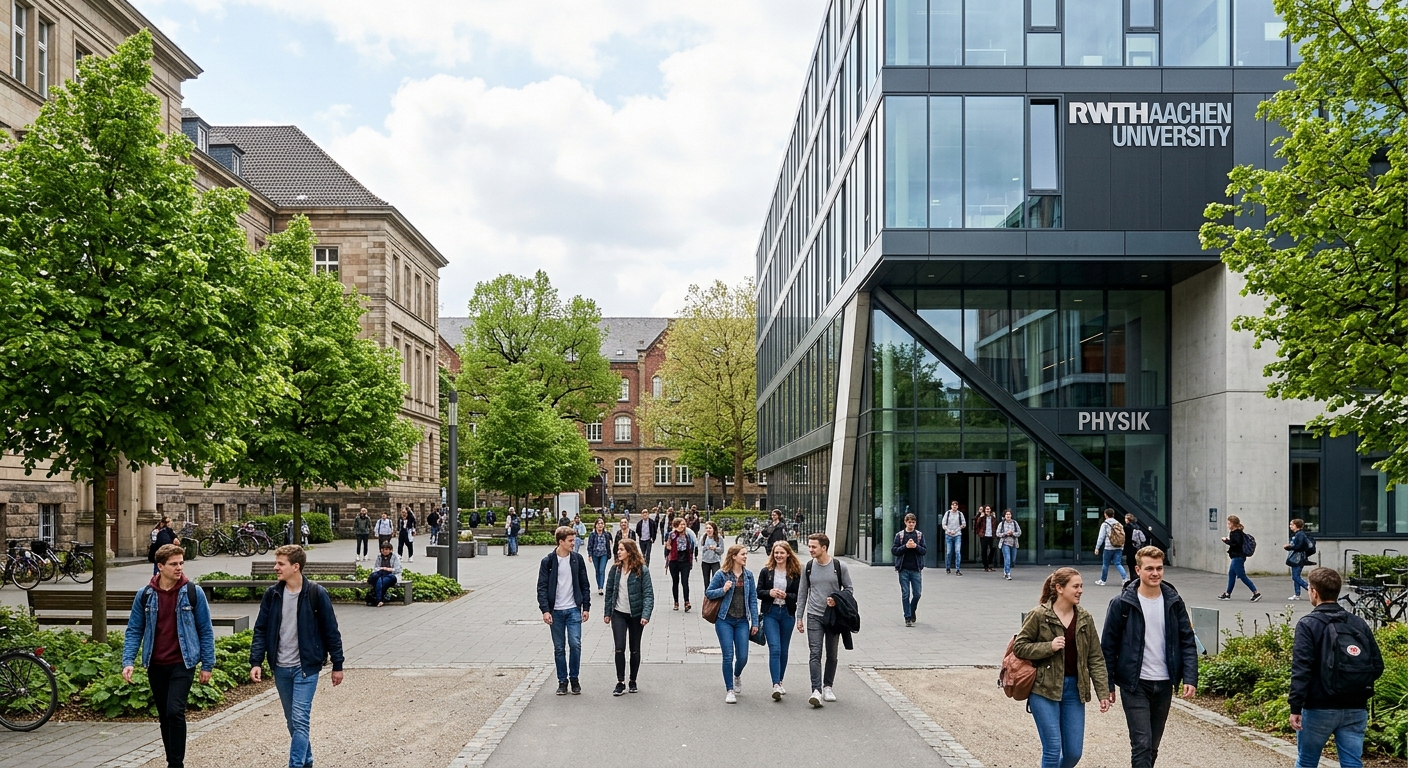
Bachelor of Science in Physics
RWTH Aachen University
Physics
Program Overview: Bachelor of Science in Physics at RWTH Aachen University
The Bachelor of Science in Physics at RWTH Aachen University provides students with a solid understanding of the fundamental principles and laws of nature, equipping them with the ability to tackle complex problems in a systematic and data-driven manner. Situated at Germany's largest technical university, the program integrates rigorous theoretical training with hands-on experimental laboratory work across six semesters.
The program benefits from RWTH Aachen's close collaboration with Forschungszentrum Juelich through the Juelich Aachen Research Alliance (JARA), as well as partnerships with leading research institutions such as CERN and the Fraunhofer Institute for Laser Technology. Students gain exposure to cutting-edge research areas including particle physics, condensed matter physics, astrophysics, and nano-optics from early in their studies.
Graduates emerge with versatile skills in critical thinking, numerical analysis, and problem-solving, making them well-prepared for advanced Master's and doctoral programs or direct entry into careers in research, industry, and technology. The program's thematic proximity to engineering sciences at RWTH Aachen also allows for uniquely varied interdisciplinary study options.
Key Program Highlights
- Strong research orientation with access to JARA, CERN, and leading German research institutes
- Interdisciplinary connections to engineering, computer science, and materials science
- International exchange opportunities through ERASMUS and partnerships with institutions such as Tokyo Institute of Technology and UC Davis
- Physics ranked 55th worldwide and 5th in Germany in QS Subject Rankings
Curriculum and Modules
The Bachelor of Science in Physics curriculum at RWTH Aachen is structured over six semesters, building progressively from foundational courses in experimental and theoretical physics to advanced specialized topics. Students develop strong analytical, mathematical, and experimental competencies through a carefully designed sequence of lectures, tutorials, and laboratory courses.
Experimental Physics I-III (Mechanics, Electromagnetism, Optics and Thermodynamics)
27 ECTSA three-part foundational sequence covering classical mechanics, electromagnetism, wave optics, and thermodynamics. Students gain core experimental skills and learn to connect physical theory with observable phenomena through demonstrations and problem sets.
Theoretical Physics I-III (Classical Mechanics, Electrodynamics, Quantum Theory)
24 ECTSThis sequence develops the mathematical framework of physics, progressing from analytical mechanics through electrodynamics to quantum mechanics. Students learn to formulate physical problems rigorously and solve them using advanced mathematical techniques.
Higher Mathematics I-III
23 ECTSComprehensive mathematics courses covering linear algebra, calculus of several variables, differential equations, and complex analysis. These modules provide the essential mathematical tools required for all areas of physics study.
Experimental Physics IV (Atoms, Molecules and Nuclei)
9 ECTSAn advanced experimental physics module exploring atomic structure, molecular physics, and nuclear physics. Students examine quantum phenomena at the atomic and subatomic scale through both theoretical frameworks and experimental evidence.
Experimental Physics V (Solid State Physics and Particle/Astrophysics)
8 ECTSThis module covers condensed matter physics including crystal structures and electronic properties, alongside an introduction to particle physics and astrophysics. Students explore modern physics research frontiers and their experimental methods.
Advanced Laboratory Course and Bachelor Thesis
21 ECTSHands-on advanced laboratory experiments develop proficiency in modern measurement techniques and data analysis. The Bachelor thesis involves an independent research project conducted at one of RWTH Aachen's physics institutes or partner research centers.
Elective Modules and Specializations
Admission Requirements
Admission to the Bachelor of Science in Physics at RWTH Aachen University is subject to a Numerus Clausus with local selection procedures. Prospective students must meet academic, language, and additional participation requirements. Contact Uni4Edu for personalized guidance on eligibility and the application process.
Academic Requirements
- Educational QualificationGeneral higher education entrance qualification (Abitur) or an equally recognized university entrance qualification (HZB)
- Selection ProcessNumerus Clausus with local procurement procedures applies
- Self AssessmentCompletion of the RWTH subject-specific Self Assessment in Mathematics and Natural Sciences is mandatory
- Information DayParticipation in a Physics Studies Information Day organized by the Department of Physics, including an aptitude component, is required before enrollment
- International CredentialsInternational qualifications must be assessed for equivalency; contact Uni4Edu for evaluation of your specific credentials
Language Requirements
- German ProficiencyDSH-2 or equivalent (e.g., TestDaF 4x4) required as the program is taught entirely in German
- Alternative German CertificatesGoethe-Zertifikat C1 or telc Deutsch C1 Hochschule may also be accepted
- English ProficiencyNot formally required for the Bachelor program, but recommended for reading scientific literature
Required Documents
Application Deadlines
For personalized admission guidance, document verification, and application support, please contact Uni4Edu
Scholarships and Funding
While RWTH Aachen University does not charge tuition fees for most programs, students should plan for semester contribution fees and living expenses. Several scholarship opportunities are available to support international students pursuing their Bachelor of Science in Physics. Contact Uni4Edu for personalized scholarship guidance.
DAAD Scholarships for International Students
Varies by program; typically EUR 861 per month for undergraduate studentsThe German Academic Exchange Service (DAAD) offers a range of scholarships for international students studying in Germany, covering living expenses and sometimes including travel allowances and health insurance contributions.
Deutschlandstipendium (Germany Scholarship)
EUR 300 per monthA merit-based national scholarship program co-funded by the German government and private sponsors. It is awarded to high-achieving students regardless of nationality and does not need to be repaid.
RWTH Aachen Education Fund Scholarships
Varies based on individual circumstancesRWTH Aachen offers financial support through its education fund for talented students who demonstrate strong academic performance and engagement. Contact Uni4Edu for current availability and application details.
For detailed tuition fee information, please contact Uni4Edu — we will guide you through the costs and available funding options for this program.
Career Prospects for Physics Graduates
Graduates of the Bachelor of Science in Physics from RWTH Aachen University are equipped with highly transferable skills in analytical thinking, quantitative reasoning, and problem-solving. The program's strong ties to industry and research institutions in the Aachen-Juelich region provide excellent networking and employment opportunities across diverse sectors.
Potential Career Paths
Notable Employers of RWTH Physics Graduates
Rankings and Recognition
RWTH Aachen University is consistently ranked among the top technical universities in Germany and globally, with particular strength in engineering and natural sciences. The Department of Physics benefits from the university's strong research infrastructure and international reputation.
| Subject | Ranking Body | Rank |
|---|---|---|
| Physics | QS Subject Rankings | #55 |
| Physics | US News Subject Rankings | #75 |
| Physical Sciences | THE Subject Rankings | Top 70 |
| Physics | EduRank (Research Output) | #108 World / #4 Germany |
How to Apply
Applying for this program is easy with Uni4Edu. Our team will guide you through every step of the process — from document preparation to final enrolment.
Contact Uni4Edu
Reach out to our team via email or phone. We will assess your profile and confirm your eligibility for this program.
Prepare Your Documents
Our advisors will provide you with a personalised checklist of required documents and help you prepare your application package.
Submit Your Application
Uni4Edu will submit your application on your behalf and keep you updated on its progress throughout the review period.
Receive Your Offer
Once accepted, we will help you understand your offer, arrange visa support if needed, and guide you through the enrolment process.
Similar Programmes

Bachelor's Degree
48 months
Physics (BA,BS)

University of Toledo, Toledo, United States
Earliest Intake
June 2026
Gross Tuition
37119 $

Master's & Postgraduate
12 months
PGCE Secondary Science with Physics - PGCE
London Metropolitan University, London, United Kingdom
Earliest Intake
April 2026
Gross Tuition
15500 £
Bachelor's Degree
48 months
Physics with Astrophysics BSc (Hons)
University of York, York, United Kingdom
Earliest Intake
January 2027
Gross Tuition
32350 £

Bachelor's Degree
36 months
Astrophysics BSc
UCL University College London, , United Kingdom
Earliest Intake
January 2027
Gross Tuition
42700 £


Bachelor's Degree
36 months
Physics - BSc (Hons)
University of Kent, Canterbury, United Kingdom
Earliest Intake
January 2026
Gross Tuition
23500 £



Uni4Edu AI Assistant