
Physical Oceanography
Bangor , United Kingdom

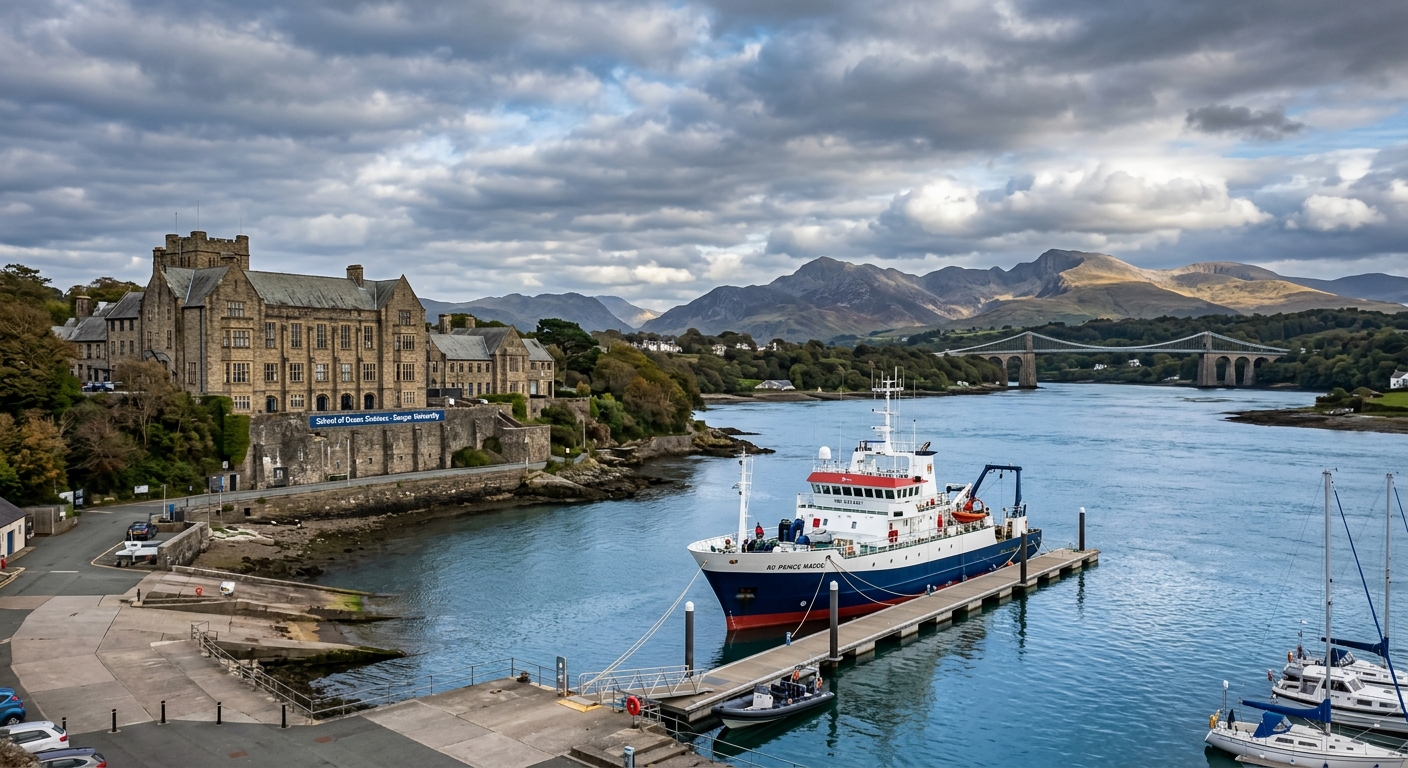
Master of Science in Physical Oceanography
Bangor University (Prifysgol Bangor)
Physical Oceanography
MSc Physical Oceanography at Bangor University — Program Overview
The MSc in Physical Oceanography at Bangor University introduces students with a degree in the physical, mathematical, or other numerate sciences to the study of ocean physics. Running for over 40 years, this program is unique in the UK for the depth of physical oceanography training it provides, combining rigorous theory with hands-on practical experience.
The first two semesters are taught, covering the physics of the ocean and its role in the climate system. Modules address both oceanographic theory and its application, including state-of-the-art instrumentation, remote sensing, numerical modelling, and practical experience aboard the University's research vessel, the Prince Madog.
During the second semester, you begin to focus on specific aspects of the subject through an extensive literature review, culminating in a major research project selected in close consultation with supervisors to align with your intended future career. This program has received NERC funding since 1965, reflecting its critical role in training modellers and numerate environmental scientists for the UK and beyond.
Key Program Highlights
- Over 40 years of continuous operation — the longest-running program of its kind in the UK
- Hands-on sea-going experience aboard the research vessel Prince Madog
- Training in state-of-the-art oceanographic instrumentation, remote sensing, and computational fluid dynamics
- Distinguished alumni include IPCC Nobel Laureates and directors of leading UK oceanographic laboratories
Curriculum and Modules
The MSc Physical Oceanography curriculum balances oceanographic theory with practical application, covering both core concepts and advanced specializations. Modules span observational techniques, numerical modelling, and field-based learning, with a substantial research project forming a major component of the degree. Please note that module listings are for guidance and may be subject to change.
Ocean Dynamics and Circulation
20 creditsCovers the fundamental physics governing ocean currents, thermohaline circulation, and large-scale ocean dynamics. You will explore wind-driven and density-driven circulation patterns and their role in the global climate system.
Waves, Tides, and Shallow Water Processes
20 creditsExamines the physics of ocean waves, tidal dynamics, and processes in coastal and shelf seas. Topics include tidal energy, storm surges, and the interaction between tides and coastal morphology.
Oceanographic Instrumentation and Observational Techniques
20 creditsIntroduces modern oceanographic instrumentation including current meters, CTD profilers, and acoustic instruments. Practical sessions include fieldwork on small boats and the research vessel Prince Madog.
Numerical Modelling and Computational Fluid Dynamics
20 creditsProvides training in numerical methods for simulating ocean processes, including computational fluid dynamics, data analysis, and fundamental modelling approaches used in oceanographic research and industry.
Remote Sensing and Data Analysis
20 creditsCovers satellite remote sensing of the ocean, including sea surface temperature, altimetry, and ocean colour. You will develop skills in processing and interpreting large oceanographic datasets.
MSc Research Project and Dissertation
60 creditsA major independent research project selected in consultation with supervisors and directly relevant to your intended future work. For overseas students, projects based on investigations at a home institute are encouraged.
Elective Modules and Specializations
Admission Requirements
The MSc Physical Oceanography at Bangor University welcomes applicants from a range of scientific backgrounds. All applications are processed through Uni4Edu, where our team will guide you through every step of the admissions process and ensure your application is complete and competitive.
Academic Requirements
- Minimum Degree Classification2:2 (Lower Second Class) Honours degree or equivalent
- Degree SubjectPhysical, mathematical, or other numerate science discipline
- Alternative BackgroundsGeography, Geology, Biology, or other sciences with strong motivation and mathematics to A-level or beyond
- Relevant ExperienceApplicants with relevant employment experience are encouraged to apply with a strong Personal Statement and CV
- International QualificationsEquivalent international qualifications are accepted — contact Uni4Edu for country-specific guidance
English Language Requirements
- IELTSOverall 6.0 with no element below 5.5
- TOEFL iBTContact Uni4Edu for accepted equivalent score
- PTE AcademicContact Uni4Edu for accepted equivalent score
Required Documents
Application Deadlines
For personalized admission guidance, document verification, and application support, please contact Uni4Edu
Scholarships and Funding
Bangor University offers a range of scholarships and funding opportunities to support international postgraduate students. Uni4Edu can help you identify and apply for the most suitable funding options based on your profile and eligibility.
Bangor University International Scholarship
Up to GBP 3,000 (postgraduate)Available to all self-funding international students on taught postgraduate courses. No separate application is required — all applicants are automatically considered based on academic performance, personal statement, and references.
Commonwealth Shared Scholarship Scheme
Full funding (tuition, living allowance, travel)Jointly funded by Bangor University and the Commonwealth Scholarship Commission for students from eligible Commonwealth countries. Covers tuition fees, living costs, and travel. Contact Uni4Edu for current eligibility details.
Bangor Merit Scholarship
Up to GBP 10,000Partial funding awarded to outstanding undergraduate and postgraduate applicants based on academic excellence. Contact Uni4Edu for current availability and application details for postgraduate taught programs.
For detailed tuition fee information, please contact Uni4Edu — we will guide you through the costs and available funding options for this program.
Career Prospects
Graduates of the MSc Physical Oceanography at Bangor are highly sought after across academic, government, and commercial sectors. Past alumni have gone on to become Nobel Laureates, directors of major UK oceanographic laboratories, and leaders in commercial oceanography. Recent figures indicate that approximately 50% of MSc graduates proceed to a PhD, while others enter roles in commercial oceanography, government agencies, and the marine energy sector.
Typical Career Roles
Notable Employers of Graduates
Rankings and Recognition
Bangor University is internationally recognised for its strength in ocean sciences and environmental research. The School of Ocean Sciences has been described by New Scientist as one of Europe's leading institutes for physical oceanography, and the program has received continuous NERC funding since 1965.
| Subject | Ranking Body | Rank |
|---|---|---|
| Environmental Sciences | QS World University Rankings by Subject | Top 350 |
| Agriculture and Forestry | QS World University Rankings by Subject | Top 150 |
| Environmental Sciences | University Guru | #239 |
| Ocean Sciences (Physical Oceanography) | NERC / New Scientist Recognition | Leading European Institute |
How to Apply
Applying for this program is easy with Uni4Edu. Our team will guide you through every step of the process — from document preparation to final enrolment.
Contact Uni4Edu
Reach out to our team via email or phone. We will assess your profile and confirm your eligibility for this program.
Prepare Your Documents
Our advisors will provide you with a personalised checklist of required documents and help you prepare your application package.
Submit Your Application
Uni4Edu will submit your application on your behalf and keep you updated on its progress throughout the review period.
Receive Your Offer
Once accepted, we will help you understand your offer, arrange visa support if needed, and guide you through the enrolment process.
Similar Programmes


Bachelor's Degree
36 months
Marine Vertebrate Conservation BSc (Hons)

Prifysgol Bangor University, Bangor, United Kingdom
Earliest Intake
May 2026
Gross Tuition
20000 £

Bachelor's Degree
36 months
Marine Biology and Zoology BSc (Hons)
Prifysgol Bangor University, Bangor, United Kingdom
Earliest Intake
May 2026
Gross Tuition
20000 £

Bachelor's Degree
36 months
Ocean Science BSc (Hons)
Prifysgol Bangor University, Bangor, United Kingdom
Earliest Intake
May 2026
Gross Tuition
20000 £


Master's & Postgraduate
12 months
PGCE Secondary Science with Biology - PGCE
London Metropolitan University, London, United Kingdom
Earliest Intake
April 2025
Gross Tuition
15500 £

Master's & Postgraduate
12 months
PGCE Secondary Science with Chemistry - PGCE
London Metropolitan University, London, United Kingdom
Earliest Intake
April 2025
Gross Tuition
15500 £



Uni4Edu AI Assistant