
Wireless Network Infrastructure
Cambridge Campus, Canada

Graduate Certificate in Wireless Network Infrastructure
Conestoga College
Wireless Telecommunications & Network Engineering
Program Overview: Wireless Network Infrastructure
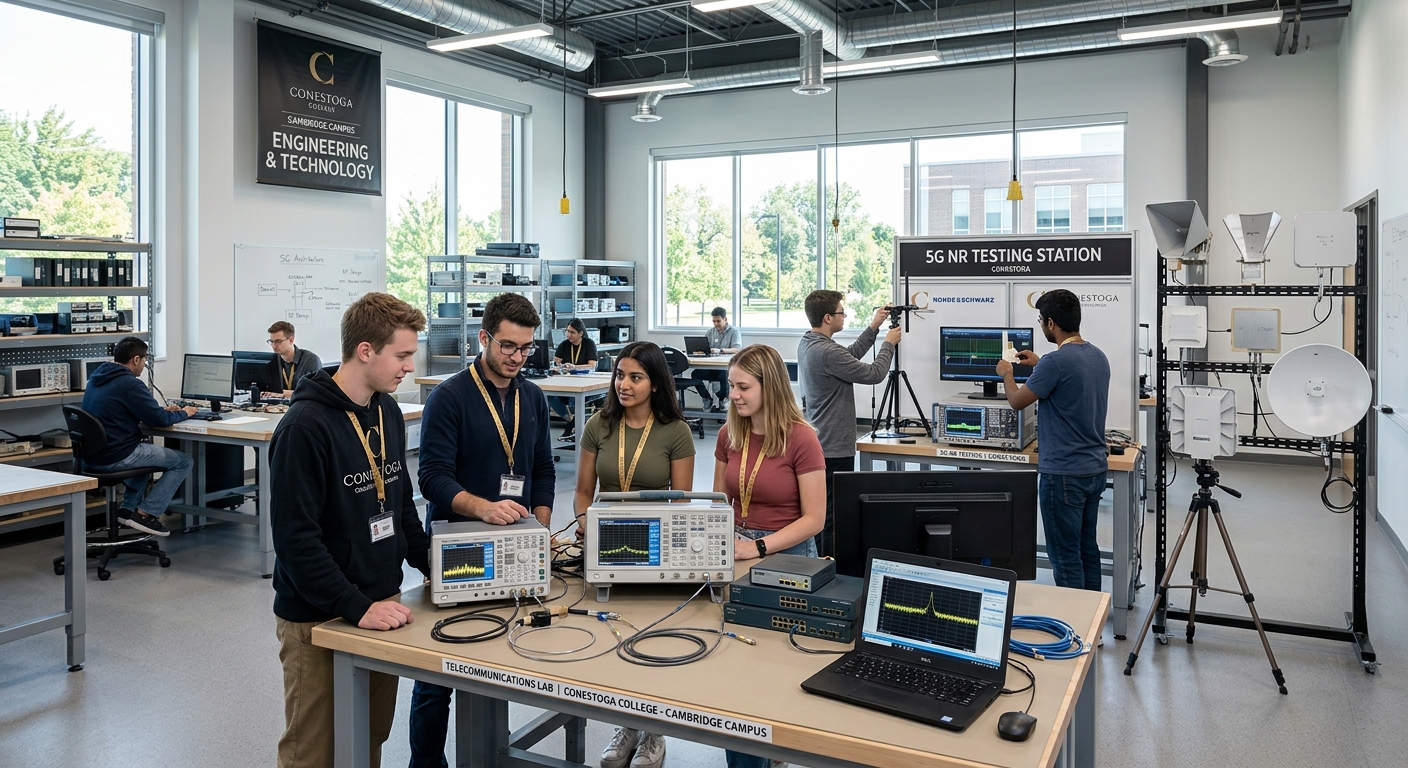
The Wireless Network Infrastructure graduate certificate at Conestoga College prepares graduates holding degrees or diplomas in telecommunications, electronics, or computer engineering and technology for careers in emerging fields within the wireless telecommunications industry. Students enhance their undergraduate knowledge with practical, hands-on skills using industry-standard tools such as drive test tools, propagation tools, spectrum analyzers, and network analyzers.
The program broadens your familiarity with troubleshooting and configuration of local area and wide area networks (LANs and WANs) as well as networking topics relevant to telecom carriers, including virtual private networks and quality of service. Cutting-edge topics such as Long Term Evolution (LTE), 5th generation wireless networks, high bandwidth wireless (WiGig+), and concurrent MIMO systems ensure graduates are well prepared for the evolving industry.
Additional areas of study include spectrum utilization and associated network design, IP-based wireless systems, enterprise WiFi, Bluetooth, intra-vehicular communication systems used in emerging automotive designs such as self-driving cars, and the Internet of Things (IoT). Graduates will be well-positioned to work in Canada's telecommunications industry, particularly at the network planning and optimization level.
Key Program Highlights
- Hands-on training with industry-standard wireless tools including spectrum analyzers, propagation tools, and network analyzers
- Coverage of cutting-edge 5G, LTE, WiGig+, and MIMO wireless technologies
- Practical focus on IoT, enterprise WiFi, Bluetooth, and intra-vehicular communication systems
- Offered at Conestoga College, recognized as the Best College in Ontario by CourseCompare for two consecutive years
Curriculum & Course Modules
The Wireless Network Infrastructure program is delivered over two semesters and combines theoretical foundations with practical lab work. The curriculum covers core areas of wireless telecommunications, from digital data communications to RF engineering and network optimization, ensuring you graduate with job-ready skills.
Covers fundamentals of digital data communications from a physical layer perspective, including digital coding of analog waveforms, source coding, baseband digital signaling, digital modulation techniques, and channel coding.
Focuses on the hardware and software knowledge required to design, set up, maintain, and troubleshoot computer networks, including LAN and WAN configuration and virtual private networks.
Explores radio frequency systems and their application in modern network infrastructure, covering RF spectrum management, propagation theory, and wireless network design principles.
Provides a comprehensive foundation in telecommunications concepts, including signal processing, transmission technologies, and the architecture of modern telecom networks.
Introduces industry-standard wireless analysis and testing tools, including drive test tools, spectrum analyzers, and network analyzers used in real-world network planning and optimization.
Elective & Supplementary Courses
Admission Requirements
Admission to the Wireless Network Infrastructure program is designed for applicants who already hold a post-secondary credential in a related technical field. All applications and inquiries should be submitted through Uni4Edu, your single point of contact for a streamlined admissions process.
Academic Requirements
- Academic CredentialA two- or three-year diploma or a degree from an accredited college or university in telecommunications, electronics, or computer engineering/technology
- Minimum Grade AverageOverall average grade of B or above (as assessed by country, to Ontario standards)
- Alternative QualificationOther relevant disciplines may be considered that offer a significant degree of networking and telecommunications in their curriculum
- Work Experience AlternativeA minimum of three to five years of related full-time formal work experience may be considered
- Credential EvaluationApplicants with transcripts from outside Canada must have documents evaluated for equivalency at an approved credential evaluation provider
English Language Requirements
- IELTS Academic6.5 overall with no band less than 6.0
- TOEFL iBT88 overall with no individual skill less than 22
- PTE Academic58 overall
Required Documents
For personalized admission guidance, document verification, and application support, please contact Uni4Edu
Scholarships & Funding
Conestoga College offers a range of financial support options for students, including merit-based scholarships, bursaries, and awards. Student Financial Services at Conestoga awarded more than 400 awards, scholarships, and bursaries last year. Contact Uni4Edu for guidance on available funding opportunities and application procedures.
Conestoga International Admission Merit Scholarship
A merit-based scholarship available to international students enrolling in the fall, winter, and spring semesters, awarded based on academic excellence demonstrated in prior studies.
Conestoga Academic Performance Scholarship
CAD 1,500Awarded each intake to students who achieve the highest level of academic performance within their program, recognizing outstanding scholarly achievement.
Conestoga Students Inc. Sporting Scholarship
CAD 1,000Awarded to college athletes or students who volunteer in the athletic community, selected by varsity coaches based on demonstrated devotion and academic excellence.
For detailed tuition fee information, please contact Uni4Edu — we will guide you through the costs and available funding options for this program.
Career Prospects for Graduates
Graduates of the Wireless Network Infrastructure program are well-positioned to enter Canada's rapidly growing telecommunications sector. With practical skills in 5G technology, network planning, and RF engineering, you will be equipped for roles across telecom carriers, equipment manufacturers, and consulting firms. Conestoga reports that more than 90 percent of its graduates find work within six months of graduation.
Potential Job Roles
Potential Employers
Rankings & Recognition
Conestoga College is a leading Canadian Institute of Technology and Advanced Learning, widely recognized for its career-focused education, applied research excellence, and strong industry partnerships. As a polytechnic institution, Conestoga holds prominent national rankings in research and program quality rather than traditional global university rankings.
| Subject | Ranking Body | Rank |
|---|---|---|
| Cybersecurity Certification Programs | CourseCompare | #1 in Canada |
| Co-op Programs | CourseCompare | #3 in Canada |
| Engineering Technology | University Magazine | #6 in Canada |
| Online Computer Science Degree Programs | CourseCompare | #6 in Canada |
How to Apply
Applying for this program is easy with Uni4Edu. Our team will guide you through every step of the process — from document preparation to final enrolment.
Contact Uni4Edu
Reach out to our team via email or phone. We will assess your profile and confirm your eligibility for this program.
Prepare Your Documents
Our advisors will provide you with a personalised checklist of required documents and help you prepare your application package.
Submit Your Application
Uni4Edu will submit your application on your behalf and keep you updated on its progress throughout the review period.
Receive Your Offer
Once accepted, we will help you understand your offer, arrange visa support if needed, and guide you through the enrolment process.
Similar Programmes


Master's & Postgraduate
16 months
Satellite Systems Engineering MSc

University of Bradford, Bradford, United Kingdom
Earliest Intake
August 2026
Gross Tuition
19500 £


Master's & Postgraduate
12 months
Electronic Engineering
Prifysgol Bangor University, Bangor, United Kingdom
Earliest Intake
May 2027
Gross Tuition
21000 £

Master's & Postgraduate
12 months
Marine Renewable Energy
Prifysgol Bangor University, Bangor, United Kingdom
Earliest Intake
May 2027
Gross Tuition
19500 £


Master's & Postgraduate
12 months
MSc Engineering Management
BPP University, City of London, United Kingdom
Earliest Intake
July 2027
Gross Tuition
17100 £


Bachelor's Degree
48 months
Engineering (BS)
University Of Arizona, Tucson, United States
Earliest Intake
May 2027
Gross Tuition
39958 $



Uni4Edu AI Assistant