
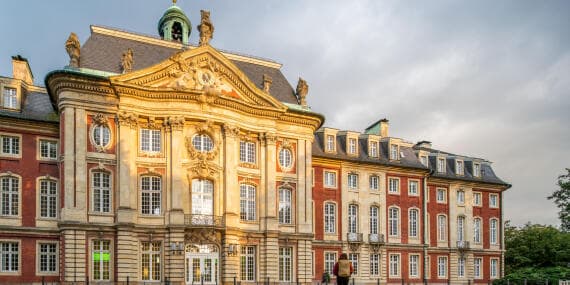
University of Münster (Westfälische Wilhelms-Universität Münster)
Münster, Germany
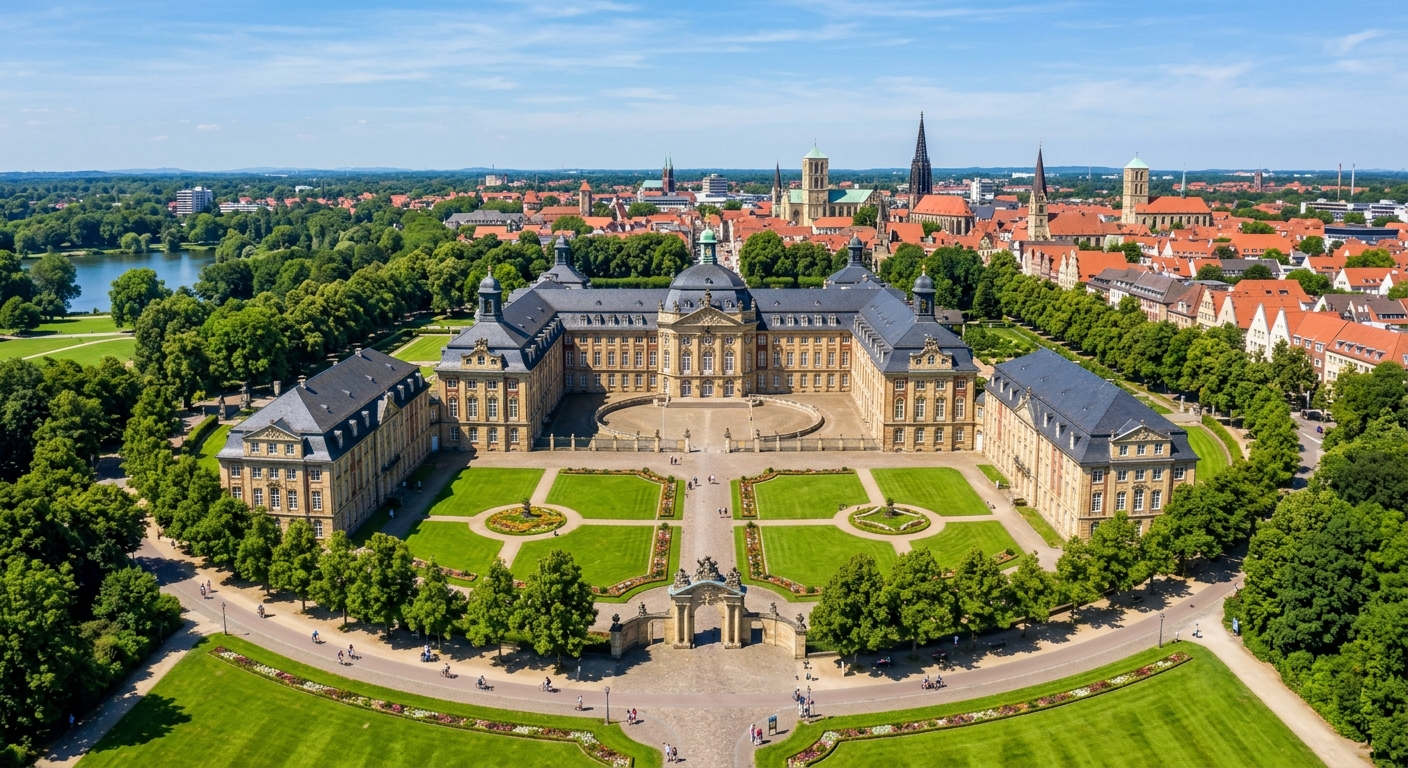
University of Münster (Westfälische Wilhelms-Universität Münster)
Münster, Germany
Founded
1780
Institution Type
Public Research University
Total Students
43,000+
Faculties
15
Discover the University of Münster: A Leading German Research University
Discover the University of Münster: A Leading German Research University
The University of Münster is a public research university located in Münster, North Rhine-Westphalia, Germany. With more than 43,000 students and over 120 fields of study across 15 faculties, it is Germany's fifth-largest university and one of the foremost centers of German intellectual life.
The university traces its roots to Münster's Jesuit College, founded in 1588. The modern university was formally established on 16 April 1780 with four founding faculties: Law, Medicine, Philosophy, and Theology. It was elevated back to full university status in 1902 under Emperor Wilhelm II and renamed Westfälische Wilhelms-Universität, a name it carried until October 2023 when it became simply the University of Münster.
Professors and former students have won ten Leibniz Prizes, one Fields Medal, and two Nobel Prizes. The university has been successful in the German government's Excellence Strategy, securing two Clusters of Excellence in Mathematics Münster and Religion and Politics. It is also a member of the German U15, a coalition of fifteen major research-intensive universities in Germany.
Key Milestones
- 1780: University officially founded on 16 April with four faculties: Law, Medicine, Philosophy, and Theology.
- 1902: Elevated back to full university status by Emperor Wilhelm II after approval of a Faculty of Law by the Prussian parliament.
- 1945: University reopened on 3 November after World War II; the Münster Schloss became the main administrative building.
- 2023: Renamed from Westfälische Wilhelms-Universität to University of Münster (Universität Münster), effective 1 October.
Academic Structure and Faculties
Academic Structure and Faculties
The University of Münster comprises 15 faculties offering over 120 degree programs and more than 280 courses of study. The university covers a full disciplinary spectrum from theology and law to natural sciences and medicine, with many programs following the Bologna bachelor's and master's structure.
Faculty of Medicine
One of the university's largest faculties, the Faculty of Medicine partners closely with the University Hospital Münster (UKM) to integrate research, teaching, and patient care with over 2,000 researchers and 3,000 enrolled students.
- Medicine (Staatsexamen)
- Dentistry
- Biomedical Sciences
School of Business and Economics
A leading faculty for economics and business in Germany with approximately 6,000 students, the school offers interdisciplinary research and houses the European Research Center for Information Systems (ERCIS).
- Business Administration (B.Sc./M.Sc.)
- Economics (B.Sc./M.Sc.)
- Information Systems (M.Sc., English-taught)
Faculty of Law
One of the university's historic founding faculties, the Faculty of Law is renowned across Germany and internationally, consistently ranking among the top law faculties in the country.
- Law (Staatsexamen)
- Taxation and Accounting
- Doctoral Program in Law
Faculty of Mathematics and Computer Science
Home to the Cluster of Excellence Mathematics Münster: Dynamics – Geometry – Structure, this faculty is one of the strongest in Germany, with five Leibniz Prize winners among its current professors.
- Mathematics (B.Sc./M.Sc.)
- Computer Science (B.Sc./M.Sc.)
- Geoinformatics (M.Sc., English-taught)
Faculty of Chemistry and Pharmacy
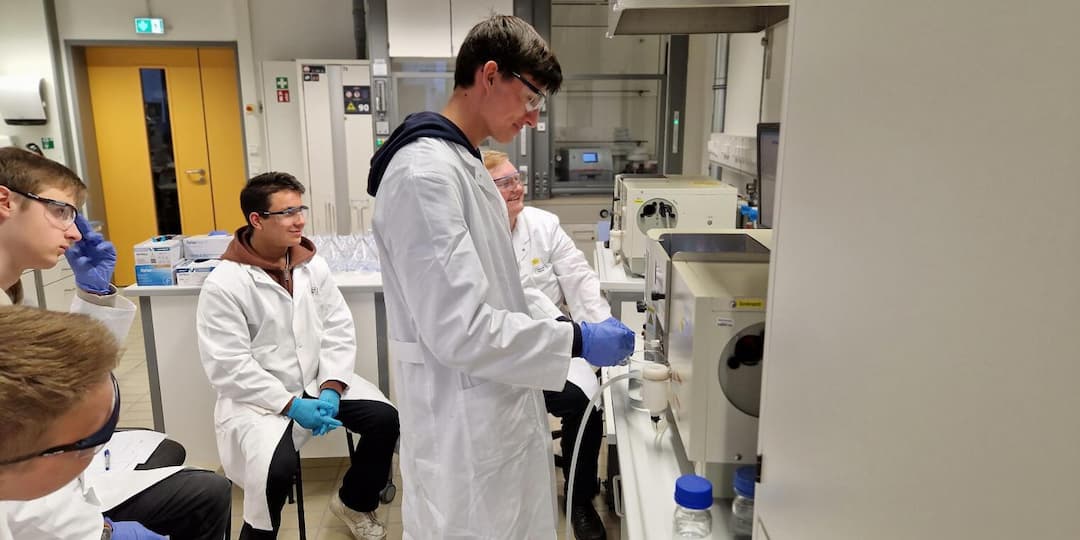
Ranked among the top chemistry faculties in Germany by the Shanghai Ranking, this faculty offers strong research programs in organic, inorganic, and physical chemistry as well as pharmaceutical sciences.
- Chemistry (B.Sc./M.Sc.)
- Pharmacy (Staatsexamen)
- Food Chemistry
Faculty of Geosciences
The Faculty of Geosciences provides interdisciplinary programs spanning geology, geography, landscape ecology, and geospatial technologies, with internationally recognized English-taught master's programs.
- Geography (B.Sc./M.Sc.)
- Geospatial Technologies (M.Sc., English-taught)
- Landscape Ecology (B.Sc./M.Sc.)
Admission Requirements for International Students
Admission Requirements for International Students
Undergraduate Admission
- Secondary School CertificateRecognized equivalent of the German Abitur or completion of a Studienkolleg with Feststellungsprüfung
- German Language ProficiencyDSH-2 or TestDaF 4x4 for German-taught programs
- English ProficiencyTOEFL or IELTS required for English-taught programs
- Application PortalApply via uni-assist or directly through the university portal
- Application FeeNo application fee at the university; uni-assist may charge a processing fee
Graduate Admission
- Bachelor's DegreeCompleted bachelor's degree in a relevant field from a recognized institution
- TranscriptsOfficial transcripts and degree certificates, translated if necessary
- Language ProficiencyDSH-2/TestDaF for German programs; TOEFL/IELTS for English programs
- Letters of RecommendationMinimum two letters from academic or professional referees
- Additional DocumentsMotivation letter, CV, and program-specific requirements (e.g. research proposal for doctoral programs)
Application deadline for most programs starting in October. International applicants should check uni-assist deadlines, which may be earlier.
Application deadline for programs with a summer semester intake starting in April. Not all programs offer summer admission.
Some master's programs have earlier or different deadlines. Check the specific program page for exact dates.
Doctoral positions are typically advertised individually. Contact prospective supervisors directly to inquire about openings.
Tuition Fees, Semester Costs, and Scholarships
Tuition Fees, Semester Costs, and Scholarships
The University of Münster does not charge tuition fees for regular degree programs, regardless of nationality. All students are required to pay a semester fee that covers student services and a regional public transport ticket. This makes studying in Münster highly affordable compared to many other countries.
| Cost Category | EU/EEA Students | Non-EU/EEA Students |
|---|---|---|
| Tuition Fees (per semester) | EUR 0 | EUR 0 |
| Semester Fee (per semester) | ~EUR 350 | ~EUR 350 |
| Living Costs (per month) | EUR 800 – 900 | EUR 800 – 900 |
| Health Insurance (per month) | ~EUR 110 | ~EUR 110 |
| Total | ~EUR 700 per semester + living costs | ~EUR 700 per semester + living costs |
ProTalent Scholarship Programme
The university's own scholarship program supporting students with excellent academic records and strong civic engagement, funded by private donors and the University of Münster Foundation.
- Award Amount: EUR 300 per month
- Eligibility: Enrolled students with excellent academic achievement and community involvement
- Open to International Students: Yes, check specific eligibility requirements
DAAD Scholarships
The German Academic Exchange Service (DAAD) offers a wide range of scholarships for international students at all academic levels to study at German universities including the University of Münster.
- Award Amount: Varies by program (typically EUR 861 – 1,200 per month)
- Eligibility: International students and researchers; criteria vary by scholarship type
- Application: Apply through the DAAD portal (www.daad.de)
Campus and Facilities
Campus and Facilities
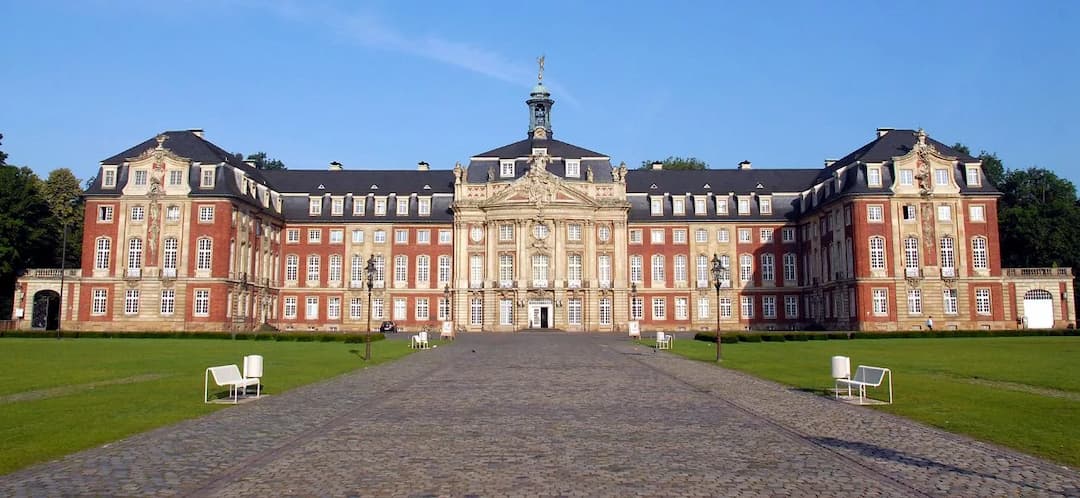
The University of Münster has an urban campus spread across the city center, blending historic buildings with modern research facilities. The iconic Münster Schloss, a Baroque palace built between 1767 and 1787, serves as the university's main administrative building and symbolic heart.
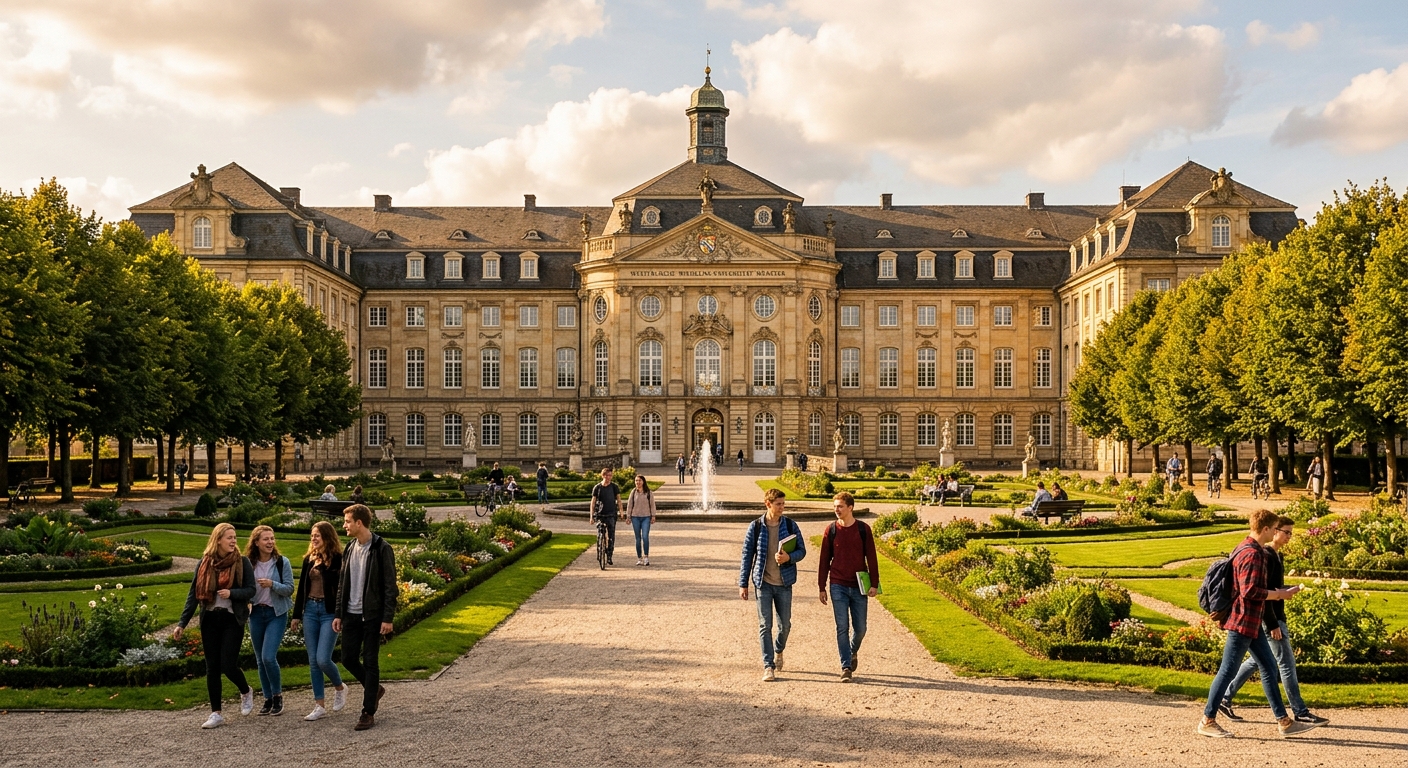
The iconic Baroque palace serves as the university's main administrative building and a beloved landmark of Münster.

The central library system holds over 6.2 million volumes and provides extensive digital resources and research databases.
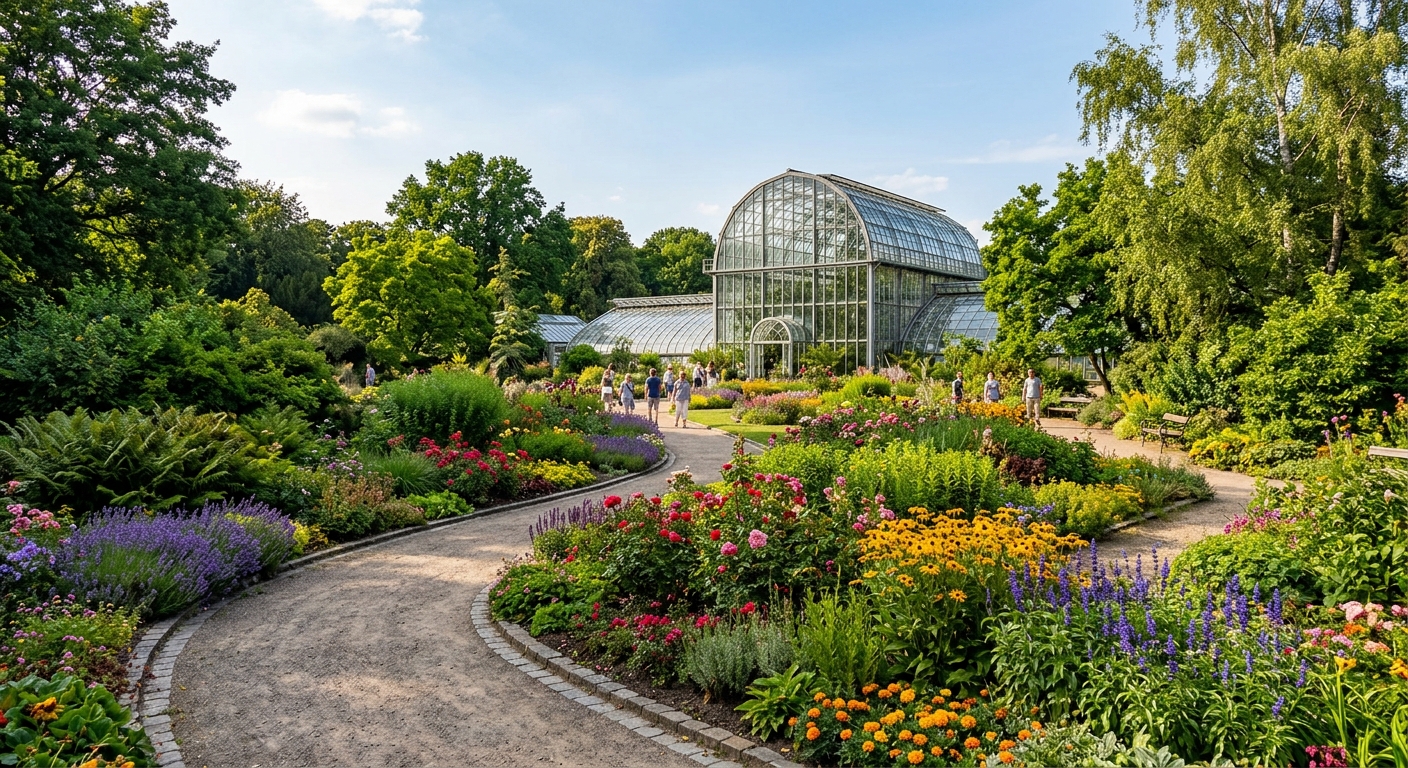
Founded in 1803, the university's historic botanical garden offers a green oasis for study, research, and relaxation.
Housing and Dining
Student Housing
Student halls in Münster are managed by the Studierendenwerk. Many students also share flats (WGs), which is a popular and affordable option in the city.
- Studierendenwerk dormitories across the city
- Shared apartments (WGs) widely available
- Rent ranges from approximately EUR 300 – 500 per month
Dining and Cafeterias
The Studierendenwerk operates multiple Mensa (cafeteria) locations across campus, offering affordable and varied meals for students throughout the day.
- Multiple Mensa locations across campus
- Affordable daily meals starting from around EUR 2 – 4
- Vegetarian, vegan, and international meal options
Student Life at the University of Münster
Student Life at the University of Münster
The University of Münster offers a vibrant and active student life in one of Germany's most livable cities. With a large student population shaping the city's character, Münster is known for its bicycle culture, lively nightlife with over 1,000 bars and clubs, and rich cultural heritage as the city of the Peace of Westphalia.
Münster: A Vibrant University City in the Heart of Germany
Münster: A Vibrant University City in the Heart of Germany
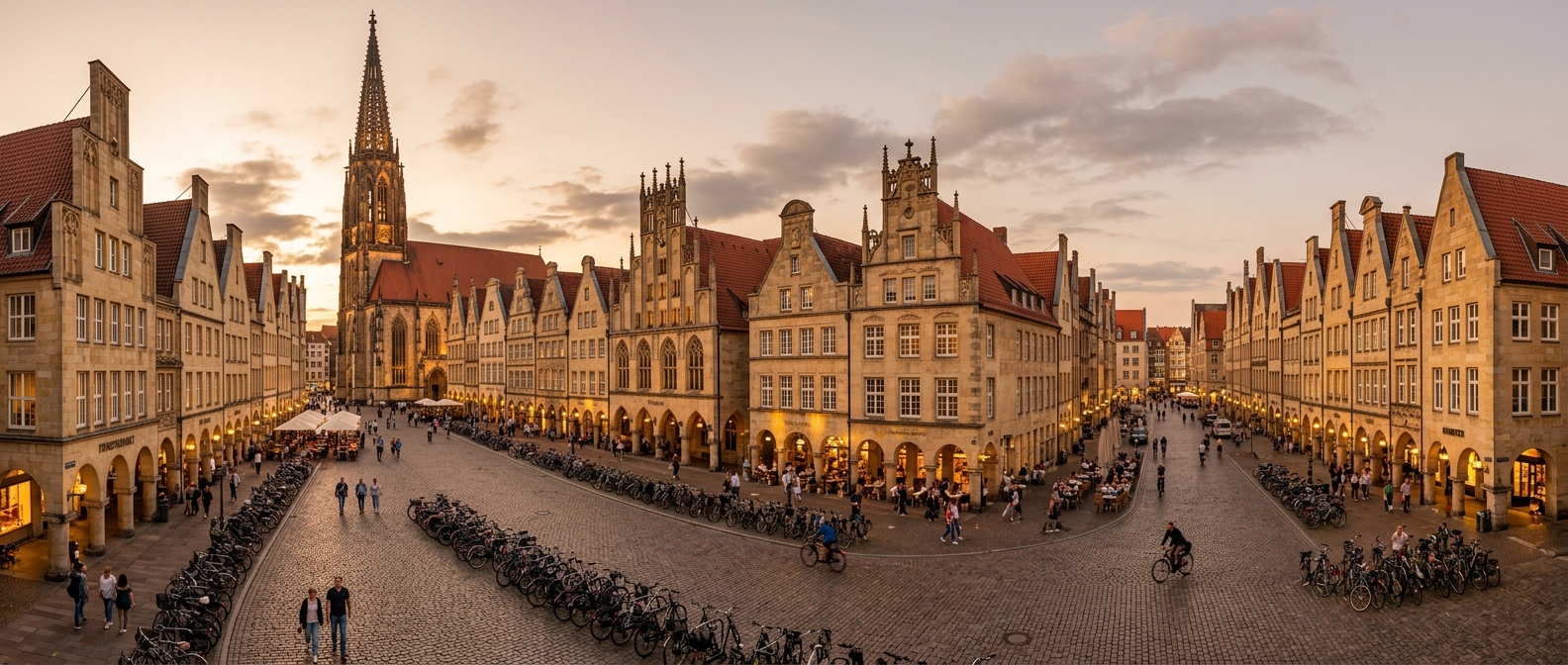
Life in Münster
Münster is a charming university city in North Rhine-Westphalia with a population of about 320,000. In 2004, it won the LivCom Award for the most livable city in the world in its size category. Known for having more bicycles than people, Münster offers a unique blend of medieval history, vibrant student culture, and a high quality of life.
Bicycle Capital of Germany
Münster is famous for its bicycle-friendly infrastructure. Cycling is the primary mode of transport for students, with dedicated bike lanes and parking throughout the city.
Rich Cultural Heritage
As the city where the Peace of Westphalia was signed in 1648, Münster boasts a wealth of historical sites, museums, and cultural events including the Pablo Picasso Museum of Graphic Art.
Nature and Recreation
The scenic Aasee lake, beautiful parks, and the surrounding Münsterland countryside offer excellent opportunities for outdoor activities and relaxation.
Central European Location
Münster's location in central Germany provides easy access to major cities like Cologne, Düsseldorf, and Hamburg, as well as neighboring countries such as the Netherlands and Belgium.
Career Outcomes and Notable Alumni
Career Outcomes and Notable Alumni
Notable Employers and Organizations Linked to Alumni
Practical Information for International Students
Practical Information for International Students
For International Students
The International Office is the first point of contact for international students and researchers, providing guidance on admissions, enrollment, visa matters, and cultural orientation programs.
The Welcome Centre supports international researchers with practical matters including housing assistance, residence permits, and integration into the university community.
The university's Language Centre offers German language courses at all levels, tandem language partnerships, and internationally recognized language certificates such as UNIcert.
Key Contacts
- +90 5435286292
- +44 7868736984
- [email protected]
- [email protected]
University of Münster: Worldwide Rankings
University of Münster: Worldwide Rankings
The University of Münster consistently ranks among the top universities in Germany and is well-regarded internationally. It is a member of the German U15 network of leading research universities and has been recognized in all major global ranking systems.
| Subject | Ranking Body | Rank |
|---|---|---|
| Chemistry | Shanghai ARWU | Top 50 Worldwide |
| Law | Times Higher Education | #84 |
| Business & Management | QS Subject Rankings | #101 |
| Mathematics | QS Subject Rankings | #149 |


Features
A series of measures have been implemented to improve the quality of teaching and studying at the University of Münster. On the basis of evaluation regulations which entered into effect in April 2005, the University established a number of quality assurance components. For example, student course evaluations [de] are now carried out in all courses taught at the University of Münster. The University also distributes questionnaires on the conditions of study and instruction, graduate student surveys [de], as well as internal and external evaluations.\n
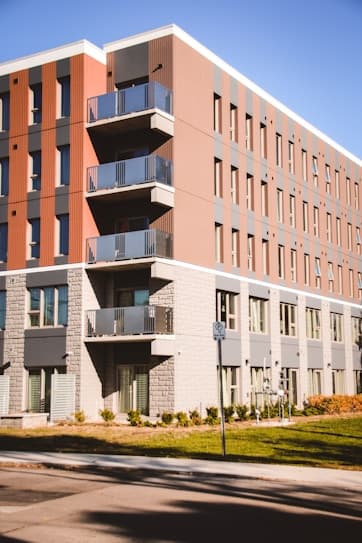
Accommodation
Accommodation service is available.\n

Work While Studying
Students can work while studying.\n

Co-op/Internship Participation
There is an internship service.\n
Featured Programmes


Location
Schlossplatz 2 48149 Münster

Map not found.

Uni4Edu AI Assistant
