
Natural Resources - Fisheries Conservation & Management (MS)
Main Campus, Tucson, United States

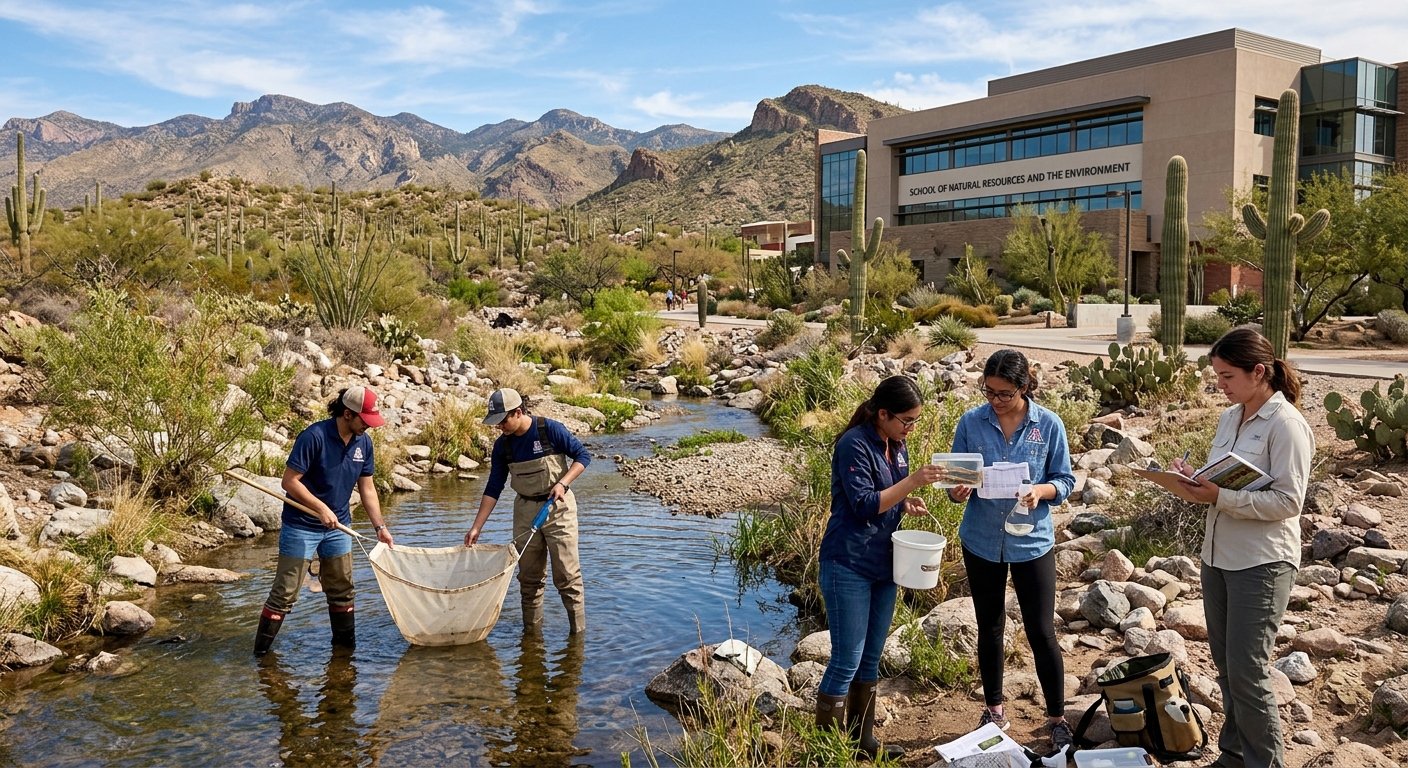
Natural Resources - Fisheries Conservation & Management (MS)
University of Arizona
Fisheries Conservation & Management
Program Overview: MS in Natural Resources - Fisheries Conservation & Management
The Master of Science in Natural Resources with a Fisheries Conservation and Management emphasis at the University of Arizona prepares you for professional careers with state and federal fish and wildlife agencies, non-governmental conservation organizations, private consulting firms, or for research and academic roles. Housed within the School of Natural Resources and the Environment (SNRE), this program combines rigorous academic coursework with hands-on field and laboratory research experiences.
Research programs range from field studies in rivers and streams, springs, reservoirs, and high mountain lakes to many types of laboratory and aquaculture experiments. You will develop an individual plan of study focused on your selected area of research, working closely with a faculty advisory committee during your first semester to identify appropriate coursework, transfer credits, and potential thesis committee members.
Students in this program frequently collaborate with the Arizona Cooperative Fish and Wildlife Research Unit, the Arizona Game and Fish Department, the National Park Service, and the U.S. Fish and Wildlife Service. Both thesis and non-thesis options are available, giving you flexibility to tailor the degree to your career goals.
Key Program Highlights
- Extensive field research opportunities in diverse aquatic ecosystems across Arizona, including desert streams, mountain lakes, reservoirs, and springs
- Active collaborations with the Arizona Cooperative Fish and Wildlife Research Unit and major federal and state agencies
- Access to state-of-the-art facilities including the Santa Rita Experimental Range and the University of Arizona Biosphere 2
- Flexible thesis and non-thesis options with an individualized plan of study designed with your faculty advisory committee
Curriculum & Modules
The MS in Natural Resources with a Fisheries Conservation and Management emphasis requires a minimum of 30 to 36 units, depending on whether you choose the thesis or non-thesis track. You will work with your faculty advisory committee to develop an individual plan of study that includes core fisheries courses, research methodologies, and elective seminars tailored to your research interests.
Fisheries Science & Conservation Biology
3 UnitsFoundational course covering the principles of fisheries science, population dynamics, aquatic ecology, and conservation strategies for native and non-native fish species in diverse freshwater ecosystems.
Aquatic Ecology & Limnology
3 UnitsStudy of freshwater ecosystems including rivers, lakes, and wetlands, examining physical, chemical, and biological processes that influence aquatic communities and fish habitat.
Quantitative Methods in Natural Resources
3 UnitsAdvanced statistical methods and data analysis techniques applied to fisheries and natural resources research, including population modeling, sampling design, and spatial analysis.
Fish Population Dynamics & Management
3 UnitsIn-depth examination of fish population assessment techniques, stock-recruitment models, harvest management strategies, and the application of adaptive management frameworks.
Natural Resources Policy & Management
3 UnitsAnalysis of environmental policy, legislation, and management frameworks governing natural resources and fisheries at local, state, and federal levels, including the Endangered Species Act and Clean Water Act.
Thesis / Master's Report Research
6 UnitsIndependent research conducted under faculty supervision resulting in a thesis or master's report. Topics may include field studies in rivers, streams, springs, reservoirs, or laboratory and aquaculture experiments.
Elective Courses
Admission Requirements
Admission to the MS in Natural Resources with a Fisheries Conservation and Management emphasis requires a strong academic background in biology, natural resources, or a related field. Competitive applicants typically hold relevant research or applied experience, and admission requires a faculty member to serve as your major advisor along with a funding plan. Contact Uni4Edu for personalized guidance on your application.
Academic Requirements
- Degree RequirementA four-year undergraduate bachelor's degree from a regionally accredited institution or comparable international degree
- Minimum GPA3.0 on a 4.0 scale (or international equivalent)
- Academic BackgroundDegree in biology, natural resources, ecology, or a closely related field is strongly preferred
- Faculty AdvisorA faculty member must agree to serve as your major advisor prior to admission
- Standardized TestsGRE scores may be recommended; contact Uni4Edu to confirm current requirements for this program
English Language Requirements
- TOEFL iBTMinimum score of 79
- IELTS AcademicMinimum composite score of 7.0, with no subject area below 6.0
- PTE AcademicMinimum score of 60
Required Documents
Application Deadlines
For personalized admission guidance, document verification, and application support, please contact Uni4Edu
Scholarships & Funding
The University of Arizona and the School of Natural Resources and the Environment offer various funding opportunities for graduate students in the Fisheries Conservation and Management program. Funding can come from faculty-derived grants, university assistantships, or external fellowships. Contact Uni4Edu for assistance in identifying and applying for available funding.
Graduate Teaching Assistantship (GTA)
Teaching assistantships are available through the School of Natural Resources and the Environment, typically covering a tuition waiver and providing a monthly stipend in exchange for supporting undergraduate courses.
For detailed tuition fee information, please contact Uni4Edu — we will guide you through the costs and available funding options for this program.
Career Prospects
Graduates of the Fisheries Conservation and Management MS program are well-prepared for professional careers in aquatic resource management, conservation biology, and environmental research. The program's strong partnerships with federal and state agencies provide valuable networking opportunities and direct pathways to employment in the natural resources sector.
Potential Career Roles
Top Employers
Rankings & Recognition
The University of Arizona is a leading public research university consistently recognized in major global rankings. The School of Natural Resources and the Environment benefits from the university's strong reputation in environmental sciences, earth sciences, and ecology, providing students with access to renowned faculty and cutting-edge research facilities.
| Subject | Ranking Body | Rank |
|---|---|---|
| Earth Sciences | U.S. News & World Report | Top 50 |
| Environment / Ecology | U.S. News & World Report | Top 50 |
| Space Science | U.S. News & World Report | #10 |
| Agricultural Sciences | QS World University Rankings | Top 150 |
How to Apply
Applying for this program is easy with Uni4Edu. Our team will guide you through every step of the process — from document preparation to final enrolment.
Contact Uni4Edu
Reach out to our team via email or phone. We will assess your profile and confirm your eligibility for this program.
Prepare Your Documents
Our advisors will provide you with a personalised checklist of required documents and help you prepare your application package.
Submit Your Application
Uni4Edu will submit your application on your behalf and keep you updated on its progress throughout the review period.
Receive Your Offer
Once accepted, we will help you understand your offer, arrange visa support if needed, and guide you through the enrolment process.
Similar Programmes


Master's & Postgraduate
24 months
Natural Resources - Ecology, Management & Restoration of Rangelands (MS)

University Of Arizona, Tucson, United States
Earliest Intake
July 2026
Gross Tuition
32065 $
Bachelor's Degree
48 months
Natural Resources (BS)
University Of Arizona, Tucson, United States
Earliest Intake
January 2027
Gross Tuition
39958 $


Bachelor's Degree
36 months
Archaeological Sciences (BA)
University of Erlangen–Nuremberg (FAU), Nürnberg, Germany
Earliest Intake
April 2026
Gross Tuition
144 €


Bachelor's Degree
36 months
Advanced Materials
University of Giessen (Justus Liebig University Giessen), Gießen, Germany
Earliest Intake
May 2026
Gross Tuition
805 €


Bachelor's Degree
36 months
Georesources Management
RWTH Aachen University, Aachen, Germany
Earliest Intake
November 2026
Gross Tuition
676 €



Uni4Edu AI Assistant