Energy Transition Systems and Technologies (MSc)
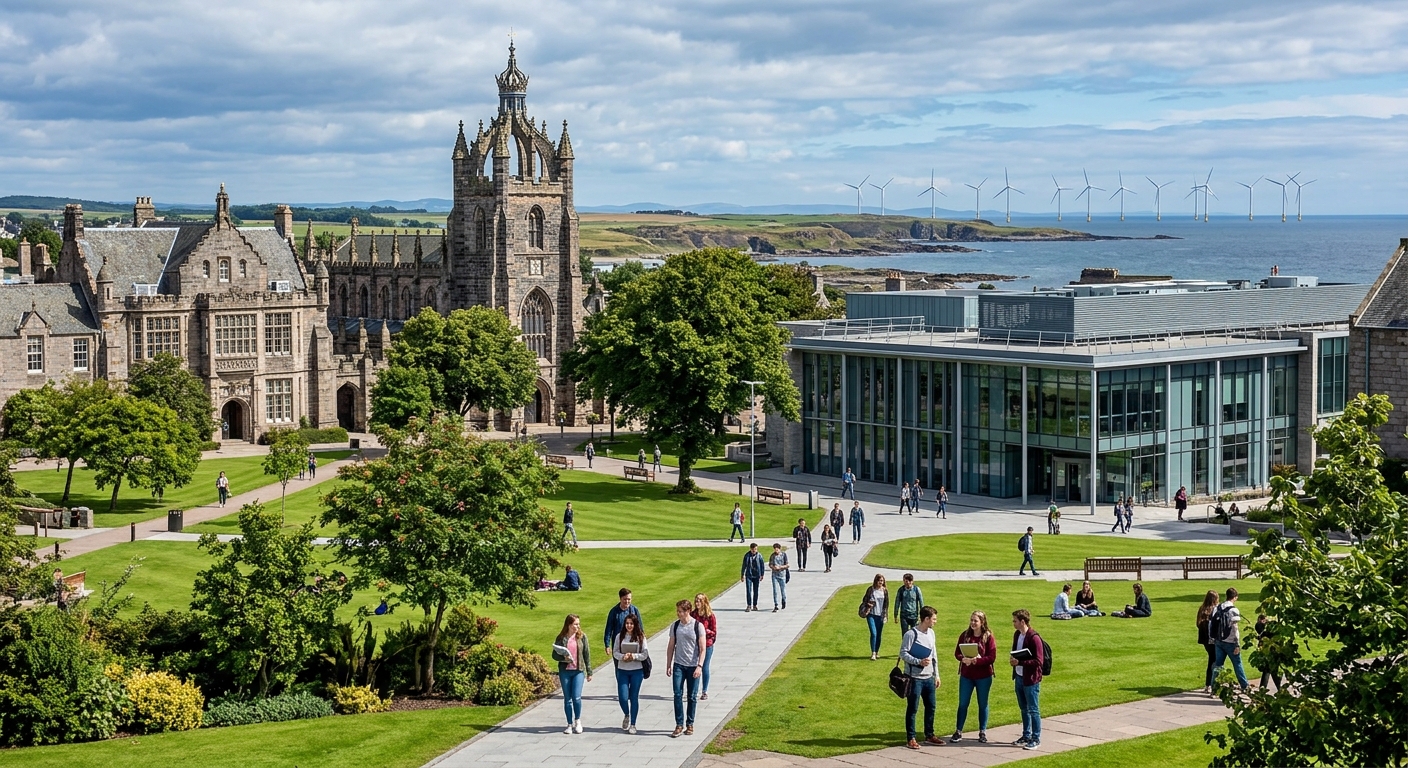
University of Aberdeen Campus, United Kingdom
Master of Science in Energy Transition Systems and Technologies
University of Aberdeen
Energy Engineering and Renewable Technologies
Program Overview: MSc Energy Transition Systems and Technologies
The MSc Energy Transition Systems and Technologies at the University of Aberdeen combines detailed knowledge of the technical and commercial aspects of Low Carbon Technologies with a broader systems-thinking approach to understanding complex, interconnected multi-energy systems. Based in the School of Engineering, this program draws on research conducted within the Centre for Energy Transition (CET), with expert contributions from the Schools of Geosciences, Business, and Law.
You will learn about the latest technological innovations in areas such as wind, tidal, and hydrogen energy, energy storage, carbon capture and storage, and biofuels, while also engaging with the wider economic and political dimensions of the energy transition. The program trains you in system-level analysis methods including Geographical Information Systems (GIS) and Energy System Analysis (ESA), equipping you with the tools to assess and compare different technologies.
Aberdeen is an exciting place to study the energy transition, as the city sits at the forefront of the UK's net zero strategy with major projects such as Equinor's Hywind project and the European Offshore Wind Deployment Centre already operational. Graduates emerge as a new generation of systems engineers prepared for careers across the entire energy sector.
Key Program Highlights
- First-of-its-kind program in the UK focusing on the transition from fossil fuels to renewables through Low Carbon Technology integration
- Interdisciplinary teaching drawing from Engineering, Geosciences, Business, and Law schools
- Hands-on training in GIS, Energy System Analysis, and techno-economic assessment tools
- Located in Aberdeen, a major international energy centre with direct industry involvement and networking opportunities
Curriculum and Core Modules
The MSc Energy Transition Systems and Technologies curriculum is structured to provide both deep technical knowledge of individual Low Carbon Technologies and a holistic understanding of energy systems integration. You will study core modules covering renewable energy sources, systems analysis, policy frameworks, and complete an independent research project that addresses a real-world industry challenge.
Introduction to Energy Transition: Demand, Technologies and Economics
15 SCQF CreditsProvides an introduction and overview of energy transition, focusing on demand, technology, and economics. Covers the current energy system, key drivers of energy reliance, and evaluates behavioural measures and technologies using technical, economic, and environmental criteria.
Wind and Marine Energy
15 SCQF CreditsDevelops understanding of the physical principles, technologies, and systems associated with renewable energy generation from wind and marine sources, including their position in current and future global energy requirements.
Energy Systems Integration
15 SCQF CreditsProvides knowledge and skills in critical analysis, multi-criteria assessment, and planning of multi-energy systems while considering system integration factors. Includes hands-on individual and group system integration projects.
Renewable Energy Legislation, Economics and Safety
15 SCQF CreditsDevelops a broad understanding of renewable energy legislation and the relevant aspects of economics and safety that govern how the renewable energy industry operates.
Carbon Capture, Utilisation and Storage (CCUS)
15 SCQF CreditsCovers fundamental concepts of carbon capture, pipeline transportation, utilisation, and safe underground geological storage, including practical applications and implementation in ongoing projects worldwide.
MSc Individual Project
60 SCQF CreditsAn independent research project on a topic related to energy transition, encouraging students to focus on an industry-relevant problem. Demonstrates how skills and knowledge gained during taught courses can provide solutions to practical challenges.
Elective Modules
Admission Requirements
The MSc Energy Transition Systems and Technologies is aimed at students with a background in engineering or similar quantitative subjects. Admission is competitive, and all applications are reviewed on a case-by-case basis taking into account qualifications and relevant experience. To begin your application, contact Uni4Edu for personalised guidance.
Academic Requirements
- Primary Academic RequirementA 2:1 (upper second class) UK Honours degree or equivalent in Engineering or a related field such as natural sciences, physical sciences, or mathematics
- Alternative Academic RequirementA 2:2 (lower second class) UK Honours degree in Engineering or a related field, or equivalent, with 5+ years of relevant professional experience
- Eligible BackgroundsBSc and BEng engineering graduates, as well as graduates of allied fields in physical sciences, natural sciences, and mathematics
- ATAS CertificateAn Academic Technology Approval Scheme (ATAS) certificate may be required for certain nationalities
- Additional ConsiderationApplications may include an interview with the Postgraduate Programme Director; relevant professional experience is valued
English Language Requirements
- IELTS AcademicOverall 6.5, with minimum 5.5 in Listening, 5.5 in Reading, 5.5 in Speaking, and 6.0 in Writing
- TOEFL iBTOverall 90, with minimum 17 in Listening, 18 in Reading, 20 in Speaking, and 21 in Writing
- Other TestsEquivalent scores on other recognised English language tests are accepted; contact Uni4Edu for details
Required Documents
Application Deadlines
For personalized admission guidance, document verification, and application support, please contact Uni4Edu
Scholarships and Funding
The University of Aberdeen offers several funding opportunities to support international postgraduate students. Scholarships are designed to ease the financial burden of studying abroad and reward academic merit. Contact Uni4Edu for help identifying the best funding options for your circumstances.
Aberdeen Global Scholarship
GBP 8,000 tuition fee waiverAutomatically applied to all eligible self-funded international on-campus Masters students. No separate application is required. Available for both taught and research Masters programs.
Alumni Postgraduate Scholarship
20% tuition fee discountAvailable to University of Aberdeen graduates pursuing postgraduate study. The discount is applied during the application process and cannot be combined with other university scholarships.
ISC Merit-Based Scholarship
Up to GBP 2,000 tuition fee discountAwarded to students who achieve a grade B (68%) or higher in their Pre-Masters pathway program at the International Study Centre before progressing to their postgraduate degree.
For detailed tuition fee information, please contact Uni4Edu — we will guide you through the costs and available funding options for this program.
Career Prospects
Graduates of the MSc Energy Transition Systems and Technologies are well placed to pursue careers across a wide range of industries, public sector organisations, and academia. The program's combination of technical depth and systems-thinking approach prepares you for leadership roles in the rapidly growing clean energy sector.
Typical Job Roles
Typical Employers
Rankings and Recognition
The University of Aberdeen, founded in 1495, is Scotland's third oldest university and the fifth oldest in the United Kingdom. It is consistently ranked among the top universities globally and nationally, with particular strength in energy-related research through its Centre for Energy Transition.
| Subject | Ranking Body | Rank |
|---|---|---|
| Engineering (General) | Complete University Guide | Top 30 UK |
| Chemical Engineering | Complete University Guide | #24 UK |
| Energy Research Impact | Leiden Rankings | Top 50 UK for scientific impact |
| Collaborative Research | Leiden Rankings | #16 UK |
How to Apply
Applying for this program is easy with Uni4Edu. Our team will guide you through every step of the process — from document preparation to final enrolment.
Contact Uni4Edu
Reach out to our team via email or phone. We will assess your profile and confirm your eligibility for this program.
Prepare Your Documents
Our advisors will provide you with a personalised checklist of required documents and help you prepare your application package.
Submit Your Application
Uni4Edu will submit your application on your behalf and keep you updated on its progress throughout the review period.
Receive Your Offer
Once accepted, we will help you understand your offer, arrange visa support if needed, and guide you through the enrolment process.
Similar Programmes

Master's & Postgraduate
24 months
Immersive Spaces MA

Istituto Europeo di Design (IED), Rome, Italy
Earliest Intake
June 2026
Gross Tuition
17300 €


Bachelor's Degree
36 months
Materials Science
University of Florence, Florence, Italy
Earliest Intake
December 2026
Gross Tuition
3000 €

Master's & Postgraduate
24 months
Migrations, Rights, Intergration Master
University of Palermo, Palermo, Italy
Earliest Intake
March 2026
Gross Tuition
356 €

Bachelor's Degree
48 months
Language and Speach Therapy
Ankara Medipol University, Altındağ, Turkey
Earliest Intake
January 2026
Gross Tuition
4080 $

Master's & Postgraduate
24 months
Master of Public Law
Kibris Aydin University, Kyrenia, Cyprus
Earliest Intake
April 2027
Gross Tuition
7000 $



Uni4Edu AI Assistant