Aquatic Resources
San Marcos, Texas, USA, United States

Master of Science in Aquatic Resources
Texas State University
Aquatic Sciences & Resources
Program Overview: M.S. in Aquatic Resources
The Aquatic Resources Master of Science program at Texas State University is a multidisciplinary, thesis-based degree rooted in aquatic sciences and aquatic resource management. Offered through the Department of Biology, the program requires a minimum of 30 credit hours of coursework and equips students with advanced knowledge in the ecology, biology, and management of aquatic ecosystems.
Students can choose between two concentrations: Aquatic Biology, which focuses on the biology and ecology of aquatic organisms and ecosystem dynamics, or Aquatic Systems, which examines the structure and functioning of aquatic systems as integrated physical, biological, and socioeconomic entities. Each student carries out an independent research project mentored by a biology faculty member, often in collaboration with state or federal agencies.
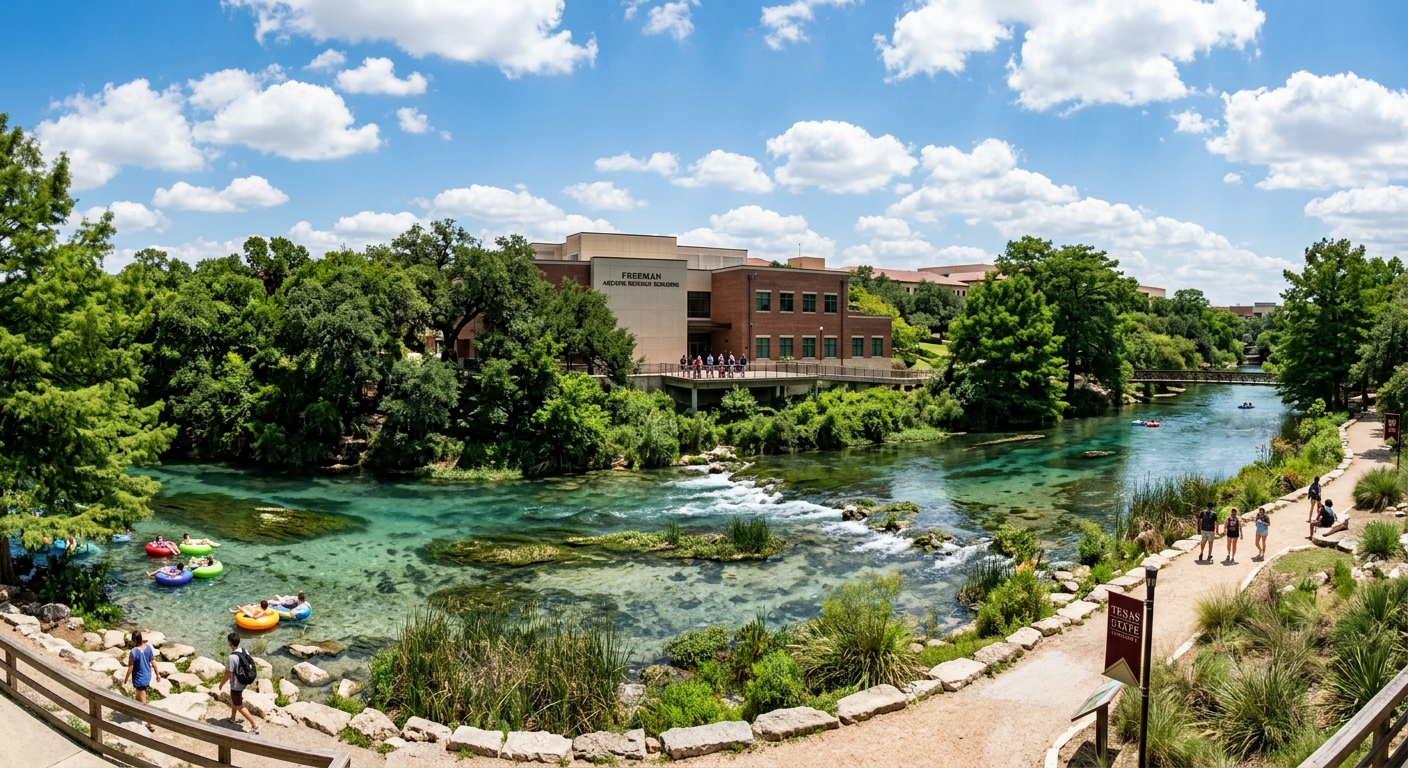
Texas State's location in San Marcos provides unparalleled access to the San Marcos River, Spring Lake, the Meadows Center for Water and the Environment, and the Freeman Aquatic Biology Building. Students benefit from proximity to diverse aquatic ecosystems throughout the Texas Hill Country and the Edwards Aquifer, creating exceptional opportunities for hands-on field research.
Key Program Highlights
- Two concentrations available: Aquatic Biology and Aquatic Systems, allowing you to tailor your studies to your career goals
- Thesis-based research program with faculty mentorship and frequent collaboration with state and federal resource agencies
- Access to the 30,000-square-foot Freeman Aquatic Biology Building with wet labs, artificial stream systems, and continuous Edwards Aquifer water supply
- Direct proximity to the San Marcos River, Spring Lake, and diverse Texas Hill Country ecosystems for unmatched field research opportunities
Curriculum & Modules
The M.S. in Aquatic Resources requires 30 semester credit hours including thesis research. Students take core courses in statistics and seminars, along with elective courses chosen in consultation with their thesis advisor, committee, and program director. All master's students must pass a final comprehensive examination administered by their thesis committee.
Seminar in Biology
1 Credit HourInteractive discussion of timely issues and problems, designed to expose students to current literature in their fields of interest and its critical analysis. This course is repeatable for credit.
Graduate Research in Biology
3 Credit HoursAllows master's level graduate students to initiate, conduct, and participate in collaborative research with graduate faculty of the Department of Biology, in addition to thesis research.
Thesis Research (BIO 5399A/B)
6 Credit HoursIndependent thesis research conducted under the supervision of a faculty mentor. Students design and execute an original research project in aquatic resources culminating in a written thesis and oral defense.
Statistics for Biological Sciences
3 Credit HoursProvides graduate-level training in statistical methods and data analysis techniques commonly used in biological and ecological research, including experimental design and hypothesis testing.
Ecology of Aquatic Ecosystems
3 Credit HoursExamines the structure and function of freshwater and aquatic ecosystems, including community ecology, nutrient cycling, energy flow, and the biological interactions that shape aquatic environments.
Interpretive Biology Programming and Design
3 Credit HoursExplores the methods and principles used by the National Park Service, museums, environmental centers, and state park systems to interpret biology and natural environments effectively for diverse audiences.
Elective Courses
Admission Requirements
Admission to the M.S. in Aquatic Resources is competitive and requires a strong academic background in biology or a related field. Applicants must secure a faculty mentor within the Department of Biology before applying, as an intent to mentor letter is a required component of the application. Contact Uni4Edu for guidance on the application process and to connect with program advisors.
Academic Requirements
- Bachelor's DegreeBaccalaureate degree in biology or a related field from a regionally accredited university. Non-U.S. degrees must be equivalent to a four-year U.S. bachelor's degree.
- Minimum GPA3.0 overall GPA or 3.0 GPA in the last 60 hours of undergraduate coursework (plus any completed graduate courses)
- Mentor LetterAn intent to mentor letter from a current Texas State faculty member in the Department of Biology is required before the application deadline
- Letters of RecommendationThree letters of recommendation addressing the substance and quality of your preparation for graduate study
- Leveling CoursesStudents lacking sufficient background coursework may be required to complete leveling courses with grades of B or better prior to admission
English Language Requirements
- TOEFL iBTMinimum overall score of 78
- IELTS (Academic)Minimum overall score of 6.5 with minimum individual module scores of 6.0
- Duolingo English TestMinimum overall score of 110
Required Documents
For personalized admission guidance, document verification, and application support, please contact Uni4Edu
Scholarships & Funding
Texas State University offers several funding opportunities for graduate students in the Aquatic Resources program, including departmental scholarships, university-wide fellowships, and graduate assistantships. The Graduate College has committed significant fellowship funding for incoming master's students, and additional department-specific awards support students pursuing aquatic and hydrological studies.
Texas State Merit Fellowship
Partial tuition coverageAwarded by The Graduate College to recruit high-quality master's degree-seeking students. Admitted students in eligible programs are automatically considered with no separate application required. Can be combined with graduate assistantships or departmental scholarships.
Chuck Nash Scholarship in Aquatic and Hydrological Studies
Up to USD 1,000Available to full-time junior, senior, or M.S. graduate students pursuing studies in aquatics or hydrology with a GPA of 3.0 or higher. Named after San Marcos businessman and former Texas Parks and Wildlife Commission member Chuck Nash.
Graduate Assistantships (Teaching, Research, Instructional)
Stipend plus tuition benefitsGraduate assistantships provide professional development, a monthly stipend, and tuition benefits. Positions average 20 hours per week and international students holding a GA position may be eligible for in-state tuition rates. Contact Uni4Edu for current availability.
For detailed tuition fee information, please contact Uni4Edu — we will guide you through the costs and available funding options for this program.
Career Prospects
Graduates of the M.S. in Aquatic Resources program are well-prepared for careers spanning aquatic resource management, aquatic ecology, hydrogeology, and environmental consulting. The program also prepares students to teach at the community college level or to continue their education by pursuing doctoral studies in aquatic resources and integrative biology or related fields.
Potential Career Paths
Typical Employers
Rankings & Recognition
Texas State University is a growing public research institution recognized for its strong commitment to academic quality and social mobility. The university has been climbing national rankings consistently and has received recognition from multiple ranking bodies for its comprehensive academic offerings and student outcomes.
| Subject | Ranking Body | Rank |
|---|---|---|
| Social Mobility | U.S. News & World Report | #144 |
| Biology (Department) | Texas State University | Home to M.S. and Ph.D. programs in Aquatic Resources |
| Life Sciences | THE World University Rankings | Contact Uni4Edu for current data |
| Environmental Sciences | Various Ranking Bodies | Contact Uni4Edu for current data |
How to Apply
Applying for this program is easy with Uni4Edu. Our team will guide you through every step of the process — from document preparation to final enrolment.
Contact Uni4Edu
Reach out to our team via email or phone. We will assess your profile and confirm your eligibility for this program.
Prepare Your Documents
Our advisors will provide you with a personalised checklist of required documents and help you prepare your application package.
Submit Your Application
Uni4Edu will submit your application on your behalf and keep you updated on its progress throughout the review period.
Receive Your Offer
Once accepted, we will help you understand your offer, arrange visa support if needed, and guide you through the enrolment process.
Similar Programmes


Bachelor's Degree
36 months
Marine Vertebrate Conservation BSc (Hons)

Prifysgol Bangor University, Bangor, United Kingdom
Earliest Intake
May 2027
Gross Tuition
20000 £

Bachelor's Degree
36 months
Marine Biology and Zoology BSc (Hons)
Prifysgol Bangor University, Bangor, United Kingdom
Earliest Intake
May 2027
Gross Tuition
20000 £

Bachelor's Degree
48 months
Reproductive Biology BSc
University of Edinburgh, Edinburgh, United Kingdom
Earliest Intake
January 2027
Gross Tuition
38900 £

Bachelor's Degree
36 months
Ocean Science BSc (Hons)
Prifysgol Bangor University, Bangor, United Kingdom
Earliest Intake
May 2027
Gross Tuition
20000 £

Master's & Postgraduate
12 months
PGCE Secondary Science with Biology - PGCE
London Metropolitan University, London, United Kingdom
Earliest Intake
April 2026
Gross Tuition
15500 £



Uni4Edu AI Assistant