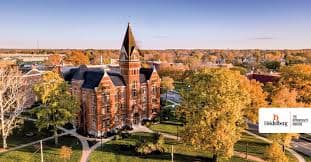
Heidelberg University
Heidelberg, Germany

Heidelberg University (Ruprecht-Karls-Universität Heidelberg)
Heidelberg, Germany
Founded
1386
Institution Type
Public Research University
Total Students
~30,000
Nobel Laureates
56 Affiliated
Discover Heidelberg University: Germany's Oldest University
Discover Heidelberg University: Germany's Oldest University
Founded in 1386 by Elector Palatine Rupert I with the permission of Pope Urban VI, Heidelberg University — officially known as Ruprecht-Karls-Universität Heidelberg or Ruperto Carola — is Germany's oldest university and one of the oldest surviving universities in the world. It was the third university established in the Holy Roman Empire, after Prague and Vienna, and was originally modeled on the University of Paris.
Today, Heidelberg University is a comprehensive public research institution with thirteen faculties offering more than 180 study programmes across the humanities, social sciences, law, natural sciences, engineering sciences, life sciences, and medicine. Around 30,000 students are enrolled, with international students from over 130 countries making up roughly 20 percent of the student body.
Heidelberg holds the prestigious status of a German University of Excellence, having been successful in all rounds of the Excellence Competition. It is a founding member of the League of European Research Universities and the Coimbra Group, and it maintains exchange programmes with approximately 480 universities worldwide.
Key Milestones
- 1386: University founded by Elector Palatine Rupert I, becoming Germany's oldest university with initial faculties in theology, jurisprudence, and philosophy.
- 1803: Reorganized as a state-financed institution by Grand Duke Karl Friedrich of Baden, adopting the name Ruperto Carola.
- 2007: Awarded University of Excellence status in Germany's Excellence Initiative, with funding for its institutional strategy and Clusters of Excellence.
- 2026: Once again awarded the title of University of Excellence in the latest Excellence Competition, with new funding beginning January 2027.
Academic Structure and Faculties
Academic Structure and Faculties
Heidelberg University is organized into thirteen faculties that span the full breadth of academic disciplines. Its broad subject spectrum includes the humanities and social sciences, law, natural and engineering sciences, life sciences, and medicine, offering degree programmes at the undergraduate, graduate, and postdoctoral levels.
Faculty of Medicine (Heidelberg & Mannheim)
One of the original four faculties from 1386, the medical faculty operates across two campuses with distinct teaching curricula — HeiCuMed in Heidelberg and MaReCuM in Mannheim — and maintains close ties with the University Hospital Heidelberg.
- Medicine (Staatsexamen)
- Molecular Medicine (M.Sc.)
- International Health (M.Sc.)
Faculty of Law
One of the oldest law faculties in Europe, Heidelberg's Faculty of Law has produced alumni who have served at the International Court of Justice, the European Court of Human Rights, and Germany's Federal Constitutional Court.
- Law (Staatsexamen)
- International Law (LL.M.)
- European Business Law (LL.M.)
Faculty of Physics and Astronomy
Home to the Heidelberg Center for Astronomy and strong research in quantum physics, astrophysics, and environmental physics, this faculty has a distinguished tradition including multiple Nobel Prize-winning physicists.
- Physics (B.Sc. / M.Sc.)
- Astronomy (M.Sc.)
- Scientific Computing (M.Sc.)
Faculty of Biosciences
Ranked among the top biology faculties in Germany, the Faculty of Biosciences conducts research in molecular biology, genetics, neuroscience, and ecology, and collaborates closely with the German Cancer Research Center (DKFZ).
- Biological Sciences (B.Sc.)
- Molecular Biosciences (M.Sc.)
- Developmental and Stem Cell Biology (M.Sc.)
Faculty of Philosophy
Heidelberg's Faculty of Philosophy has been a center for intellectual inquiry since the university's founding, with historic ties to luminaries such as Hegel, Jaspers, and Gadamer. It covers a wide range of disciplines including history, art history, and classical studies.
- Philosophy (B.A. / M.A.)
- History (B.A. / M.A.)
- Classical Archaeology (M.A.)
Faculty of Economics and Social Sciences
Located on the Bergheim Campus, this faculty offers programmes in economics, political science, and sociology, emphasizing interdisciplinary approaches and quantitative methods within the social sciences.
- Economics (B.Sc. / M.Sc.)
- Political Science (B.A. / M.A.)
- Sociology (B.A. / M.A.)
Admission Requirements for International Students
Admission Requirements for International Students
Undergraduate Admission
- University Entrance QualificationRecognized secondary school certificate equivalent to the German Abitur; some nationalities may need to complete Studienkolleg first
- German Language ProficiencyDSH-2 or TestDaF 4x4 required for German-taught programmes
- Application PortalApply via uni-assist or directly through the university's online portal, depending on nationality
- Subject-Specific RequirementsSome programmes have additional prerequisites such as entrance exams, portfolios, or aptitude tests
- Application FeeNo application fee charged by Heidelberg University
Graduate (Master's) Admission
- Previous DegreeCompleted Bachelor's degree or equivalent from a recognized university in a related field
- Academic PerformanceAbove-average grades in the undergraduate degree are typically required
- Language ProficiencyGerman (DSH-2/TestDaF) for German-taught programmes; TOEFL/IELTS for English-taught Master's programmes
- Motivation and ReferencesMotivation letter and letters of recommendation are commonly required
- Additional RequirementsSome programmes require specific professional experience or subject-specific prerequisites as outlined in their admission regulations
Application deadline for most programmes beginning in the winter semester (October). Some programmes may have earlier deadlines.
Application deadline for programmes that accept entry in the summer semester (April). Not all programmes offer summer intake.
Some programmes set earlier deadlines for non-EU/EEA applicants to allow time for visa processing. Check your specific programme.
Doctoral admissions are typically arranged individually with supervisors and do not follow a fixed application cycle.
Tuition Fees and Cost of Attendance
Tuition Fees and Cost of Attendance
Heidelberg University is a public institution and does not charge traditional tuition fees for most students. EU/EEA students pay only a modest semester fee, while non-EU/EEA international students are required to pay a tuition fee of EUR 1,500 per semester as mandated by the state of Baden-Württemberg.
| Cost Category | EU/EEA Students (per semester) | Non-EU/EEA Students (per semester) |
|---|---|---|
| Tuition Fee | EUR 0 | EUR 1,500 |
| Semester Fee (Administrative) | EUR 161.10 | EUR 161.10 |
| Estimated Living Costs (monthly) | EUR 850 – 1,200 | EUR 850 – 1,200 |
| Health Insurance (approx. monthly) | EUR 110 – 120 | EUR 110 – 120 |
| Total | EUR 161.10 per semester + living costs | EUR 1,661.10 per semester + living costs |
DeutschlandStipendium
A merit-based scholarship funded jointly by the German federal government and private sponsors, awarded to high-performing students regardless of nationality.
- Award Amount: EUR 300 per month
- Duration: At least two semesters, renewable
- Eligibility: Open to all enrolled students based on academic achievement and social engagement
DAAD Scholarships
The German Academic Exchange Service (DAAD) offers a wide range of scholarships for international students at all academic levels to study at German universities including Heidelberg.
- Award Amount: Varies by programme (typically EUR 861 – 1,200 per month for Master's students)
- Coverage: May include tuition fee waiver, travel allowance, and health insurance subsidy
- Application: Apply through the DAAD portal; deadlines vary by programme and country of origin
Campus and Facilities
Campus and Facilities
Heidelberg University is spread across three main campuses in the city, each with its own distinct character and academic focus. The Altstadt (Old Town) campus houses the humanities, the Neuenheimer Feld campus hosts the natural sciences and medicine, and the Bergheim campus is home to the social sciences.
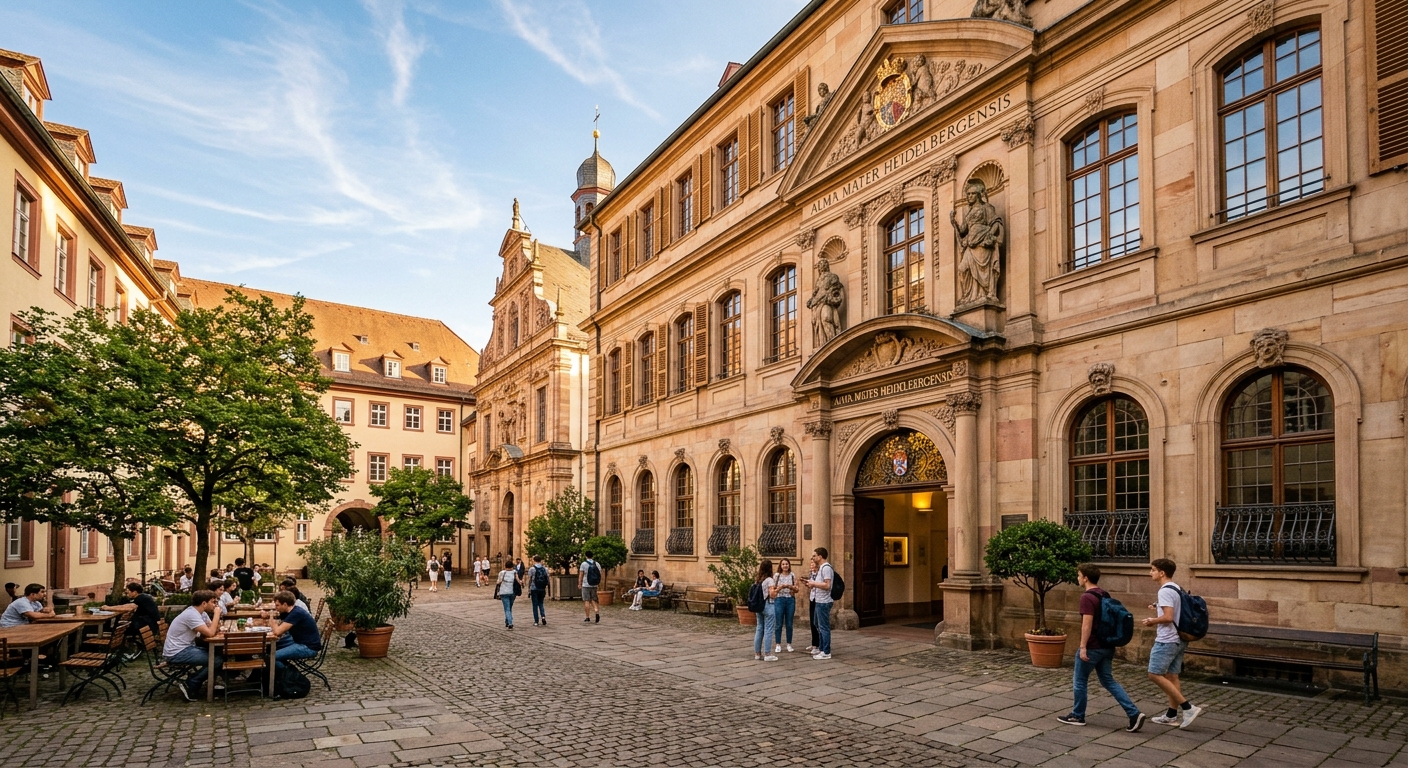
The historic heart of the university featuring the Old University building, the University Library, and humanities faculties set among medieval streets.
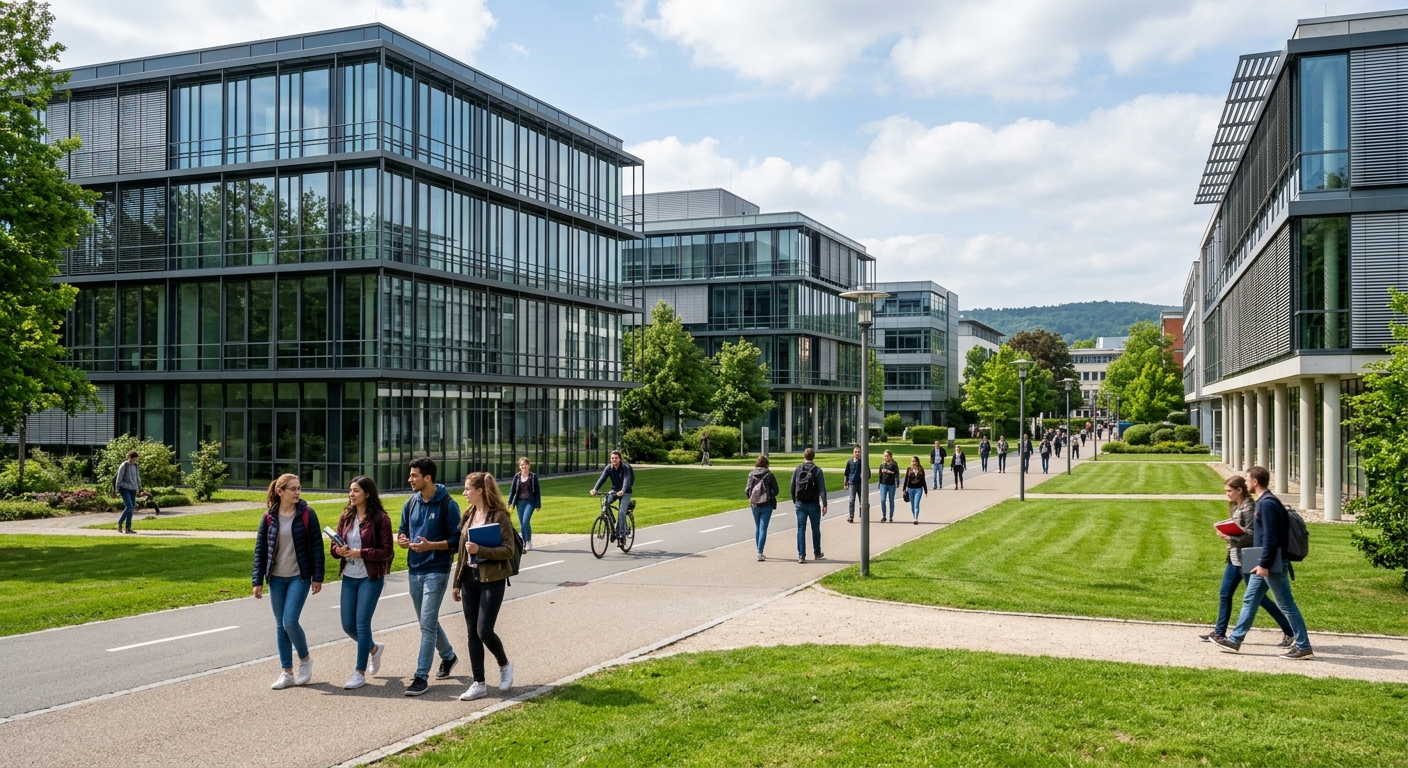
A modern campus across the Neckar River housing natural sciences, life sciences, and medical faculties alongside the University Hospital and the German Cancer Research Center.

One of Germany's most important academic libraries, housing millions of volumes including rare medieval manuscripts from the famous Bibliotheca Palatina collection.
Housing and Student Services
Student Housing
Student housing is provided through Studierendenwerk Heidelberg, offering affordable dormitory rooms and shared apartments across the city for enrolled students.
- Multiple dormitory locations throughout Heidelberg
- Single rooms and shared apartment options available
- Apply early as demand is high — private housing is also available
Dining and Amenities
Studierendenwerk operates several canteens (Mensas) on each campus offering affordable meals, along with cafeterias and student lounges.
- Multiple Mensa locations with diverse meal options
- University sports center with over 100 activities
- Counseling, health services, and career guidance available
Student Life at Heidelberg
Student Life at Heidelberg
Heidelberg University offers a vibrant student life enriched by centuries of tradition, a diverse international community, and the charming setting of one of Germany's most picturesque cities. With roughly a quarter of the city's population being students, Heidelberg is truly a university town.
Heidelberg: A Historic University City
Heidelberg: A Historic University City
Living in Heidelberg
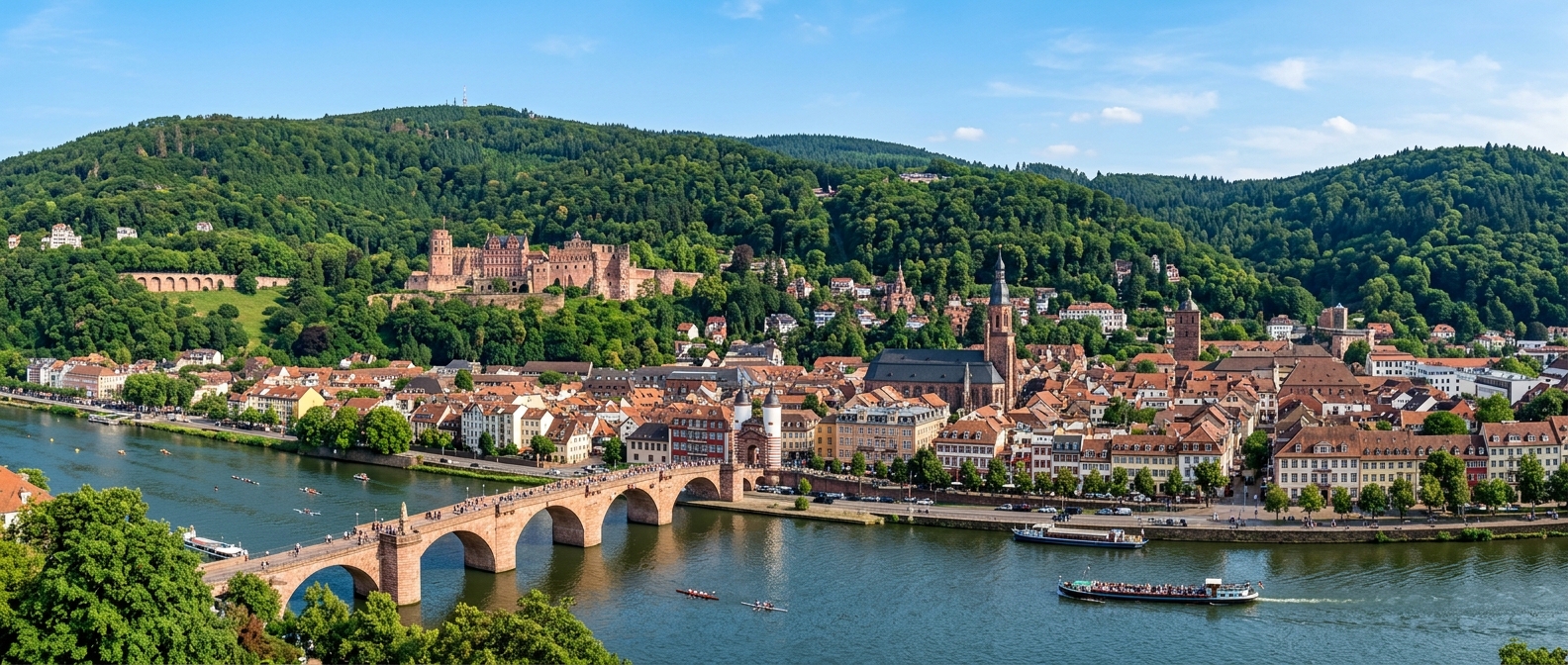
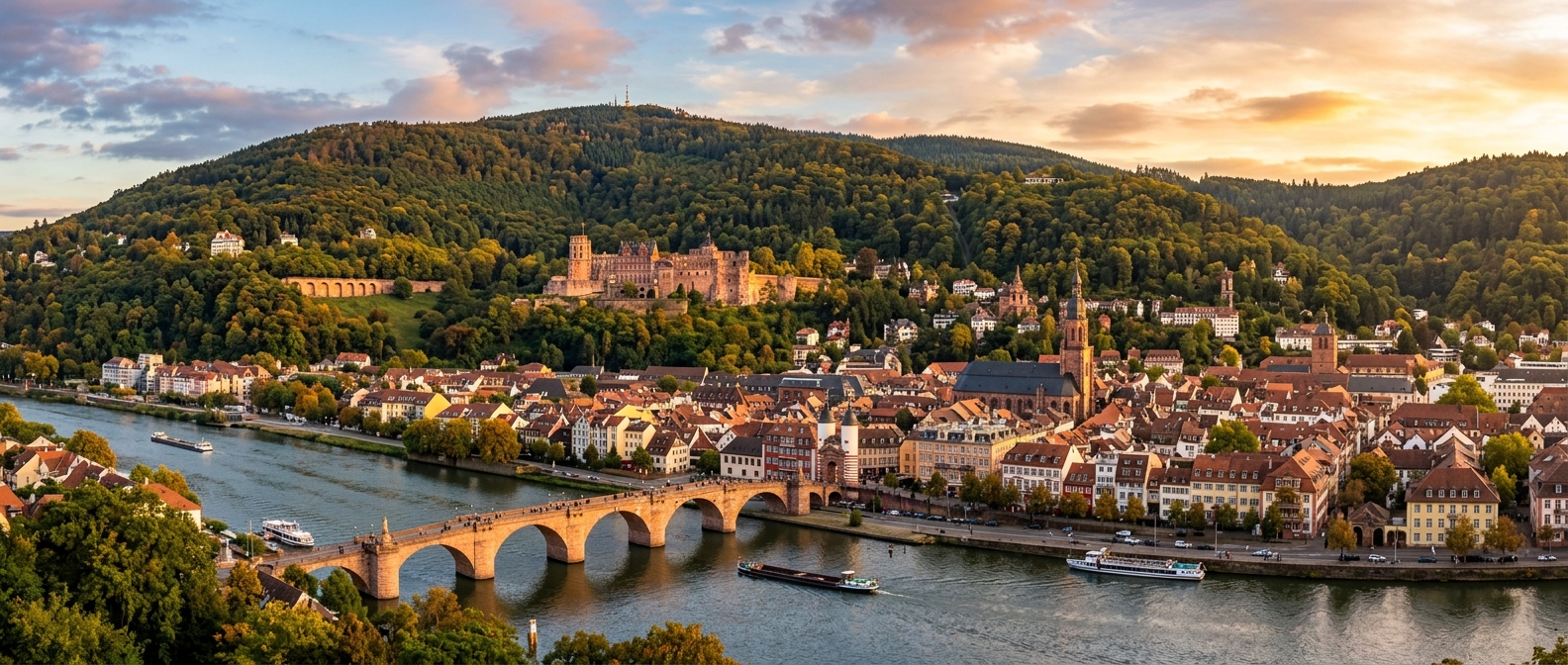
Heidelberg is a picturesque city of approximately 163,000 residents in the state of Baden-Württemberg, located about 78 km south of Frankfurt on the banks of the Neckar River. Known for its romantic Old Town, historic castle, and vibrant academic culture, roughly a quarter of its population are students, giving the city an energetic and youthful atmosphere.
Heidelberg Castle
One of Germany's most iconic landmarks, this Renaissance castle ruin sits atop the Königstuhl hillside and offers panoramic views of the city, the river, and the Rhine Plain.
Old Town (Altstadt)
A beautifully preserved medieval city center with baroque architecture, charming streets, the Heiliggeistkirche, and the famous Hauptstrasse — one of Europe's longest pedestrian shopping streets.
Philosophers' Walk (Philosophenweg)
A scenic hillside path on the north bank of the Neckar offering stunning views of the Old Town, the castle, and the river valley — a favorite walk for thinkers and students for centuries.
Rhine-Neckar Metropolitan Region
Heidelberg is part of the dynamic Rhine-Neckar metropolitan area with excellent transport links to Frankfurt, Mannheim, and Stuttgart, providing access to major employers and cultural attractions.
Career Outcomes and Distinguished Alumni
Career Outcomes and Distinguished Alumni
Notable Employers and Alumni-Founded Companies
Practical Information for International Students
Practical Information for International Students
For International Students
The International Relations Office provides comprehensive support for international students including application guidance, orientation programmes, the Buddy Program, and advice on residence permits and financing your studies.
The university offers German language courses and the DSH exam for international students. Most undergraduate programmes are taught in German, while many Master's programmes are available in English.
The Career Service provides an online job portal, career counseling, workshops on the German job market, and guidance on work visas. The heiSKILLS Centre offers language courses and key competences for professional development.
Key Contacts
- +90 5435286292
- +44 7868736984
- corporate@uni4edu.com
- info@uni4edu.com
Heidelberg University World Rankings
Heidelberg University World Rankings
Heidelberg University consistently ranks among the top universities in Germany and worldwide. It is one of only three German universities to appear in the global Top 50 in the Times Higher Education rankings, and it maintains strong positions across all major international ranking systems.
| Subject | Ranking Body | Rank |
|---|---|---|
| Medicine | EduRank | #1 in Germany, #22 Worldwide |
| Life Sciences | Times Higher Education | #36 Worldwide |
| Biology | EduRank | #1 in Germany, #34 Worldwide |
| Psychology | EduRank | #1 in Germany, #48 Worldwide |


Features
to advance outstanding individual disciplines, cross-linking them and addressing issues at the highest scholarly level;\nto create and safeguard the conditions for comprehensive, interdisciplinary collaboration that will make possible essential contributions toward the solution of major issues facing humanity, society, and government in an increasingly changing world;\nto make research results available to society and encourage their utilisation in all sectors of public life.
Accommodation
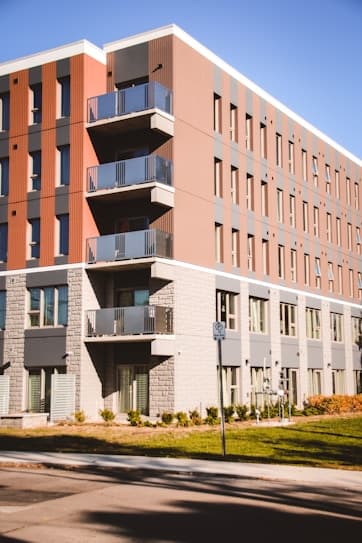
Accommodation service is available\n

Work While Studying
Students can work while studying\n\n

Co-op/Internship Participation
There is an internship service\n
Featured Programmes



Average Time To Receive Acceptance Letter
January - June
Location
Fischmarkt 1, 69117, Heidelberg, Rhein-Neckar-Kreis, Baden-Württemberg, Germany

Map not found.

Uni4Edu AI Assistant