Electrical Engineering (Ph.D.)
Harvard University, United States

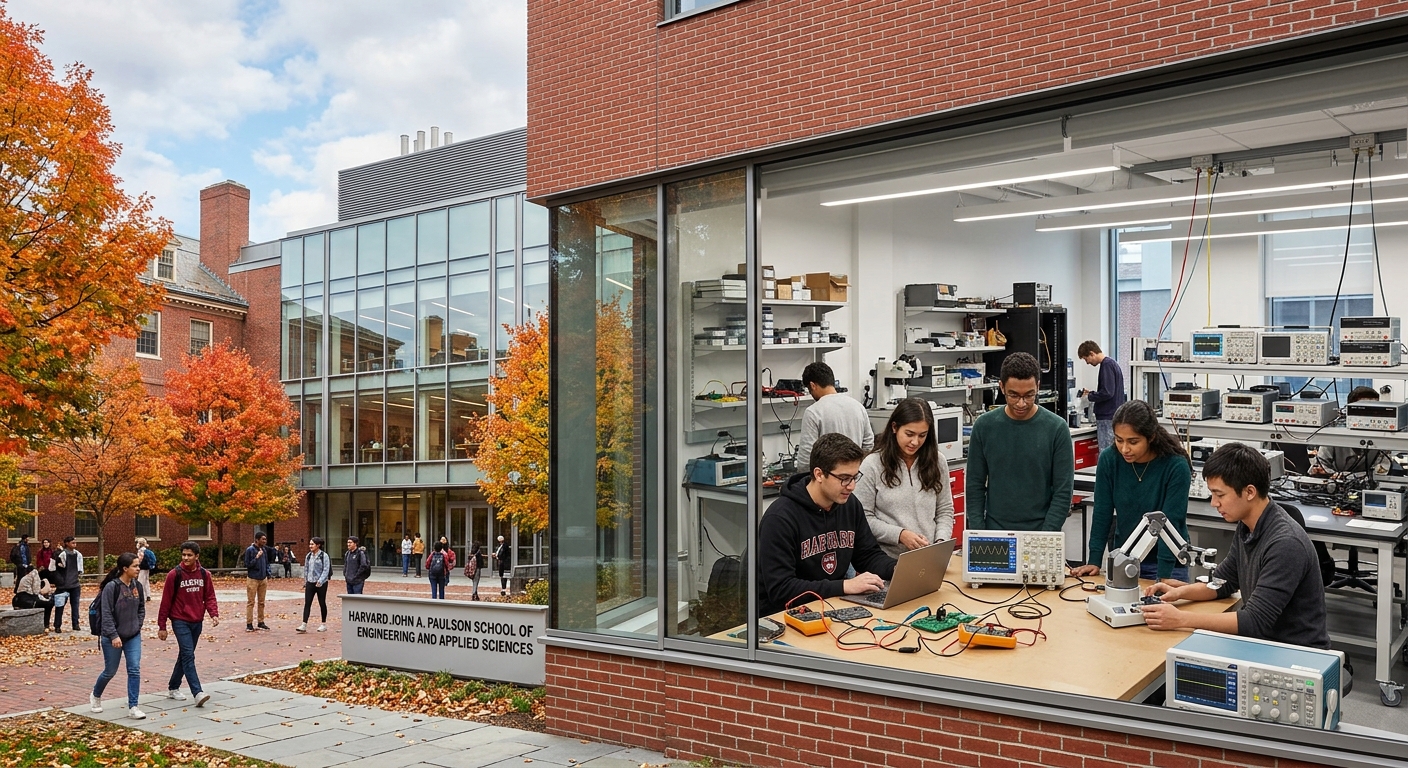
Doctor of Philosophy (Ph.D.) in Engineering Sciences: Electrical Engineering
Harvard University
Electrical Engineering
Program Overview: PhD in Electrical Engineering at Harvard
The Electrical Engineering PhD program at Harvard studies systems that sense, analyze, and interact with the world. Offered through the Harvard John A. Paulson School of Engineering and Applied Sciences (SEAS) and conferred by the Harvard Kenneth C. Griffin Graduate School of Arts and Sciences, this doctoral program provides opportunities for both theoretical and experimental research grounded in fundamental science and mathematics.
As a PhD student, you will choose from a wide range of research areas such as circuits and VLSI, computer engineering and architecture, robotics and control, and signal processing. Current research at Harvard SEAS includes work on diamond nanofabrication, quantum devices, integrated circuits for cellular biotechnology, millimeter-scale robots, hardware for machine learning, and the optimization of smart power grids.
Graduates of the program have gone on to a range of careers in industry at companies such as Tesla, Microsoft HoloLens, and IBM, while others have secured academic positions at institutions including the University of Maryland, University of Michigan, and University of Colorado. The program emphasizes both deep specialization and broad interdisciplinary engagement across engineering and the sciences.
Key Program Highlights
- Conduct cutting-edge research in quantum devices, smart grids, robotics, and machine learning hardware at one of the world's leading engineering schools
- Flexible, advisor-guided curriculum drawing from SEAS, statistics, mathematics, physics, computer science, and chemistry
- Opportunity to earn a Master of Science (S.M.) degree en route to the PhD and pursue secondary fields in Data Science or Computational Science and Engineering
- Access to cross-Harvard collaboration including the Health Sciences and Technology program with Harvard Medical School and MIT
Curriculum and Research Areas
The PhD program requires a minimum of 10 semester-long graduate courses, including at least 8 disciplinary courses and at least 5 graduate-level SEAS technical courses. Students work closely with their advisors to develop an individualized program plan, as electrical engineering draws from disparate areas of knowledge. The curriculum is complemented by a teaching fellowship requirement and an oral qualifying examination.
Circuits and VLSI
Varies by courseAdvanced study of integrated circuit design, VLSI systems, and next-generation computing platforms including circuits for cellular biotechnology and edge computing applications.
Robotics and Control Systems
Varies by courseResearch and coursework in control theory, autonomous systems, and millimeter-scale robotics, with applications spanning industrial automation to biomedical devices.
Signal Processing and Information Theory
Varies by courseExploration of algorithms for analysis and control, information processing theory, and methods for distilling information from large stochastic datasets.
Energy Systems and Smart Grids
Varies by courseStudy of power and energy distribution, optimization of smart power grids and networked systems, and renewable energy technologies.
Quantum Engineering and Photonics
Varies by courseResearch in quantum devices, diamond nanofabrication, optoelectronic devices, and optical systems at the intersection of applied physics and electrical engineering.
Professional Development and Teaching
Varies by courseProfessional skills development including ES 297 Professional Writing for Scientists and Engineers, ES 301 SEAS Teaching Practicum, and a required Teaching Fellow semester.
Elective and Interdisciplinary Courses
Admission Requirements
Admission to the Electrical Engineering PhD at Harvard is highly competitive. Applicants typically hold bachelor's degrees in the natural sciences, mathematics, computer science, or engineering. A master's degree is not required for application. All applications are processed through Uni4Edu, which guides you through every step of the process.
Academic Requirements
- Academic BackgroundBachelor's degree in natural sciences, mathematics, computer science, or engineering
- GRE RequirementNot accepted — applicants should not submit GRE scores
- Master's DegreeNot required for PhD application
- Research ExperienceStrong research background preferred; alignment with faculty research interests is important
- Grade RequirementEach course must be passed with B- or better; B average must be maintained throughout the program
English Language Requirements
- TOEFL iBTMinimum score of 80 (speaking score of 26+ to meet oral proficiency requirement)
- IELTS AcademicMinimum overall score of 6.5 (speaking score of 8.0+ to meet oral proficiency requirement)
- ExemptionApplicants with an undergraduate degree from an English-medium institution may be exempt; scores valid for 2 years
Required Documents
Application Deadlines
For personalized admission guidance, document verification, and application support, please contact Uni4Edu
Scholarships and Funding
Harvard SEAS PhD students receive comprehensive financial support throughout their doctoral studies. The university is committed to ensuring that financial considerations do not prevent talented students from pursuing their research goals. Contact Uni4Edu for detailed information about available funding packages and how to maximize your financial support.
Harvard SEAS PhD Full Funding Package
All admitted PhD students receive a funding package that typically includes tuition coverage, a living stipend, and health insurance for the duration of their program, subject to satisfactory academic progress.
Teaching and Research Assistantships
PhD students serve as Teaching Fellows and Research Assistants, which form part of the financial support package. A one-semester teaching fellowship is required for the degree.
External Fellowships and Grants
Varies by awardStudents are encouraged to apply for external fellowships such as NSF Graduate Research Fellowships and other national or international awards. Uni4Edu can advise on additional funding opportunities.
For detailed tuition fee information, please contact Uni4Edu — we will guide you through the costs and available funding options for this program.
Career Prospects
Graduates of the Harvard Electrical Engineering PhD program are well-positioned for leadership roles in both industry and academia. The program's emphasis on fundamental research combined with practical innovation prepares graduates for impactful careers across diverse sectors including technology, energy, robotics, and higher education.
Potential Career Roles
Where Graduates Work
Rankings and Recognition
Harvard University consistently ranks among the top universities in the world across all major international ranking systems. Its engineering programs benefit from the university's exceptional research output, global employer reputation, and extensive international research network.
| Subject | Ranking Body | Rank |
|---|---|---|
| Engineering and Technology | QS World University Rankings | #9 |
| Engineering | Times Higher Education (THE) | #1 |
| Natural Sciences | QS Subject Rankings | #1 |
| Electrical and Electronic Engineering | QS Subject Rankings | Contact Uni4Edu for current data |
How to Apply
Applying for this program is easy with Uni4Edu. Our team will guide you through every step of the process — from document preparation to final enrolment.
Contact Uni4Edu
Reach out to our team via email or phone. We will assess your profile and confirm your eligibility for this program.
Prepare Your Documents
Our advisors will provide you with a personalised checklist of required documents and help you prepare your application package.
Submit Your Application
Uni4Edu will submit your application on your behalf and keep you updated on its progress throughout the review period.
Receive Your Offer
Once accepted, we will help you understand your offer, arrange visa support if needed, and guide you through the enrolment process.
Similar Programmes


Master's & Postgraduate
12 months
Advanced Electronic and Electrical Engineering MSc

Queen Mary, University of London, London, United Kingdom
Earliest Intake
January 2026
Gross Tuition
31450 £


Bachelor's Degree
48 months
Civil Engineering
Texas State University, San Marcos, United States
Earliest Intake
February 2027
Gross Tuition
24520 $

Bachelor's Degree
48 months
Electrical and Electronics Engineering
Beykent University, Sarıyer, Turkey
Earliest Intake
January 2026
Gross Tuition
3500 $

Bachelor's Degree
36 months
Electrical and Electronic Engineering BEng
University of Sheffield, Sheffield, United Kingdom
Earliest Intake
January 2026
Gross Tuition
32100 £


Bachelor's Degree
48 months
Electronic Engineering and Internet of Things (including foundation year) - BEng (Hons)
London Metropolitan University, London, United Kingdom
Earliest Intake
April 2025
Gross Tuition
15500 £



Uni4Edu AI Assistant