
Safety and Human Factors in Aviation
Cranfield School of Management, United Kingdom

MSc in Safety and Human Factors in Aviation
Cranfield University
Aviation Safety & Human Factors
Program Overview: MSc Safety and Human Factors in Aviation
The MSc in Safety and Human Factors in Aviation at Cranfield University is delivered through the specialist Safety and Accident Investigation Centre, which has supported global safety and investigation for over 30 years. This program uniquely synthesises the study of human factors with safety and safety assessment, creating a powerful combination that enables graduates to add value in applied aviation and safety-critical contexts.
The course attracts a wide variety of students, from aviation professionals in civil and military domains to high-quality graduates in engineering and social science disciplines. Accredited by the Chartered Institute of Ergonomics and Human Factors (CIEHF), the program equips students with industry-relevant skills delivered through a mix of lectures and practical exercises.
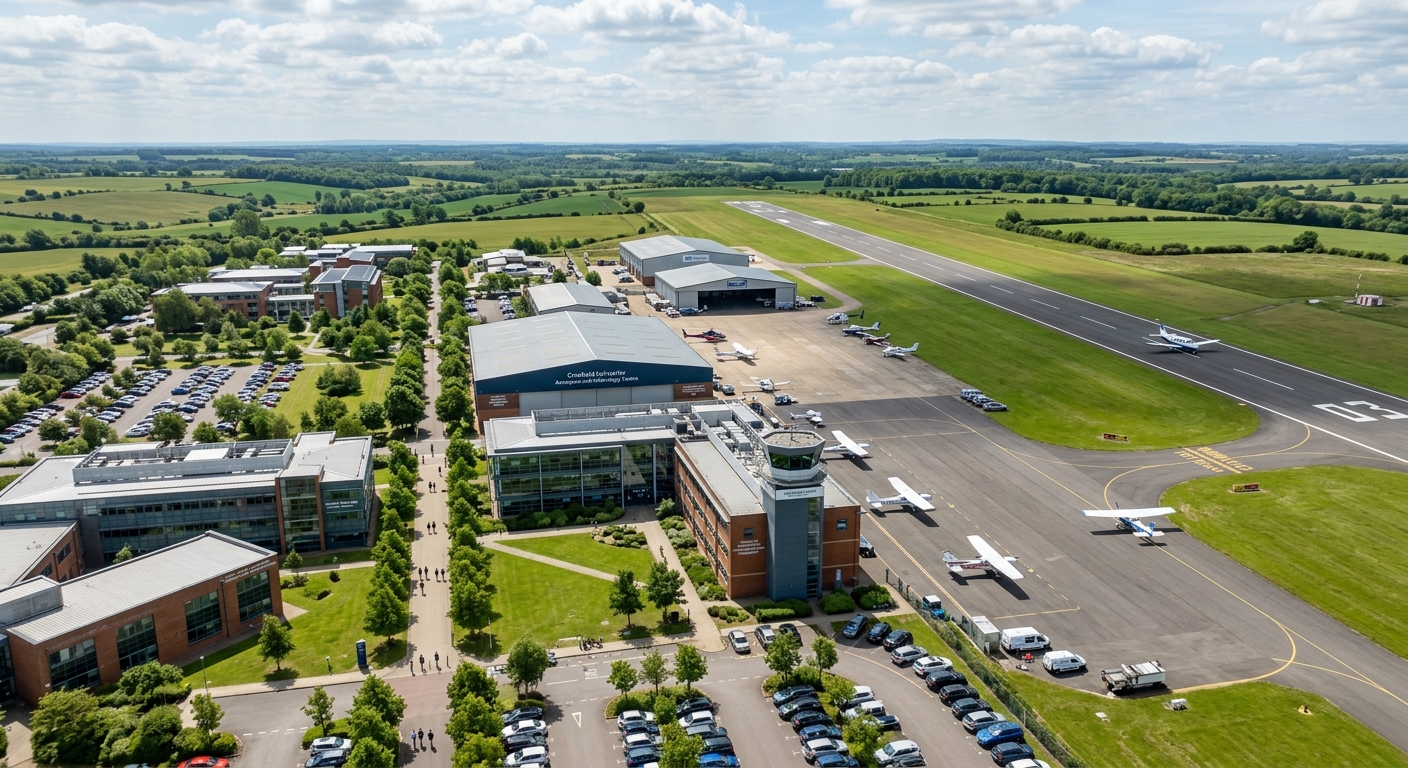
Students benefit from Cranfield's unique position as the only university in the UK with its own operational airport, runway, and air traffic control on campus. You will also have the opportunity to fly during a Student Experience Flight in the National Flying Laboratory Centre's light aircraft, focusing on control effects, spatial disorientation, and the cognitive challenges associated with flight.
Key Program Highlights
- Accredited by the Chartered Institute of Ergonomics and Human Factors (CIEHF), ensuring industry-recognised professional standards
- Delivered by the Safety and Accident Investigation Centre with over 30 years of global safety and investigation expertise
- Unique Student Experience Flight in the National Flying Laboratory Centre's light aircraft to explore spatial disorientation and cognitive challenges
- Cranfield is the only UK university with its own operational airport, runway, and air traffic control on campus
Curriculum and Module Structure
The MSc comprises 12 modules: eight compulsory taught modules, two optional taught modules, and two group project modules alongside an individual research project. The assessment weighting is distributed as 40% taught modules, 20% group projects, and 40% individual research project, ensuring a balance of theoretical knowledge and practical application.
Human Factors in Aviation
Core ModuleProvides an introduction to key areas of human psychology that underpin principles, theories, and models applied in aviation human factors, including cognitive psychology topics related to mental workload and situation awareness.
Human Error and Performance
Core ModuleEquips students with the knowledge and skills to appraise human error and factors affecting human performance, and to apply tools and methods for error prediction and measurement.
Safety Assessment and Risk Evaluation
Core ModuleCovers safety assessment methodologies and risk evaluation techniques used across the aviation industry, integrating both quantitative and qualitative approaches to safety analysis.
Safety Management Systems
Core ModuleExplores the design, implementation, and management of safety management systems within aviation organisations, addressing regulatory frameworks and operational safety practices.
Capstone Group Project
Core ModuleProvides a simulated industrial environment where knowledge and skills gained from the taught components of the course can be consolidated and applied to solving a human factors and safety problem.
Individual Research Project
Core Module (40% of MSc)Each student undertakes an individual research project, producing a written report in scientific paper format. The project provides an opportunity to apply technical and analytical skills to a specific subject or problem area in greater depth.
Elective Modules
Admission Requirements
The MSc in Safety and Human Factors in Aviation welcomes applications from aviation professionals and graduates with relevant academic backgrounds. All applications are processed through Uni4Edu, where our advisors can guide you through every step of the admissions process.
Academic Requirements
- Academic QualificationA first or second class UK Honours degree (minimum 2:2) or equivalent international qualification
- Preferred DisciplinesEngineering, aeronautical engineering, mathematics, ergonomics, psychology, or other science disciplines
- Alternative QualificationsHND or alternative qualifications may be acceptable with evidence of sufficient relevant work experience
- Professional ExperienceRelevant aviation or safety industry experience is valued but not mandatory for all applicants
- Study ModeAvailable as full-time (1 year) or part-time (2 years) to suit individual needs
English Language Requirements
- IELTS Academic6.5 overall with minimum 5.5 in all skill components
- TOEFL iBT92 total with minimum component scores of 18 reading, 17 listening, 20 speaking, and 17 writing (pre-January 2026 scale)
- Duolingo English Test120 overall with minimum subscores of 95 in speaking, writing, reading, and listening
Required Documents
Application Deadlines
For personalized admission guidance, document verification, and application support, please contact Uni4Edu
Scholarships & Funding
Cranfield University offers a range of scholarships and funding opportunities for students pursuing the MSc in Safety and Human Factors in Aviation. These awards are designed to support outstanding candidates from diverse backgrounds and help make postgraduate study accessible. Contact Uni4Edu for guidance on eligibility and application procedures.
Cranfield Excellence Scholarship
Up to GBP 10,000 tuition fee reductionAwarded to high-quality international applicants based on academic achievement for full-time master's courses. This merit-based scholarship is designed to attract exceptional students from around the world.
GREAT Scholarships (British Council Partnership)
GBP 10,000 tuition fee contributionOffered in partnership with the British Council and the GREAT Britain Campaign, these scholarships support students from eligible countries pursuing one-year postgraduate study in the UK.
Chevening Scholarships
Fully funded (tuition, travel, and monthly stipend)Awarded to outstanding emerging leaders from around the world to pursue a one-year master's degree at Cranfield. The scholarship covers full tuition fees, travel costs, and a monthly living stipend.
For detailed tuition fee information, please contact Uni4Edu — we will guide you through the costs and available funding options for this program.
Career Prospects and Employment Outcomes
Graduates of the MSc in Safety and Human Factors in Aviation enjoy strong employment prospects in safety-related management and operational positions across the aviation and wider safety-critical industries. Cranfield University's close ties with industry and its graduate employment rate ensure that students are well-positioned for impactful careers upon completion.
Typical Graduate Roles
Where Graduates Work
Rankings & Recognition
Cranfield University is an exclusively postgraduate institution with a strong reputation in aerospace, engineering, and management. While it does not appear in traditional undergraduate-focused league tables, it is consistently recognised in specialist subject rankings and industry-aligned assessments for its applied research and career outcomes.
| Subject | Ranking Body | Rank |
|---|---|---|
| Mechanical, Aeronautical & Manufacturing Engineering | QS World University Rankings by Subject | #55 globally, #5 in the UK |
| Engineering & Technology (Broad) | QS World University Rankings by Subject | Top 200 globally |
| Research Excellence | Research Excellence Framework (REF) | 88% rated world-leading or internationally excellent |
| Sustainability | QS World University Rankings: Sustainability | Top 10% globally |
How to Apply
Applying for this program is easy with Uni4Edu. Our team will guide you through every step of the process — from document preparation to final enrolment.
Contact Uni4Edu
Reach out to our team via email or phone. We will assess your profile and confirm your eligibility for this program.
Prepare Your Documents
Our advisors will provide you with a personalised checklist of required documents and help you prepare your application package.
Submit Your Application
Uni4Edu will submit your application on your behalf and keep you updated on its progress throughout the review period.
Receive Your Offer
Once accepted, we will help you understand your offer, arrange visa support if needed, and guide you through the enrolment process.
Similar Programmes


Bachelor's Degree
48 months
Avionics

Istanbul Gelisim University, Avcılar, Turkey
Earliest Intake
February 2026
Gross Tuition
3500 $

Bachelor's Degree
48 months
Aviation Management
Istanbul Gelisim University, Avcılar, Turkey
Earliest Intake
February 2026
Gross Tuition
3500 $
Bachelor's Degree
48 months
Aviation Management (English)
Istanbul Gelisim University, Avcılar, Turkey
Earliest Intake
February 2026
Gross Tuition
4000 $


Bachelor's Degree
48 months
Aviation Management
FSM University, Üsküdar, Turkey
Earliest Intake
May 2026
Gross Tuition
5983 $
Bachelor's Degree
48 months
Aviation Management
Özyeğin University, Çekmeköy, Turkey
Earliest Intake
February 2026
Gross Tuition
22000 $



Uni4Edu AI Assistant