
Doctor of Medicine (WA)
Fremantle Campus, Australia
Doctor of Medicine (WA)
University of Notre Dame Australia
Medicine
Doctor of Medicine (WA) Program Overview
The Doctor of Medicine (WA) at the University of Notre Dame Australia is a four-year postgraduate degree accredited by the Medical Board of Australia on the recommendation of the Australian Medical Council. Based at the Fremantle campus in Western Australia, this program is the only medical degree offered by a Catholic university in Australia, aiming to develop caring and ethical doctors grounded in the values of compassion, respect, and service.
The first two years of the program are underpinned by Problem-Based Learning (PBL) delivered in small groups and include the study of basic clinical sciences, population and preventive health, bioethics, and therapeutics. In your third and fourth years, you will undertake clinical placements in a wide variety of settings, including aged care facilities, public and private hospitals, general practices, and community-based services in urban and rural areas across Australia.
The program features a spiralling curriculum with a strong research training pathway that runs across all four years, ensuring you graduate with well-developed clinical skills, ethical reasoning, and research competencies. Students also have the opportunity to participate in the Rural Clinical School of WA and gain experience in Aboriginal health and remote medicine.
Key Program Highlights
- Small group Problem-Based Learning (PBL) led by experienced clinician tutors throughout the foundation years
- Extensive clinical placements in public and private hospitals, general practices, and community health settings in years three and four
- Strong focus on Aboriginal health, rural and remote medicine, and bioethics integrated throughout the curriculum
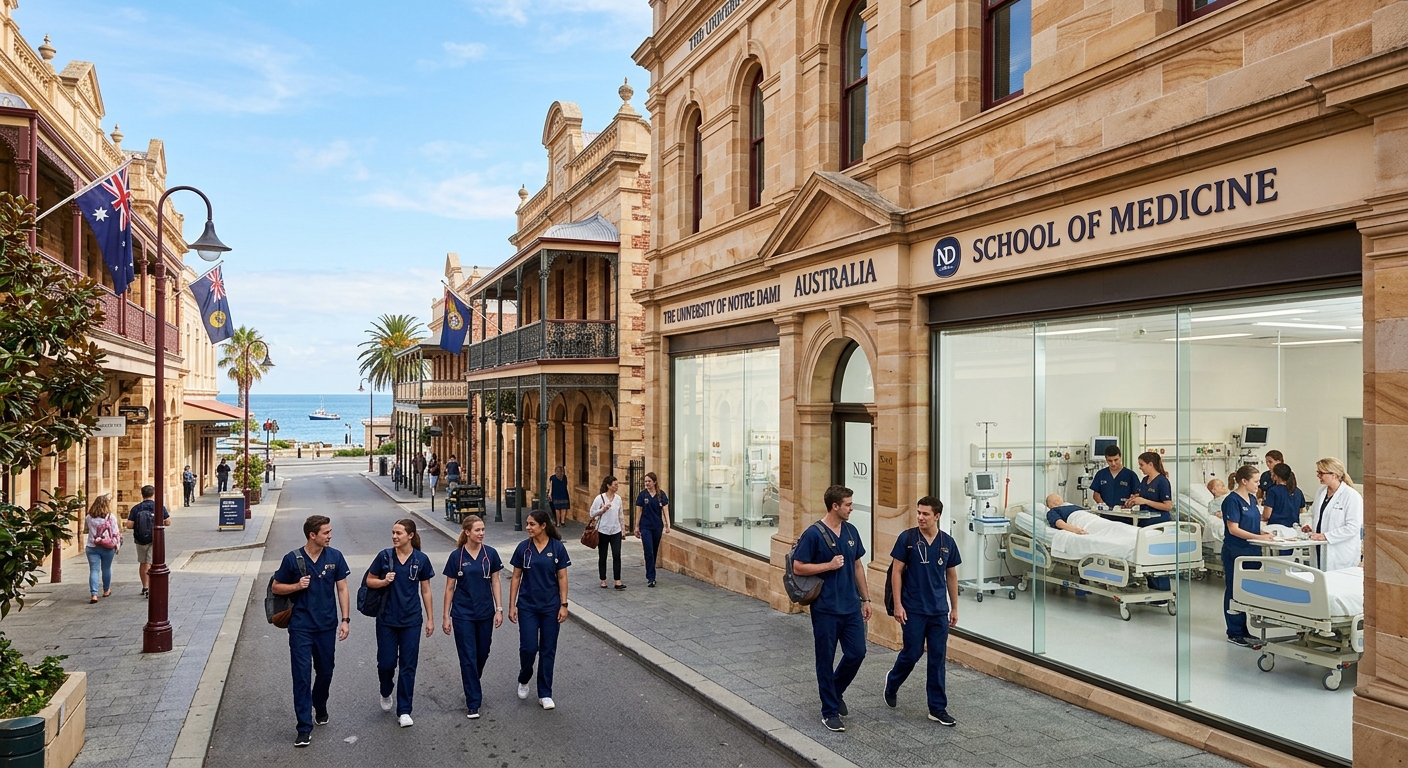
- State-of-the-art simulation facilities including simulated clinic rooms, hospital wards, and procedural skills labs on the Fremantle campus
Curriculum and Modules
The Doctor of Medicine (WA) curriculum is delivered through an integrated, spiral-based approach that places patients at the centre of learning. The foundation years (Years 1 and 2) focus on building medical knowledge through PBL, while the clinical years (Years 3 and 4) involve discipline-based rotations in hospital and community settings. A research training pathway runs across all four years, culminating in an applied research project.
Foundations of a Medical Vocation (Year 1)
Full YearFocuses on the normal structure and function of the human body and homeostatic responses to physiological challenges. Includes PBL tutorials, clinical examination skills, bioethics through the Core Curriculum, and an introduction to population and preventive medicine.
Foundations of Clinical Practice (Year 2)
Full YearBuilds on Year 1 learning with emphasis shifting to pathophysiological processes impacting the human body. Covers six domains of learning including Basic and Clinical Sciences, Communication and Clinical Practice, First Nations Holistic Health, Public Health, Personal and Professional Development, and Medical Research.
Clinical Rotations (Year 3)
Full YearStudents complete eight to nine week discipline-based rotations in clinical settings, engaging with patients, families, and healthcare teams. Rural and remote training opportunities are available, including placement with the Rural Clinical School of WA for selected students.
Advanced Clinical Practice (Year 4)
Full YearContinuation of discipline-based clinical rotations across specialties such as surgery, paediatrics, and internal medicine. Students further develop research skills through a translational research project based in the health sector.
Research Training Pathway
Integrated Across 4 YearsA spiralling research curriculum engaging students from week one, covering evidence-based practice, epidemiology, critical analysis of literature, research design, and culminating in an applied research project in Year 4.
Core Curriculum in Bioethics
Integrated Across 4 YearsAs part of Notre Dame's liberal arts tradition, all medical students explore bioethics throughout the program, developing skills to navigate complex ethical dilemmas in clinical practice and professional life.
Elective and Specialised Training Opportunities
Admission Requirements
Entry into the Doctor of Medicine (WA) is competitive and considers academic achievement, aptitude testing, situational judgement, and personal qualities assessed through interview. The program welcomes applicants from a wide range of undergraduate disciplines. Contact Uni4Edu for personalised guidance on your eligibility and application.
Academic Requirements
- Prior QualificationBachelor's degree (recognised by the Australian Qualifications Framework or equivalent) completed within the last 10 years, or be in the final year of a Bachelor's degree in any discipline
- Grade Point AverageMinimum overall GPA of 5.2 on a 7-point scale (international applicants: weighted GPA of 5.2 or higher from most recent three years of undergraduate study)
- Admissions Test (Domestic)GAMSAT with an unweighted average score of 52 or greater and a minimum of 50 in each section
- Admissions Test (International)GAMSAT minimum score of 50 in all sections and overall, or overall MCAT score of at least 500
- InterviewMultiple Mini Interview (MMI) format; interview offers are based on a combination of GPA, GAMSAT/MCAT, and CASPer scores
Language Requirements
- Medium of InstructionBachelor's degree must have been taught and assessed in English within the last 10 years
- IELTS (if applicable)Contact Uni4Edu for current English language proficiency requirements for non-English medium graduates
- CASPer TestCASPer score from the online Situational Judgement Test is required (no minimum score specified)
Required Documents
Application Deadlines
For personalized admission guidance, document verification, and application support, please contact Uni4Edu
Scholarships and Funding
The University of Notre Dame Australia offers various scholarships to prospective and current postgraduate students, funded by the university, industry partners, individuals, and non-profit organisations. These scholarships provide financial support for costs associated with study and living expenses. Contact Uni4Edu for personalised scholarship advice and application support.
Notre Dame Postgraduate Scholarships
A range of scholarships are available to postgraduate students across all campuses, funded by Notre Dame and external partners to help cover living costs including rent, transport, and household expenses.
Commonwealth Supported Places (CSP)
Partial Government SubsidyEligible domestic students may receive a Commonwealth Supported Place where the Australian Government subsidises part of the tuition fees. Students pay a reduced student contribution amount.
For detailed tuition fee information, please contact Uni4Edu — we will guide you through the costs and available funding options for this program.
Career Prospects
Graduates of the Doctor of Medicine (WA) receive provisional registration with the Medical Board of Australia, enabling them to enter the medical workforce as junior doctors (doctors-in-training). The program prepares you for a wide range of medical career pathways depending on your area of specialisation or interest, from clinical practice to research and public health leadership.
Potential Career Pathways
Employment Sectors and Employers
Rankings and Recognition
The University of Notre Dame Australia is recognised for its strong emphasis on teaching quality, student support, and graduate employment outcomes. The university has earned top ratings in the Good Universities Guide and is acknowledged for producing highly employable graduates, particularly in medicine and health sciences.
| Subject | Ranking Body | Rank |
|---|---|---|
| Medicine | EduRank | #39 in Australia |
| Medicine (Skill Development) | Good Universities Guide | 86.4% Satisfaction |
| Medicine (Teaching Quality) | Good Universities Guide | 75.2% Satisfaction |
| Medicine (Student Support) | Good Universities Guide | 76.9% Satisfaction |
How to Apply
Applying for this program is easy with Uni4Edu. Our team will guide you through every step of the process — from document preparation to final enrolment.
Contact Uni4Edu
Reach out to our team via email or phone. We will assess your profile and confirm your eligibility for this program.
Prepare Your Documents
Our advisors will provide you with a personalised checklist of required documents and help you prepare your application package.
Submit Your Application
Uni4Edu will submit your application on your behalf and keep you updated on its progress throughout the review period.
Receive Your Offer
Once accepted, we will help you understand your offer, arrange visa support if needed, and guide you through the enrolment process.
Similar Programmes


Bachelor's Degree
48 months
Optometry - Biology (BS OD)

Seton Hill University, Greensburg, United States
Earliest Intake
June 2027
Gross Tuition
42294 $

Master's & Postgraduate
48 months
Doctor of Medicine (NSW)
University of Notre Dame, Chippendale, Australia
Earliest Intake
February 2026
Gross Tuition
77625 A$


Doctoral & PhD
24 months
Doctorate in Medicine MD
University of Bradford, Bradford, United Kingdom
Earliest Intake
August 2026
Gross Tuition
24180 £


Master's & Postgraduate
36 months
Periodontology (TR) - Masters (With Thesis)
Altinbas University, Bağcılar, Turkey
Earliest Intake
March 2027
Gross Tuition
16200 $

Doctoral & PhD
48 months
Orthodontics PhD
Altinbas University, Bağcılar, Turkey
Earliest Intake
March 2027
Gross Tuition
25000 $



Uni4Edu AI Assistant