
Aquatic Resources and Integrative Biology
San Marcos, Texas, USA, United States

Doctor of Philosophy (Ph.D.) in Aquatic Resources and Integrative Biology
Texas State University
Aquatic Resources & Integrative Biology
Program Overview: Ph.D. in Aquatic Resources and Integrative Biology
The Ph.D. in Aquatic Resources and Integrative Biology at Texas State University emphasizes original research—both basic and applied—to provide depth and breadth of knowledge across aquatic resources and related disciplines, from the watershed and ecosystem scale down to the population, organismal, and microbial scale. Students are engaged in a collaborative research environment alongside faculty, natural resource agencies, nonprofit organizations, and public and private interests.
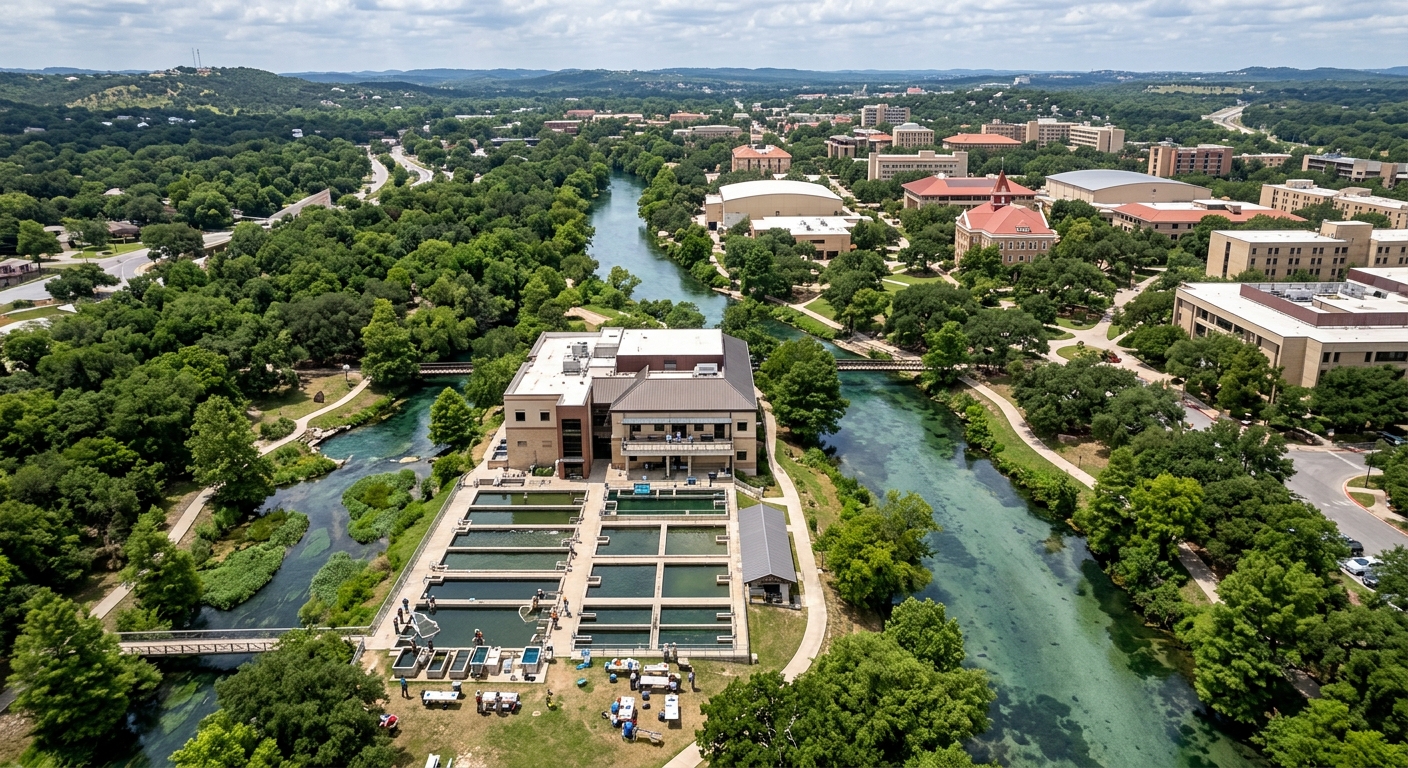
Texas State's location near many terrestrial and aquatic ecosystems, including San Marcos Springs, the headwaters of the San Marcos River, The Meadows Center for Water and the Environment, Aquarena Center, and the Freeman Center, provides students with a unique opportunity for study and research. The program integrates scientific, technical, and socioeconomic elements to address the sustainable use of aquatic resources from local to international levels.
The program prepares students to identify and solve complex problems relevant to the sustainable use of terrestrial and aquatic resources and ecosystems. It facilitates the entry of its students into the professional community of scholars and natural resource practitioners through the completion, presentation, and publication of original, creative research.
Key Program Highlights
- Access to San Marcos Springs, the San Marcos River, and the Freeman Aquatic Biology Building with wet labs, experimental ponds, and artesian well water from the Edwards Aquifer
- Faculty funded by NSF, NIH, NASA, and federal and state natural resource management agencies with publications in top-tier journals
- Multidisciplinary approach integrating ecology, hydrology, conservation biology, environmental policy, and socioeconomic analysis
- Flexible entry with both bachelor's-level (91 credit hours) and master's-level (61 credit hours) admission pathways
Curriculum & Modules
The doctoral curriculum combines core coursework, elective specialization, and original dissertation research. Students entering with a master's degree complete 61 semester credit hours (21 core + 40 elective/dissertation), while those entering with a bachelor's degree complete 91 semester credit hours. Each student's program of study is individually designed in consultation with their Ph.D. advisor and the program director.
Problems in Aquatic Resources (BIO 7302)
3 Credit HoursAn advanced seminar examining complex issues in aquatic resource management. Students critically analyze current research and develop problem-solving frameworks applicable to real-world aquatic challenges.
Government Policy and Aquatic Resources (BIO 7312)
3 Credit HoursExplores the intersection of governmental regulation, public policy, and aquatic resource management. Students examine how legislation and policy frameworks shape the sustainable use of water and aquatic ecosystems.
Statistics and Experimental Design I (BIO 7405)
4 Credit HoursProvides a rigorous foundation in statistical methods and experimental design for biological research. Students learn to plan experiments, analyze data, and interpret results relevant to aquatic and integrative biology.
Statistics and Experimental Design II (BIO 7406)
4 Credit HoursBuilds on foundational statistics with advanced analytical techniques including multivariate analysis and modeling approaches commonly used in ecological and aquatic resource research.
Environmental Ethics and Sustainable Aquatic Resources (PHIL 7323)
3 Credit HoursAn interdisciplinary course examining ethical frameworks surrounding environmental stewardship and the sustainable management of aquatic resources. Students evaluate moral dimensions of resource allocation and conservation decisions.
Research (BIO 7303)
3 Credit HoursA pre-candidacy research course that students enroll in every semester until admission to candidacy. It supports early-stage dissertation development and active engagement in original research under faculty mentorship.
Elective Course Options
Admission Requirements
Admission to the Ph.D. program in Aquatic Resources and Integrative Biology normally requires an earned master's or bachelor's degree from an accredited college or university in Biology, Chemistry, Engineering, Geology, or other areas relevant to the study of living systems. A faculty mentor agreement is a critical component of the application. Contact Uni4Edu for guidance on securing a mentor and completing your application.
Academic Requirements
- Degree RequirementBachelor's or Master's degree in Biology, Chemistry, Engineering, Geology, or a related natural science discipline from an accredited institution
- Minimum GPA3.0 cumulative GPA on all prior graduate coursework (or last 60 hours of undergraduate work)
- Faculty Mentor LetterA letter of intent to mentor from a current Texas State doctoral faculty member in the Aquatic Resources and Integrative Biology program is required
- Letters of RecommendationThree letters of recommendation addressing the substance and quality of your preparation for doctoral study
- Grade RequirementsNo grade below B on any graduate course work may apply toward the Ph.D. degree
English Language Requirements
- TOEFL iBTMinimum score of 78 overall
- IELTSContact Uni4Edu for current minimum score requirements
- ExemptionApplicants who have earned a bachelor's degree or higher from a regionally accredited U.S. institution or equivalent from an exempt country may be waived
Required Documents
For personalized admission guidance, document verification, and application support, please contact Uni4Edu
Scholarships & Funding
Texas State University offers a range of funding opportunities for doctoral students, including assistantships, fellowships, and scholarships through The Graduate College and the Department of Biology. The university has made significant financial investments in Ph.D. student support, including dedicated funding for the Aquatic Resources and Integrative Biology program. Contact Uni4Edu for personalized guidance on available funding options.
Doctoral Research Support Fellowship
Up to USD 5,000Provided by The Graduate College to support expenses directly related to conducting dissertation research. Two rounds of funding applications are available each year.
Graduate College Scholarship
USD 1,000 per semester (up to 3 semesters)Awarded to continuing graduate students with intellectual, creative, and leadership promise. Recipients qualifying for at least USD 1,000 in competitive scholarships may also receive a nonresident tuition waiver.
Texas State Merit Fellowship
Varies (percentage of tuition)Intended to recruit top-quality doctoral students. Covers a percentage of tuition for the first academic year and can be combined with assistantships or departmental scholarships. Admitted students are automatically considered.
For detailed tuition fee information, please contact Uni4Edu — we will guide you through the costs and available funding options for this program.
Career Prospects
Graduates of the Ph.D. in Aquatic Resources and Integrative Biology are well-prepared for leadership roles in academia, government agencies, nonprofit organizations, and the private sector. The program's emphasis on original research, interdisciplinary collaboration, and practical problem-solving equips graduates with skills highly valued across environmental and biological science careers.
Potential Career Roles
Typical Employers
Rankings & Recognition
Texas State University has been steadily climbing national rankings and gaining recognition for its commitment to research, social mobility, and student outcomes. The university is recognized by multiple ranking bodies and was named among America's Top Colleges by Forbes for 2026. Its biology and environmental science programs benefit from strong faculty research funded by NSF, NIH, and NASA.
| Subject | Ranking Body | Rank |
|---|---|---|
| Life Sciences (Biology) | THE World University Rankings | Contact Uni4Edu for current data |
| Social Mobility | U.S. News & World Report | #144 |
| Engineering | U.S. News & World Report | 194–211 range |
| Overall Quality | College Factual | Top 20% nationally |
How to Apply
Applying for this program is easy with Uni4Edu. Our team will guide you through every step of the process — from document preparation to final enrolment.
Contact Uni4Edu
Reach out to our team via email or phone. We will assess your profile and confirm your eligibility for this program.
Prepare Your Documents
Our advisors will provide you with a personalised checklist of required documents and help you prepare your application package.
Submit Your Application
Uni4Edu will submit your application on your behalf and keep you updated on its progress throughout the review period.
Receive Your Offer
Once accepted, we will help you understand your offer, arrange visa support if needed, and guide you through the enrolment process.
Similar Programmes

Master's & Postgraduate
12 months
Human Complex Trait Genetics MSc

University of Edinburgh, Edinburgh, United Kingdom
Earliest Intake
January 2026
Gross Tuition
45410 £

Master's & Postgraduate
24 months
Ecology and Evolutionary Biology (MS)
University Of Arizona, Tucson, United States
Earliest Intake
May 2026
Gross Tuition
32065 $


Master's & Postgraduate
12 months
Food Science - MSc
London Metropolitan University, London, United Kingdom
Earliest Intake
April 2025
Gross Tuition
20000 £
Master's & Postgraduate
12 months
PGCE Secondary Science with Biology - PGCE
London Metropolitan University, London, United Kingdom
Earliest Intake
April 2025
Gross Tuition
15500 £
Master's & Postgraduate
12 months
PGCE Secondary Science with Chemistry - PGCE
London Metropolitan University, London, United Kingdom
Earliest Intake
April 2025
Gross Tuition
15500 £



Uni4Edu AI Assistant